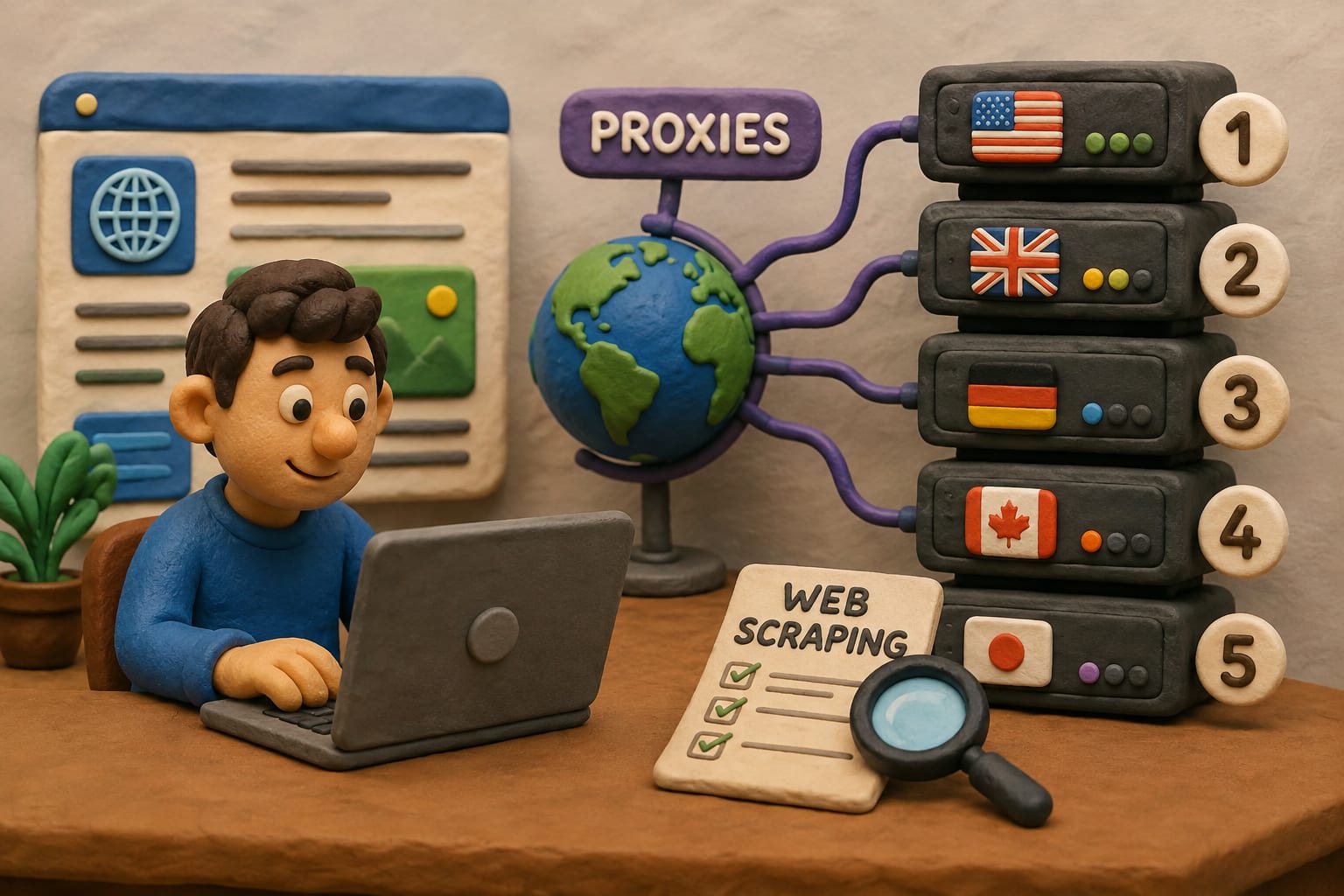
In 2026 vanity marketing metrics are far from the only thing that should be on your mind when you choose your next proxy provider. The best proxies for web scraping seamlessly integrate with your specific stack. That means you should evaluate every offer based on a variety of factors, including but not limited to IP pool quality, rotation speed, geo-targeting precision, and predictable pricing plans.
Methodology: How the Best Proxies for Web Scraping Were Ranked
The ranking relies on information directly from the providers’ official product pages and documentation. The comparison separates provider-reported specifications from independent performance testing and does not present marketing claims as laboratory results. The assessment considers:
- the stated IP pool size and geographic coverage;
- proxy types available for scraping;
- published speed, success rate, and uptime figures;
- rotation and session management options;
- proxy authentication methods;
- geo-targeting capabilities;
- pricing models and publicly listed starting rates;
- integration options for Python, Scrapy, Playwright, Puppeteer, cURL, and other tools;
- stated concurrent connection limits;
- information about ethical IP sourcing and acceptable use.
The methodology also considers the balance between price and functionality. Proxy-Seller and Geonix take the first two positions because their combined features provide a strong mix of large IP pools, flexible rotation, geographic targeting, and accessible pricing models. The other three best proxies for web scraping can handle specific scraping scenarios, but each gives up some advantages compared with the leaders.
1. Proxy-Seller: An All-Around Strong Choice for Scraping at Different Scales
Proxy-Seller takes first place compared to the rest of the best proxies for web scraping because of its broad range of options. It offers residential, mobile, ISP, IPv4, and IPv6 proxies. Its residential network provides targeting by country, region, city, and ISP, along with several rotation options.
Every developer knows how important infrastructure diversity can be. That’s why the best proxies for web scraping absolutely can’t force an entire project to constantly rely upon just one IP category. With that in mind, Proxy-Seller offers a variety of options:
- Residential nodes for projects that involve high-volume scraping.
- IPv6 solutions and datacenter proxies for high concurrency and speed-reliant tasks.
- ISP proxies provide a middle ground for long stable sessions.
Session management gives Proxy-Seller another advantage among other best proxies for web scraping. Developers can configure a list to rotate IP addresses after a specific time interval, change the address after each request, or maintain a sticky session. A crawler that sends independent requests can rotate frequently, while a browser automation workflow can preserve the same IP during a longer session.
Proxy-Seller also provides API access for residential proxy management. Developers can create, configure, rename, and delete proxy lists programmatically, retrieve available geographic locations, change rotation settings, and monitor traffic consumption.
The residential product page lists individual pricing plans from the low-dollar-per-GB range and offers a three-day trial. Developers evaluating where to buy proxies can therefore test integration and target-domain performance before committing to a larger workload.
Proxy-Seller also offers mobile proxies using 4G infrastructure. ISP proxies provide static residential addresses, while IPv4 and IPv6 products target workloads that require stable datacenter infrastructure. This product diversity puts the provider among the best proxies for web scraping for teams that need to combine several proxy categories inside one scraping system.
2. Geonix: A Powerful Second Choice With a Large Residential Pool and Flexible Rotation
Geonix takes second place among best proxies for web scraping, with residential, ISP, mobile, IPv4, and IPv6 products covering a broad range of scraping requirements. The provider describes its residential infrastructure as a dynamic network of more than 15 million residential IP addresses sourced from over 200 countries.
Authentication options include username/password credentials and IP whitelisting. Users can create multiple proxy lists and configure individual geographic and rotation settings per project. Such segmentation can simplify large scraping systems that collect data from several regions simultaneously.
Geonix offers several proxy categories beyond residential traffic. Its IPv4, IPv6, ISP, and mobile products address different technical requirements. Datacenter IPv4 and IPv6 proxies can support workloads that require high speed and stable connections. ISP proxies support persistent sessions, while mobile proxies provide another option for workflows that require frequent IP changes.
Each proxy type has its own starting price. The full cost depends on a number of criteria:
- Type(s) of proxy
- IP location(s)
- The number of proxy addresses you wish to obtain
- The duration of the rental period
API access adds another advantage and supports proxy-list retrieval across IPv4, IPv6, mobile, ISP, and residential categories.
Geonix documentation describes HTTPS/SOCKS5 support for residential connections. Its API tool also allows developers to restrict exit IPs to a specific country through authentication parameters. For concurrent requests, the documentation recommends different ports within the available port range. Such controls can simplify integration with custom crawlers and automated scraping frameworks.
Among the best proxies for web scraping, Geonix therefore represents a strong second option. Proxy-Seller takes the lead through the broader overall balance of infrastructure and configuration options, while Geonix remains highly competitive for teams that value geographic coverage, multiple proxy types, API integration, and flexible rotation.
3. Webshare: An Accessible Option for Less Complex Scraping Projects
The combination of a straightforward self-service model and a low entry barrier puts Webshare into third place on the list of the best proxies for web scraping. This provider is focused heavily on residential proxies and offers extra features such as geotargeting and IP rotation. Webshare’s network includes over 80 million unique IP addresses sourced across 195 countries. According to the provider’s website, uptime is at 99.97%.
The pricing structure uses traffic-based plans for rotating residential proxies. The provider lists prices that decrease as monthly traffic increases, making the service more attractive to larger workloads than to very small test projects.
Webshare also offers a free starting option with a limited proxy allocation. Such an entry point can help developers test compatibility with their scraping stack before committing to paid traffic.
Webshare’s status as one of the best proxies for web scraping is based on several core factors: IP rotation, geographic access, and request-rate management. For most small and medium-sized crawlers, its offers are optimal.
Webshare makes particular sense for teams that value a simple dashboard, quick setup, and transparent self-service purchasing. More complex projects that need several proxy categories, specialized mobile infrastructure, or deeper automated provisioning can gain more flexibility from Proxy-Seller or Geonix.
4. IPRoyal: Flexible Residential Sessions With a Higher Entry Cost
IPRoyal takes fourth place among other best proxies for web scraping with its vast residential network of over 64 million IPs from 195 countries total, with HTTP(S) and SOCKS5 options both available. The provider’s website promises 99.4% uptime and 0.5 seconds response time. Geotargeting and API-based IP management are both on the menu. Plus, you get a choice between sticky sessions that will let you preserve the same address for an extended period and rotating IPs. Such flexibility helps when a scraping workflow combines independent page requests with longer browser-based sessions.
IPRoyal also allows unlimited concurrent sessions. Developers can change IPs through the dashboard or API, which makes the service suitable for automated scraping infrastructure.
The main disadvantage concerns the cost of smaller residential packages. The provider's pricing becomes more competitive at high traffic volumes, while small Pay As You Go packages cost significantly more per GB. For a large crawler with substantial traffic, the economics can improve considerably. For a small development team testing a new scraper, the initial cost can make other providers more attractive.
IPRoyal remains a useful choice when session persistence and high concurrency matter more than the lowest possible starting price.
5. SOAX: A Large Network With Strong Targeting but Higher Costs
The reason SOAX lands fifth behind the best proxies for web scraping is the higher pricing. It does, however, offer a healthy infrastructure that includes over 155 million IPs across 195+ countries. Its best feature is its truly granular geo-targeting, all the way down to ASN. The uptime and response time figures on the website look great: 99.95% and 0.55s respectively. You get to pick between IP rotation and sticky sessions. Additionally, SOAX offers mobile and ISP products, allowing development teams to combine different proxy categories according to workload requirements.
SOAX supports unlimited proxy connections and flexible IP refresh settings. Such features can benefit large scraping systems that require substantial concurrency and detailed session control.
The residential pricing structure starts at a higher level than several competitors in this ranking. The provider offers several plans with progressively lower per-GB prices at higher traffic volumes. Enterprise customers can request custom conditions.
SOAX therefore suits teams that prioritize a large proxy pool, detailed geographic targeting, and broad infrastructure options. However, developers working under strict cost constraints may receive better overall value from Proxy-Seller or Geonix.
Why Residential vs. Datacenter Proxies for Scraping Changes the Project Architecture
The best proxies for web scraping should come in multiple categories, so that developers can easily alter the infrastructure to fit the target website. Residential proxies, just as the name suggests, use IPs that come from actual residential networks. They generally provide stronger trust characteristics for websites with more advanced anti-bot systems and support detailed geographic targeting. Datacenter proxies operate through data center infrastructure and often provide higher speed at a lower cost.
A practical scraping architecture can assign each proxy type to a different workload. Datacenter IPs can handle straightforward catalogs, public pages, and websites with relatively light restrictions. Residential proxies can handle domains where IP reputation and geographic targeting matter more.
Session duration also influences the choice of the best proxies for web scraping for your needs. Independent requests can use frequent rotation, while workflows that require a consistent identity across several requests can benefit from sticky sessions.
How Pool Size and Rotation Help Reduce IP Blocks During Large-Scale Scraping
Proxy pool size and IP rotation directly affect scraper stability. Best proxies for web scraping should give developers control over both variables. A larger pool allows a crawler to distribute requests across more addresses and reduce repeated traffic from the same IP.
However, developers should look beyond the headline IP count. The useful size of a pool depends on geographic distribution, proxy type, rotation options, and the quality of available addresses.
Rotation frequency also requires careful configuration. Per-request rotation can suit large collections of independent pages. Longer sessions can work better when a target website expects a consistent user identity across related requests.
A large IP pool on its own can’t guarantee you’ve found the best proxies for web scraping. If many addresses frequently encounter blocks, the nominal pool size loses practical value. Success rate, response quality, and actual results against target domains provide more useful indicators.
How Speed, Latency, and Concurrent Connections Factor in Scraping Proxy Evaluation
You should test every web scraping proxy specifically against the domains your crawler will be accessing. Provider-reported benchmarks offer useful reference points, but they cannot reproduce every network route, geographic combination, or anti-bot system.
A meaningful benchmark should measure:
- median and p95 response time;
- successful HTTP response percentage;
- CAPTCHA and 403/429 frequency;
- retry frequency;
- connection stability as concurrency increases;
- cost per successfully retrieved document.
Developers should also distinguish proxy latency from total page-load time. A fast proxy cannot compensate for a slow target server, heavy JavaScript execution, browser rendering, or network delays elsewhere in the request chain.
Concurrent connections require similar caution. Sometimes, the provider sees no problem with simultaneous connections happening in big numbers, but then you run into the target website’s own rate limits.
How to Compare Proxy Pricing Models When Scraping at Scale
Proxy pricing models compared across providers can produce very different results. The best proxies for web scraping can vary significantly in total cost even when two services advertise similar per-GB prices.
Residential proxies commonly use traffic-based pricing. Datacenter products may charge per IP or traffic volume. ISP products often use IP-based rental models, while mobile products can use traffic, IP, or rental-period pricing.
Pay As You Go models are great for smaller projects with flexible timeframes. Large crawlers should compare several traffic levels because the per-GB price often falls as consumption increases.
The cost of failed requests also matters. A cheap proxy that frequently encounters blocks can become more expensive than a higher-priced proxy with a stronger success rate. Developers should therefore calculate the cost per successful document rather than relying exclusively on the advertised cost per GB.
How Scrapy, Playwright, Puppeteer, and Custom Code Help Integrate a Proxy
You want your web scraping proxy to blend cleanly into the existing development stack. HTTP clients generally need a proxy endpoint, port, and authentication credentials. Browser automation tools require proxy configuration at the browser or browser-context level.
A dedicated proxy-management layer can simplify larger systems. Among the best proxies for web scraping, providers with API access offer particular advantages because developers can automate proxy provisioning, geographic selection, list management, rotation, and usage monitoring.
A scraper can therefore separate business logic from proxy infrastructure. One workflow might use datacenter IPs for simple pages, residential proxies for more protected domains, and ISP addresses for persistent sessions. The crawler itself can remain unchanged while the proxy-management layer selects the appropriate endpoint.
Authentication also matters. Username/password authentication and IP whitelisting remain common options. Proxy-Seller and Geonix support both approaches for their residential infrastructure.
Important Legal Considerations Before Launching a Large Scraping Operation
Even the best proxies for web scraping don’t automatically make every action you take through them legit. Before you launch a large crawler, you absolutely have to:
- review the target website's Terms of Use;
- identify whether the project will collect personal data;
- determine whether the workflow requires access to restricted or authenticated areas;
- consider robots.txt as an important crawler-policy signal;
- control request frequency to avoid unnecessary infrastructure load;
- document the sources and compliance rules that govern the project.
The proxy provider's own acceptable-use policy also matters. Geonix restricts certain unauthorized activities and requires users to comply with applicable rules. Webshare likewise places restrictions on abusive traffic, unlawful activity, and the collection of certain sensitive or non-public information. Legal requirements also considerably differ depending on the jurisdiction and the nature of the data you are collecting.
Final Verdict: Where to Shop for the Best Proxies for Scraping in 2026?
- If you’re looking for a versatile solution with broad geography, flexible rotation patterns, multiple proxy IP categories, and robust automation capabilities, Proxy-Seller is the optimal choice.
- Geonix follows closely, with a large residential pool, multiple proxy types, detailed geographic targeting, flexible rotation, and API integration.
- Webshare works well for budget-conscious projects and teams that value simple self-service setup.
- IPRoyal makes sense when sticky sessions and high concurrency matter more than the lowest starting cost.
- SOAX provides a large network and detailed targeting, but its pricing makes it less attractive for projects with strict budgets.
Remember not to base your choice of best proxies for web scraping on IP pool size alone. You should always consider the full list of factors, such as proxy type, geographic coverage, rotation, latency, success rate, concurrency, etc.
The strongest provider for one crawler may not suit another. A price-monitoring system, SERP scraper, e-commerce crawler, browser automation workflow, and regional data-collection pipeline can require very different proxy configurations. Developers who match the proxy infrastructure to the workload can reduce unnecessary failures, control operating costs, and build a more predictable data-collection pipeline.
Comments
Loading comments…