AI-powered conversational tools have rapidly become part of modern business operations. From customer support assistants to intelligent automation systems, organizations increasingly rely on AI to improve productivity, streamline workflows, and enhance digital customer experiences. Today, most companies already use some form of conversational AI, especially chatbots, which handle common queries and support tasks across websites, apps, and messaging platforms.
AI-powered conversational tools, especially within modern CCaaS platforms, are becoming essential for businesses looking to streamline customer communication, automate support, and deliver consistent digital experiences across channels.
At the same time, a newer category of systems—AI agents—is gaining attention. Unlike traditional chatbots that mainly respond to questions, AI agents can reason, plan tasks, and take actions across software systems to achieve specific goals.
This shift from simple conversational interfaces to autonomous systems represents the next stage of AI evolution. In this article, I explain what AI agents and chatbots are, how they differ, and when businesses should implement each. Let’s get started.
What Is an AI Agent?
An AI agent is an autonomous software system that can perceive information from its environment, reason about goals, and take actions to achieve specific outcomes. Unlike traditional conversational tools, AI agents are designed to operate with a higher level of independence. They can analyze a task, decide what steps are required, and interact with different digital systems to complete the objective.
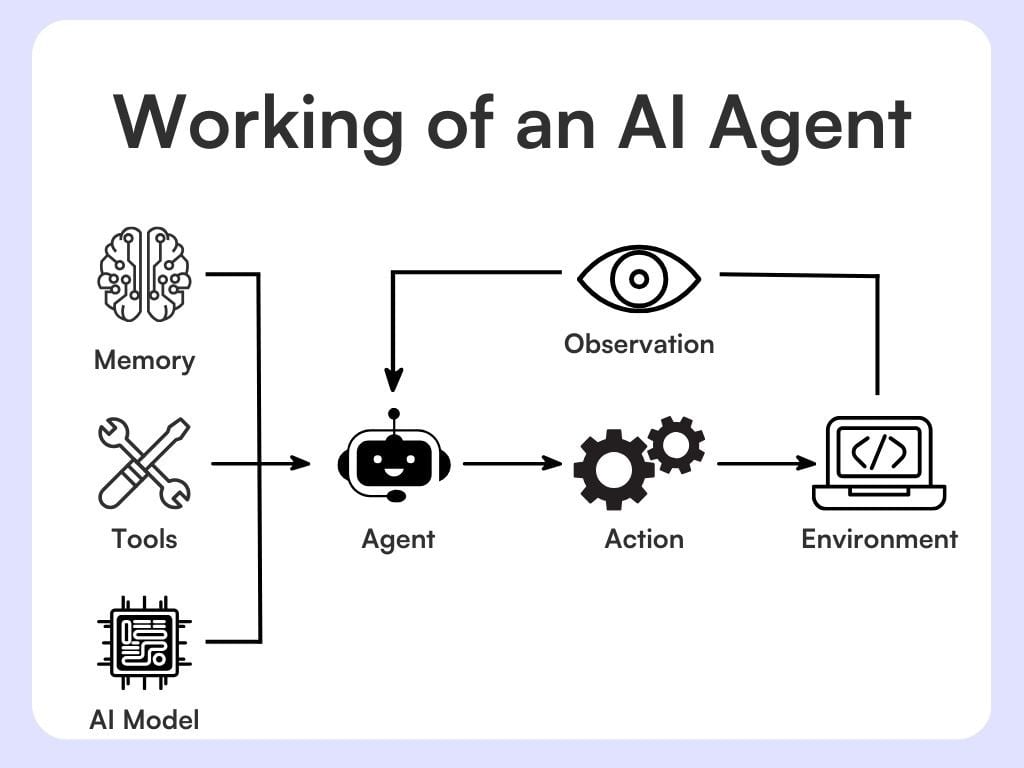
Working of an AI agent
Modern AI agents often rely on large language models combined with external tools and data sources, which enables them to move beyond simple responses and perform complex tasks.
Core characteristics of AI agents include:
- Autonomy: Operate with minimal human supervision once given a goal.
- Goal-driven behavior: Focus on achieving a defined outcome rather than only answering questions.
- Reasoning and planning: Break complex tasks into smaller logical steps.
- Tool usage: Interact with APIs, databases, software tools, and online services.
- Memory and context: Maintain conversation history and contextual information across interactions.
- Multi-step execution: Perform sequences of actions automatically.
Technologies behind AI agents typically include:
- Large Language Models (LLMs)
- Retrieval-Augmented Generation (RAG)
- Tool and API integrations
- Planning and reasoning frameworks
- Multi-agent orchestration systems
For example, if a user asks an AI agent to plan a three-day trip to Tokyo within a $1500 budget, the agent could search flights, compare hotel options, build an itinerary, recommend restaurants, and organize bookings automatically. Instead of simply providing information, the system completes tasks. To better understand where these systems are applied, let’s look at common use cases of AI agents.
Use Cases of AI Agents
AI agents already operate across many industries because they can automate complex tasks and interact with multiple systems. Organizations deploy them to improve efficiency, reduce manual work, and support decision-making.
Common use cases include:
- Customer support automation: Diagnose issues, access CRM systems, process refunds, update tickets, and escalate complex cases instead of only sending help links.
- Workflow automation: Schedule meetings, manage emails, update project management tools, and perform data analysis across applications.
- Financial monitoring: Track spending patterns, detect unusual transactions, flag potential fraud, and suggest budget adjustments automatically.
- Supply chain automation: Monitor inventory levels, forecast demand, and reorder products when stock drops below thresholds.
- Research and productivity: Assist with market research, analyze documents, summarize reports, and support coding tasks.
Productivity and research automation represent some of the fastest-growing applications of AI agents today.
What Is a Chatbot?
A chatbot is a software application designed to simulate human conversation through text or voice interfaces. Businesses use chatbots to interact with users on websites, mobile apps, and messaging platforms.
Their primary purpose is to answer user questions, provide information, and guide people through predefined workflows such as checking order status, resetting passwords, or booking appointments. Chatbots help organizations automate repetitive conversations and offer instant responses without requiring human agents for every interaction.
Types of chatbots include:
1. Rule-based chatbots
- Follow scripted responses and predefined decision trees
- Work well for structured conversations such as FAQs or basic support
2. AI-powered chatbots
- Use natural language processing (NLP) to understand user queries
- Modern versions often use generative AI models to produce more natural responses
Key characteristics of chatbots:
- Reactive rather than proactive
- Focused primarily on conversation
- Limited ability to perform actions across systems
- Typically designed for single-task interactions
Common examples include website customer support bots that answer FAQs, virtual assistants in messaging apps, helpdesk bots that guide users through troubleshooting steps, and ecommerce chatbots that assist with product questions.
While chatbots excel at conversational interactions, their capabilities differ significantly from AI agents. Next, let’s explore the most common use cases of chatbots.
Use Cases of Chatbots
Chatbots are most effective in scenarios that involve repetitive questions, structured interactions, and high volumes of customer inquiries. Many organizations deploy them to automate simple conversations and provide instant responses.
Common use cases include:
- Customer service FAQs: Help users check order status, reset passwords, understand refund policies, and get account assistance. Many companies use chatbots to handle routine support requests and reduce the workload on human support teams.
- Website lead generation: Greet visitors, ask qualifying questions, collect contact information, and route potential customers to sales representatives.
- Ecommerce assistance: Help customers search for products, track orders, answer shipping questions, and explain return policies.
- HR and internal support: Provide information about leave policies, employee benefits, and onboarding processes.
- Appointment booking: Schedule medical visits, salon appointments, or restaurant reservations.
Despite overlapping applications, AI agents and chatbots differ significantly in architecture and capabilities. Let’s understand the key differences between the two.
AI Agents vs Chatbots: The Key Differences
Although AI agents and chatbots both use conversational interfaces and AI models, their capabilities and roles are fundamentally different. Chatbots primarily focus on answering questions and guiding users through predefined conversations, while AI agents are designed to plan tasks and execute actions across systems to achieve specific goals.
One major difference lies in autonomy. Chatbots are reactive systems that respond only when users send prompts. They typically wait for instructions and then provide information or guidance. AI agents, on the other hand, are more proactive and can act independently to achieve defined goals once they are given a task.
Another key difference is task complexity. Chatbots usually handle simple tasks such as answering questions, retrieving information, or guiding users through basic workflows. AI agents are capable of managing multi-step workflows that require reasoning and complex decision-making.
The level of intelligence also differs. Many chatbots rely on predefined rules or basic natural language processing to understand user queries. AI agents incorporate reasoning, planning capabilities, and contextual understanding, which allows them to analyze problems and determine the steps required to solve them.
There are also differences in system integration. Chatbots often have limited integrations with external tools, while AI agents can connect with APIs, databases, CRMs, and other software systems to perform actions across platforms.
Finally, the user experience differs. Chatbots mainly provide conversational interactions, whereas AI agents combine conversation with actual task execution.
For example, if a user asks to cancel a flight and book another one tomorrow, a chatbot might simply provide a support link or instructions. An AI agent, however, could log into the airline system, cancel the ticket, search for alternative flights, book the new option, and send a confirmation automatically.
In short, chatbots act as conversational assistants, while AI agents function more like digital workers. Understanding these differences helps organizations decide which solution best fits their needs. Next, let’s explore when businesses should implement AI agents or chatbots.
AI Agents vs Chatbots: Which One to Implement
Choosing between an AI agent and a chatbot depends on the complexity of the tasks you want to automate. While both technologies can improve efficiency and customer experience, they serve different purposes. Organizations should evaluate their operational needs, automation goals, and technical resources before deciding which approach to implement.
Choose chatbots if:
- You need simple automation for common interactions
- Your business handles repetitive FAQs or support queries
- You want a solution that can be deployed quickly
- Development resources and budgets are limited
- The primary goal is to provide instant responses and basic assistance
Chatbots are typically easier and cheaper to implement, which makes them a practical starting point for many organizations.
Choose AI agents if:
- Your workflows involve multi-step tasks
- You need automation across multiple software systems
- Integrations with APIs, databases, or CRMs are required
- Personalization and contextual decision-making are important
- You want AI systems that can plan and execute tasks autonomously
Hybrid approach (increasingly common):
- A chatbot provides the conversational interface
- AI agents operate in the background to perform tasks
- Users interact through chat while agents execute actions across systems
Businesses should choose between chatbots and AI agents based on the complexity of the automation they need rather than following industry hype. In many cases, organizations benefit from custom AI development, where solutions are designed specifically for their workflows, integrations, and customer interactions instead of relying on generic off-the-shelf tools.
From Chatbots to AI Agents: The Next Evolution
Chatbots have played a major role in transforming digital customer interactions by enabling businesses to automate conversations at scale. From handling FAQs to guiding users through simple processes, they have become a common part of websites, apps, and messaging platforms.
AI agents represent the next step in this evolution. Instead of only responding to user queries, they can reason about goals, plan tasks, and take actions across systems.
Both technologies serve different roles in modern AI systems. Chatbots primarily function as conversational interfaces that help users access information quickly. AI agents, on the other hand, focus on autonomous task execution and workflow automation.
Today, many platforms combine both capabilities to create agentic conversational systems where users interact through chat while agents complete tasks in the background. As AI continues to evolve, understanding these distinctions remains essential for building effective AI-powered solutions.
Comments
Loading comments…