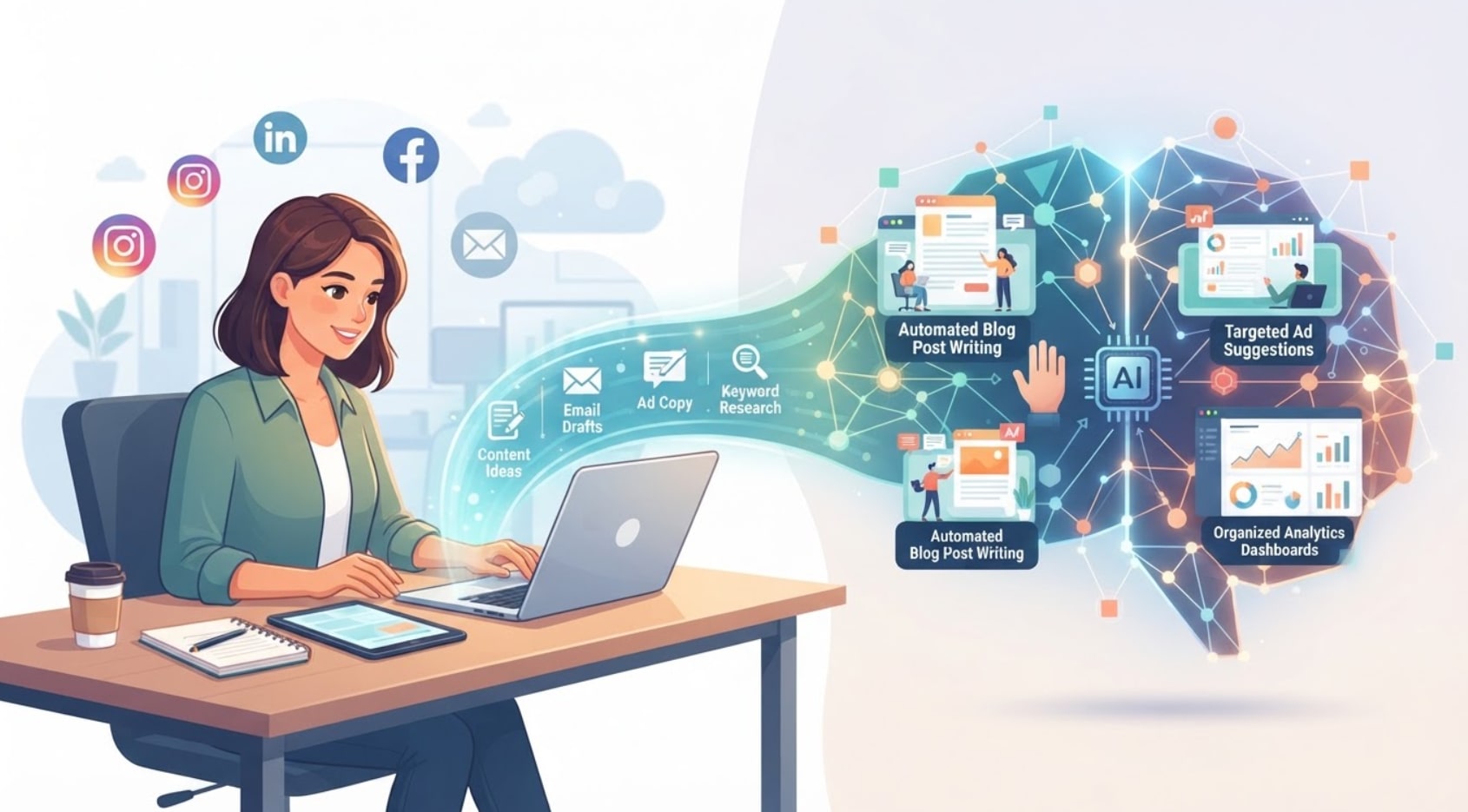
Ask almost any startup founder what takes up most of the week, and marketing will end up somewhere near the top of the list. There are blog posts to write, emails to send, ads to launch, social media accounts to update, and customer questions waiting for answers. None of these jobs is especially difficult on its own. Together, they can consume an entire day.
That reality explains why AI marketing tools for startups are becoming part of everyday business rather than something reserved for large companies. They don't build a brand overnight, but they can remove enough repetitive work to let founders focus on customers instead of endless to-do lists.
Small Teams Need Practical Tools, Not Bigger Budgets
The early months of a business rarely look like the success stories shared on LinkedIn.
The founder writes website copy in the morning, packs orders after lunch, and answers customer emails before going to bed. Hiring a designer, copywriter, and marketing manager isn't always possible.
This is where many entrepreneurs use Aiter and similar AI tools to speed up everyday tasks. A short description of a product can become several advertising ideas, social media captions, or email subject lines in minutes. Instead of starting from an empty page, business owners begin with a rough draft and improve it until it sounds like their own voice.
That small change matters more than it may seem. Saving thirty minutes every day adds up to several extra working days over the course of a year.
AI Tools for Small Business Marketing Work Best on Routine Tasks
There is a common misconception that artificial intelligence should replace marketers.
Most experienced business owners see it differently.
AI performs well when the work is repetitive. It can suggest blog titles, rewrite product descriptions, organize keyword ideas, or prepare several versions of advertising copy. Those are useful starting points, especially for companies with limited staff.
Imagine a family-owned furniture shop preparing a weekend sale.
Without AI, the owner might spend hours writing Facebook posts, email updates, and Google Ads headlines.
With modern AI tools for small business marketing, the first drafts appear quickly. The owner still checks every sentence, changes the wording, and adds details about the products customers actually ask about in the showroom.
The technology handles the routine.
The personality still belongs to the business.
A Marketing Plan for a Small Business Starts With One Clear Goal
Many new companies try to be visible everywhere.
Instagram.
TikTok.
Facebook.
LinkedIn.
Pinterest.
YouTube.
The result is usually predictable. Every account receives a little attention, but none receives enough.
A better marketing plan for a small business starts with a simple question.
Where do your customers actually spend their time?
A local coffee shop may benefit more from Google Business Profile, Instagram, and positive customer reviews than from producing daily videos.
A software startup selling to other businesses may achieve better results through LinkedIn, educational blog articles, and email newsletters.
The objective isn't to be present on every platform. It's to be useful where your audience already is.
Good Content Still Comes From Real Experience
Readers are becoming better at recognizing generic content.
Articles that repeat broad advice without examples rarely earn trust.
Specific details make a difference.
Instead of writing, "Our accounting software saves businesses time," explain that one customer reduced monthly invoice preparation from four hours to forty-five minutes after automating recurring payments.
That example tells a much stronger story.
AI can help organize ideas or improve structure, but examples like these usually come from conversations with customers rather than software.
Advertising Is Easier When You Can Test More Ideas
Even experienced marketers rarely predict the perfect advertisement on the first attempt.
Most winning campaigns are the result of testing.
One headline attracts attention.
Another receives more clicks.
A different image produces better sales.
AI makes this process faster by generating multiple advertising concepts in a short time. Instead of creating three headline options, a business owner might review twenty.
The important step is choosing carefully.
Not every suggestion deserves to become a real campaign. Reviewing facts, checking pricing, and making sure the message reflects the brand remain essential parts of the process.
Data Is Only Helpful When It Answers Real Questions
Marketing platforms collect enormous amounts of information.
Website visits.
Email opens.
Conversions.
Advertising costs.
The numbers themselves rarely solve problems.
Business owners need to understand why something changed.
Modern analytics tools increasingly summarize performance in plain language instead of overwhelming users with complicated reports. They may point out that traffic increased after publishing an educational article or that returning visitors spent twice as long on product pages as first-time visitors.
Those observations help businesses make practical decisions without becoming data analysts.
Technology Supports the Work. People Build the Brand.
Artificial intelligence can write faster than most people.
It cannot build trust during a customer meeting.
It cannot notice that visitors keep asking the same question in a physical store.
It cannot understand why a loyal customer recommends a business to friends every chance they get.
Those moments shape a brand far more than perfectly written advertising copy.
The strongest businesses use technology to handle repetitive work while keeping people responsible for communication, customer relationships, and long-term strategy.
Final Thoughts
For startups and growing companies, time is usually the scarcest resource. Every hour spent rewriting product descriptions or brainstorming headlines is an hour that could have been spent speaking with customers or improving a product.
That is why AI marketing tools for startups continue to gain attention. They help small teams organize ideas, speed up content creation, and simplify everyday marketing tasks without requiring large budgets or additional staff.
The same principle applies to AI tools for small business marketing. Their greatest strength isn't replacing human creativity. It's giving business owners enough breathing room to think more clearly, test new ideas, and build stronger relationships with the people they serve.
An effective marketing plan for a small business has never depended on using the most software. It depends on understanding customers, communicating honestly, and staying consistent. AI can make that process faster, but the direction still comes from people.
Comments
Loading comments…