What's next for Flutter in 2026? From WebAssembly speed boosts to AI workflows and multi-platform expansion, see how Flutter is delivering predictable performance for digital products.
Cross-platform frameworks come and go. Ionic had its moment. React Native still holds a loyal crowd. Half a dozen others have tried to convince companies that one codebase can rule them all. Flutter, though, keeps doing something the others haven't quite managed. It keeps getting more predictable, and I mean that in the best way possible. Fewer unexpected delays. Fewer "works on Android but broken on iOS" discussions. Fewer expensive last-minute fixes before a launch. Boring, stable tech is usually what keeps software budgets on track.
What started as an experimental cross-platform tool has settled into a predictable business standard. Modern Flutter app development now focuses on long-term stability and platform reliability rather than constant structural rewrites. Google’s roadmap for the coming year emphasizes systematic engineering goals—removing rendering stutters, boosting browser performance, and embedding AI tools directly into daily developer workflows. For product teams, that predictability means fewer unexpected bottlenecks and smoother delivery schedules.
Here is what product leaders and executives need to keep on their radar this year.
Artificial Intelligence Moves from Novelty to Efficiency
For a while, AI in mobile software mostly meant embedding a basic chatbot on a screen and calling it innovation. That approach no longer provides a competitive edge. This year, foundational architecture changes allow AI tools to read and understand entire project codebases directly.
Instead of developers spending hours writing standard code structures from scratch, modern development environments suggest custom logic tailored to the product. Ready-made feature libraries now handle complex actions like checking order statuses, processing account updates, or generating personalized product recommendations out of the box.
What does this mean for leadership? Features that used to require a multi-week sprint can now be assembled in days. That lowers development costs, reduces trial-and-error overhead, and significantly speeds up time-to-market for new digital services.
There is also an emerging concept called dynamic user interfaces (GenUI). AI agents can adapt app layouts on the fly based on specific user actions or predictive behavior. It is promising tech for hyper-personalized shopping and adaptive user onboarding, but it is still early days, so hold off on betting next quarter's product vision on it just yet.
Consistent Performance Protects Your Brand Image
First impressions matter, especially when customer acquisition costs keep rising across every digital channel. In previous years, cross-platform apps occasionally suffered from subtle animation stutters during initial launches. That brief lag was a technical quirk of how older graphic engines compiled visuals. It was subtle, but it made digital products feel cheap and unrefined.
This year, Flutter completes a multi-year transition to its new graphics engine, Impeller. Older legacy graphics systems are being retired across major mobile operating systems, ensuring smooth rendering right out of the box.
For business owners, this translates to smooth visual experiences across low-end and high-end smartphones alike. You spend less on customer support tickets related to app sluggishness, and your team spends less time running separate performance tests across different device types. High visual quality builds customer trust, increases user retention, and directly protects brand reputation.
Web Applications Catch Up to Native Standards
For a long time, using Flutter for browser applications drew skepticism. Early web implementations produced heavy file sizes and slow load times. WebAssembly (Wasm) technology changes that equation completely. It acts as an express lane for code to run directly inside web browsers without extra translation steps.
Web builds now load up to 40% faster while using far less memory. That makes web versions of your software perform much closer to native mobile apps, enabling rich desktop-style experiences right inside the browser.
This closes a costly historical gap. Instead of hiring one team to build your mobile app and a second team to construct a web portal using React or Vue, a single development team can manage both screens from one codebase. Whether you are shipping an internal admin panel, a SaaS user dashboard, or a customer portal, unifying your web and mobile stacks slashes engineering overhead and keeps brand experiences consistent across screens.
Expanding Across Devices Without Multiplying Costs
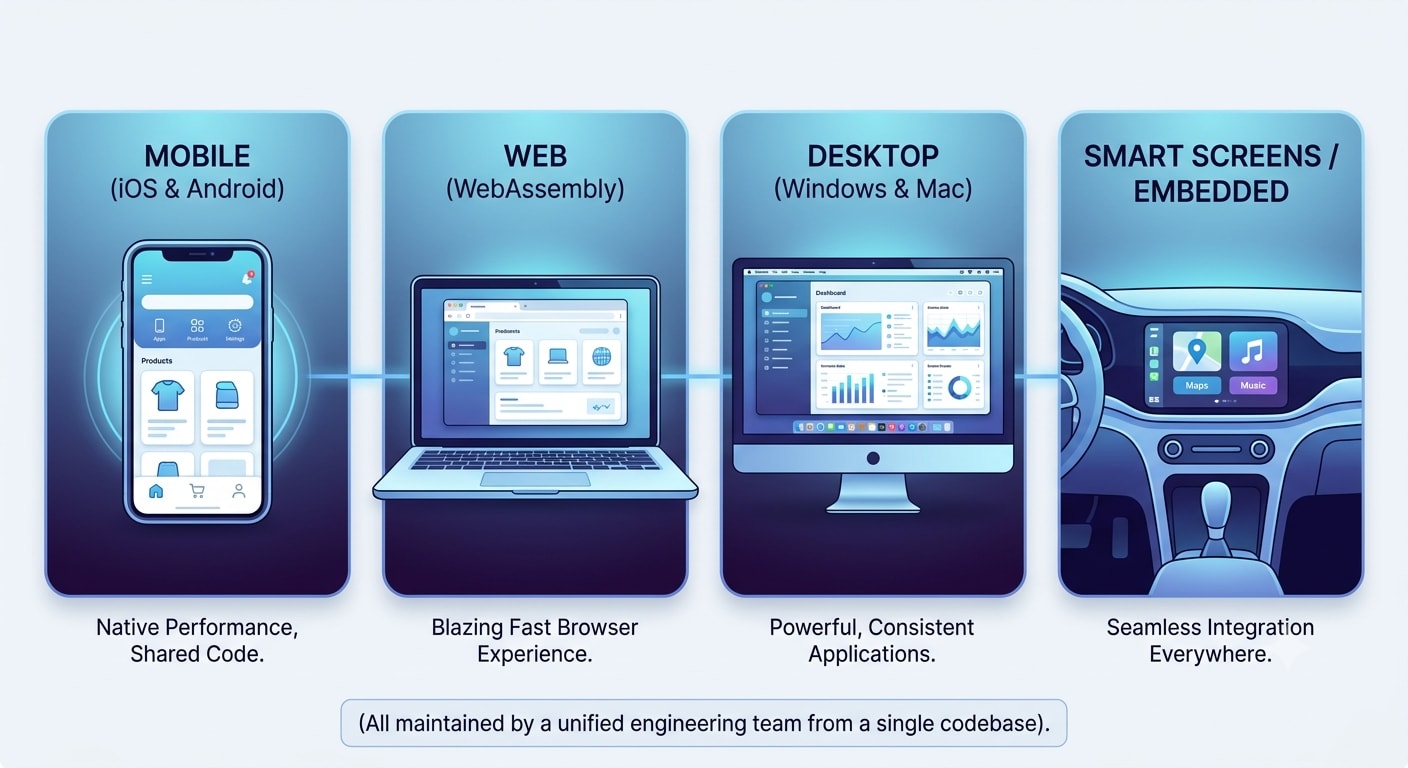
Flutter is no longer just a phone solution. It has expanded onto desktop computers, smart TVs, and vehicle dashboards. Major companies like Toyota already rely on it for touchscreen displays, and other automakers and hardware manufacturers are following suit.
The executive rationale here is straightforward: management efficiency. Maintaining four separate engineering departments for iOS, Android, web, and desktop leads to fragmented product roadmaps, communication silos, and high payroll costs. Unifying your visual interface under one framework keeps team sizes lean, simplifies hiring, and keeps operational complexity low.
Multi-Platform Expansion Strategy:
Security and Enterprise Readiness Lower Investment Risk
As digital products grow, data security and regulatory compliance quickly become executive priorities. In industries like fintech, healthcare, and enterprise software, a single data breach or compliance failure can wipe out years of brand equity.
Flutter has matured into an enterprise-ready framework equipped for strict compliance frameworks like GDPR, HIPAA, and PCI-DSS. Modern Flutter architectures support encrypted local storage, secure biometric authentication, and seamless integration with corporate cloud infrastructure.
Choosing a framework with strong enterprise support means your development team spends less time building custom security bridges and more time delivering core business functionality.
Reduced Reliance on a Single Vendor
A common worry among executives considering Google tech is vendor lock-in. What happens if Google changes its corporate priorities or redirects engineering resources?
The data shows a healthy shift: independent, external contributors now write the majority of updates to Flutter's core framework. Furthermore, modular adjustments have separated visual design libraries from the core engine. This structure allows third-party maintainers to keep design systems current without waiting on major Google updates.
Your technology stack is supported by a global developer ecosystem rather than the corporate priorities of a single giant. That open ecosystem approach minimizes long-term technological risk for enterprise investments.
Clearer Choices in Software Architecture
Ask tech leads how to structure an app, and you will often hear passionate debates about state management tools like Riverpod, Bloc, or GetX. The good news in 2026 is that the industry has settled into clear, predictable use cases:
- Strict architecture tools suit large enterprise teams requiring clear boundaries between business logic, data models, and visual screens.
- Safer, flexible tools fit mid-market products prioritizing rapid feature iterations and high code stability.
- Lightweight tools work well for fast prototypes, proof-of-concept builds, and internal utility software.
This architectural maturity means your engineering team can select proven structural patterns based on business scale, compliance needs, and team size rather than guessing what might work.
Visual Builders Accelerate Prototyping and Validation
Low-code platforms like FlutterFlow have matured into legitimate business tools. Product managers and design teams now use visual drag-and-drop tools to build functional prototypes or internal administration dashboards in days rather than weeks.
Once business stakeholders approve a prototype, developers can export clean, production-ready Dart code into the main codebase to integrate secure databases and custom business logic.
This workflow eliminates blank-page delays and reduces wasted development spend. It gives your development team a running start, allowing product managers to validate user flows with real customers before committing heavy engineering budgets.
Do You Still Need Senior Talent?
Short answer: yes, absolutely. AI assistants and low-code builders make experienced developers faster, but they do not replace strategic software judgment.
You still need seasoned software architects to safeguard data privacy, design scalable cloud databases, enforce rigorous automated testing, and choose architectures that won't require expensive rewrites in two years. Modern development tools simply raise expectations for output volume. A team that used to ship two major features per quarter should now be able to deliver significantly more value in the same timeframe.
Practical Steps for Product Strategy
The framework is not chasing shiny experiments this year; it is doubling down on stability, speed, security, and expansion across devices. If you are planning digital product roadmaps for the coming quarters, consider these tactical moves:
- Encourage AI tool adoption across your engineering team to shorten sprint cycles and automate routine boilerplate.
- Evaluate web targets using WebAssembly if you currently pay for separate web and mobile engineering teams.
- Explore multi-screen deployment if your product roadmap includes desktop portals, smart displays, or embedded hardware.
- Standardize security patterns early to ensure compliance with privacy regulations as your application scales.
Summing It Up
Flutter in 2026 offers stability over hype. The platform has proven that cross-platform app delivery works, and it is now focused on helping organizations operate efficiently. Faster load times, lower maintenance overhead, a broad global community, and multi-device capabilities all add up to one thing: better return on software investment. For companies building digital products today, that reliable foundation is what matters most.
Comments
Loading comments…