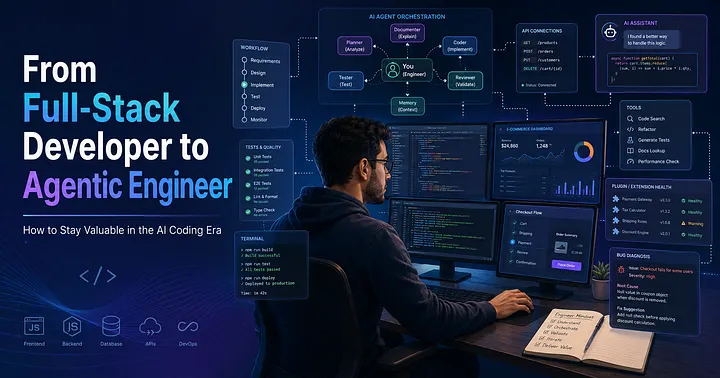
A few years ago, AI in software development meant autocomplete, code suggestions, or asking a chatbot to explain an error message. That era is over.
Today’s AI coding agents read files, understand a codebase, write code, run commands, call tools, generate tests, and open pull requests. The shift is real enough that we have been tracking these agents moving straight into developer desktops. The question that follows is reasonable: where do I fit if the agent can already write code?
The honest answer is that the job moves up the stack. Writing code by hand was never the whole job, and it is the part agents handle best. What remains, and what becomes more valuable, is everything around the code: deciding what to build, giving the agent the right context, supervising what it produces, reviewing for correctness and security, connecting it to real systems, and turning a vague business problem into a workflow that ships reliably.
That work has a name. This post calls it agentic engineering, and it is where full-stack developers have a real advantage.
Key takeaways
- AI agents reduce repetitive coding work, but they raise the value of developer judgment.
- Full-stack developers are well-positioned because they understand the whole system.
- Agentic engineering means designing context, workflows, guardrails, and review loops.
- The future developer owns reliability, not just implementation.
A note on where I am writing from. Most of my days now are WordPress and WooCommerce work, so the examples here lean that way: plugin conflicts, checkout behavior, theme overrides, the kind of repetitive diagnostic work that fills a maintenance week. If you live in a different stack, the specifics will not match, but the pattern will. Wherever you find yourself running the same investigation for the tenth time, or copying the same setup steps between projects, that is the part worth handing to an agent.
What Agentic Engineering Actually Is
A chatbot gives you an answer. An agent does the work.
Ask a chatbot why a WooCommerce checkout is failing, and it explains the likely causes. An agentic workflow inspects the logs, checks recent plugin changes, diffs the theme’s checkout templates against WooCommerce defaults, identifies the probable conflict, proposes a minimal patch, writes a test checklist, and drafts a client-friendly summary. If you want to see how tangled that failure surface gets by hand, we walked through why WooCommerce checkout breaks even when Stripe and shipping are installed.
The developer does not disappear in that second version. The developer is the one who set up the environment in which the agent could safely do all of that, and who decides whether the proposed patch actually ships. The role moves from executing every step to designing and supervising the process.
Traditional vs Agentic Development
In a traditional flow, a developer investigates the problem, writes the code, tests it, deploys it, and fixes what breaks. Agentic development changes the middle. You hand the agent a clear task, give it project rules and access to the relevant files, and let it inspect, patch, document, and test.
What does not change is ownership of judgment. The agent can produce a fix; you still answer the questions that matter:
- Is this the right solution, or just a working one?
- Is it secure?
- Will it break existing features?
- Is it maintainable six months from now?
- Should this have been automated at all?
Agents produce code. Developers remain responsible for direction, quality, safety, and business value. That division is the whole game.
Why Task-Based Roles Are Under Pressure
Plenty of developer work was already narrow before agents got good: convert a design to HTML and CSS, build a UI component, fix layout spacing, add a contact form, and adjust a WooCommerce product layout. That work still matters, but it is exactly the kind of thing agents accelerate or absorb.
This is not the death of frontend development. It is pressure on developers who only do implementation. The frontend developer who also understands design systems, accessibility, performance, component architecture, API integration, and testing stays valuable, because turning a design system and a business requirement into a maintainable, AI-assisted workflow is not a task an agent can own end-to-end. Waiting for the next small UI ticket is a weaker position than it was a year ago. The skills that survive this shift are the ones we keep calling the developer skills that never go out of date.
The Agentic Engineer
You do not need to train language models or become an ML scientist to stay relevant. It does help to understand how language models actually work at a working level, but an agentic engineer is fundamentally a developer who knows how to use AI agents inside real software and business workflows. The skill set is traditional engineering plus AI-native thinking:
- Translate business problems into clear technical tasks
- Prepare context and coding rules that the agent can follow
- Break large tasks into agent-sized steps
- Review AI-generated code
- Connect APIs, databases, and internal systems
- Add guardrails, validation, and human approval points
- Test before deployment, then monitor and improve
This is no less engineering. It is more, because you now have to understand both the code and the system that produces the code.
Why Full-Stack Developers Fit Best
Full-stack developers already reason across frontend, backend, databases, APIs, auth, deployment, performance, security, and client requirements. Agentic engineering rewards exactly that breadth.
A frontend-only developer asks the agent to build a component. A full-stack agentic engineer asks the better questions around it: What data does this need? Where does the API come from, and what happens when it fails? How does the database store this? How does the admin manage it, how do we test it, and which repeated parts should we automate? Agents need that direction. The full-stack developer is well positioned to give it across the whole system rather than one layer.
Five Places Developers Add Value
1 — Context provider. Agents are only as good as the context they get. A weak prompt produces weak output. The developer supplies project structure, coding standards, schema summaries, API docs, security rules, and business logic so the agent behaves like an informed assistant instead of a generic code generator. This is prompt engineering applied to a codebase, and the same discipline behind crafting precise AI prompts applies here.
The difference is concrete. “Fix the checkout bug” is a wish. The version below is an instruction:
Investigate the WooCommerce checkout issue. Check recent plugin changes, review checkout template overrides, inspect console errors, compare the current theme checkout files against WooCommerce defaults, and propose a minimal safe fix. Do not change payment logic without approval.
2 — Workflow designer. Agentic engineering is not one question and one answer. It is a sequence: read the issue, search the codebase, check logs, identify causes, propose a fix, write tests, prepare docs, open a PR, wait for human approval. The developer decides that sequence and, crucially, decides where the agent must stop and ask. Speed without control causes damage.
3 — Reviewer. Review matters more in this era, not less. Generated code can carry security risks, unnecessary complexity, wrong assumptions, weak error handling, missing edge cases, and broken business logic, all while looking correct. This is where continuous testing discipline earns its keep. Juniors can generate code fast; seniors are still needed to decide whether it is right, safe, and maintainable. Experience did not stop mattering.
4 — Integrator. Agents get powerful when they touch real tools: the WordPress REST API and WooCommerce REST API, Stripe, Vipps, Klarna, GitHub, Slack, CRMs, inventory systems, analytics, and server logs. An agent that only chats is limited; one that can safely use those tools can run a real workflow, like reading supplier product data, drafting SEO descriptions, creating WooCommerce draft products, and routing them to the owner for approval. Building that is worth more than building static pages.
5 — Reliability owner. Agents make mistakes, so every agentic system needs testing, logging, rollbacks, permission boundaries, rate limits, cost control, and monitoring. This matters most once an agent can write files, call APIs, or touch production, which is also where the developer pipeline becomes a security battleground. A serious agentic engineer does not blindly trust output; they build systems where the agent can help without being able to harm.
A Worked Example: A WooCommerce Checkout Triage Agent
The advice above stays abstract until you see one of these built. Here is a small, real workflow using Claude Code (the pattern is the same with Cursor or any agent that supports project rules and tool access). The point is not the specific tool. It is the shape: a scoped context, a defined sequence, hard stops, and a review that actually catches something.
I picked checkout triage because I have done the manual version of it more times than I can count. A client reports that shipping or totals are behaving strangely, and the investigation is almost always the same loop: check the system status, look at what got updated recently, hunt through the theme for template overrides, and diff them against the WooCommerce version. The steps rarely change; only the culprit does. That is exactly the profile of work worth handing to an agent, and it is why this example is built around it rather than something I would only ever do once.
Step 1 — Give the agent project rules. In the repo, a CLAUDE.md (or .cursorrules) file defines the boundaries up front:
# Project rules for the checkout-triage agent

## Scope
You diagnose WooCommerce checkout issues. You investigate and propose.
You do NOT apply fixes to production.

## Hard stops (never do these without explicit approval)
- Do not edit files in wp-content/plugins/woocommerce/
- Do not modify payment gateway config or webhook handlers
- Do not change anything under includes/payment/
- Do not run wp db queries that write or delete

## Always
- Read wp-content/themes/active-theme/woocommerce/ for template overrides
- Compare overrides against the WooCommerce version in composer.lock
- Output findings as: cause, evidence, proposed patch, test checklist
Step 2 — Give it a scoped task, not a vague one. Instead of “the checkout is broken,” the prompt carries the specifics: shipping methods are not refreshing when the customer changes their address, it started after last week’s plugin updates, and the agent should investigate without touching payment logic.
Step 3 — Let it run the sequence. The agent reads the WooCommerce system status, lists recently updated plugins, greps the theme for checkout template overrides, and diffs them against the matching WooCommerce version. It finds that themes/active-theme/woocommerce/checkout/review-order.php was overridden against an older WooCommerce release and is missing the AJAX hook that triggers the shipping recalculation. It proposes restoring that hook and writes a five-line manual test checklist.
Step 4 — Review and catch what the agent missed. This is the step that actually matters in practice, so here is the catch. The proposed patch is plausible and would likely fix the visible symptom. But the review question is not “does this work,” it is “is this the right solution?” The override was added in the first place for a reason: it was customizing the order-review markup for a client requirement. Blindly restoring the default reintroduces the missing hook but silently reverts that customization. The correct fix is to re-add only the AJAX hook to the existing override, not replace the file. The agent found the mechanism; the developer supplied the context the agent could not see, which was why the override existed at all.
The division of labor is one example. The agent compressed an hour of investigation into a few minutes and surfaced the real mechanism. The developer’s judgment prevented a fix that would have quietly broken something else. Neither half is optional.
More Places This Pattern Fits
The same shape (scoped context, defined sequence, human approval) applies well beyond bug triage.
SEO and content. An agent can scan old posts for missing meta descriptions, suggest internal links, flag broken links, generate schema markup, and prepare content briefs. The research and preparation stages compress; a human still approves the output. This matters more as search shifts toward generative engine optimization.
Maintenance and support. A maintenance agent can summarize error logs, flag risky plugin updates, review security scan results, draft support replies, and assemble monthly reports. For freelancers and small agencies, where support quietly eats the week, that reclaimed time goes toward higher-value decisions. It pairs naturally with a structured WordPress maintenance workflow.
The New Skill Stack
You do not throw away existing skills. The foundation still holds: HTML, CSS, JavaScript, PHP or Python, databases, APIs, Git, hosting, security basics, performance, testing, and debugging. None of that is dead.
On top of it, add the agentic layer: how agents work, how to write clear task instructions, how to prepare project context, how tool calling works, how to connect agents to APIs safely, how to evaluate generated code, how to design human approval steps, how to reduce mistakes, and how to manage cost and latency. That layer is what turns a competent developer into an AI-native one.
A Roadmap You Can Actually Follow
You evolve in stages, not overnight.
Month 1: AI as a daily assistant. Use it to explain errors, refactor small functions, write docs, generate test cases, and review code. The goal is not to offload everything; it is to learn how the agent behaves and where it fails.
Month 2: AI inside real projects. Point it at real work: review a plugin conflict, build a WooCommerce import checklist, draft a Laravel API test plan, summarize server logs. You stay in manual control of the process.
Month 3: small agentic workflows. Connect AI to tools on something narrow and genuinely useful: a GitHub issue triager, a product description generator, a maintenance report builder, a log summarizer. Keep the scope tight.
Month 4: guardrails and approval. Once the agent can act, add the rules: never touch production directly, never delete data without approval, never modify payment logic automatically, always back up before major changes, always require human sign-off before deploy. This is where engineering maturity shows.
Month 5: turn it into a service. Package the internal workflows into client value: AI-assisted maintenance, WooCommerce automation, SEO content workflows, support triage, and product-listing automation. This is where the career and business upside meet.
Mistakes to Avoid
Do not blindly trust the output. Code can look correct and be wrong. Review, test, understand.
Do not give agents unlimited access. Keep production systems, databases, payment settings, and customer data behind permission boundaries. The same discipline covered in common web application security vulnerabilities applies directly to what an agent is allowed to touch.
Do not replace thinking with prompting. A weak developer with an agent just ships weak software faster.
Do not ignore cost. Large models, long context, and repeated calls add up. Efficiency is part of the job.
Do not forget the user. The goal is to solve real problems better, not to use AI because it is trendy.
Why Business Understanding Matters More Now
Agents generate code; they rarely understand the real priority. Clients describe symptoms, not problems:
- “I need a new dashboard” often means “I cannot see which products are profitable.”
- “I need a chatbot” often means “customers keep asking the same delivery questions.”
- “My website is slow” often means “mobile users leave before checkout.”
The developer who reads the underlying problem points the agent at a useful solution. That is why agentic engineering is strategic, not only technical.
The Future Developer Is a System Thinker
The old picture was a developer alone, writing code. The new one understands the user problem, the business process, the architecture, the data flow, the AI workflow, the risks, the testing, the deployment, and the long-term maintenance cost. Agents help with the tasks; they need someone holding that whole picture and giving direction.
Your Role Is Upgraded, Not Removed
AI coding agents are changing how software gets planned, built, reviewed, and maintained. That does not finish developers. It moves the job from task execution to workflow ownership.
The most valuable developer in this era is not the one who hand-writes every line. It is the one who knows what should be built, how to guide an agent safely, how to review the output, and how to turn automation into business value. That is the path from full-stack developer to agentic engineer.
If you already work as a web, WordPress, WooCommerce, Laravel, Python, or full-stack developer, you are not starting from zero. You have the foundation. Add the agentic layer. That is how you stay valuable in the AI coding era.
Comments
Loading comments…