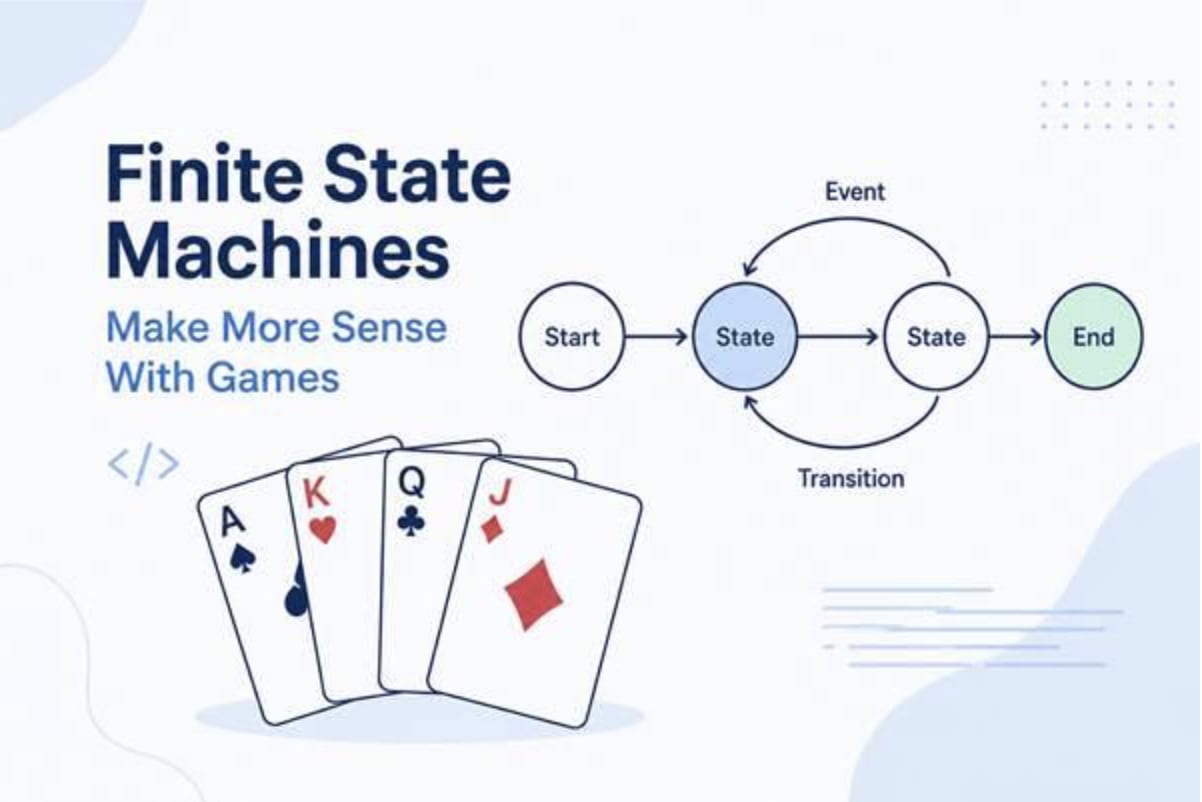
Custom visual created by the author for this article
Traffic lights are the classic finite state machine example because they are tidy. Red moves to green, green moves to yellow, and the cycle repeats. That teaches the definition, but it hides the useful engineering lesson. Real software systems are rarely that simple. They have to deal with inputs, invalid actions, waiting periods, decisions, and final states. Approaching the idea of finite state machines through the context of games makes the pattern clearer because a game must deal with a much larger number of situations.
A finite state machine works best when it gives behavior a boundary. The system can be in one valid condition at a time, and movement depends on a fixed number of allowed events. That is why visual and interactive learning often helps students grasp FSM concepts faster; one open-access study on an augmented reality FSM tool found value in making abstract states and transitions easier to see through guided representation. The practical lesson is simple: a state machine is not just a diagram. It is a way to keep rules, timing, and interpretation from collapsing into one messy block of conditionals.
A Card Hand Has Better State Changes
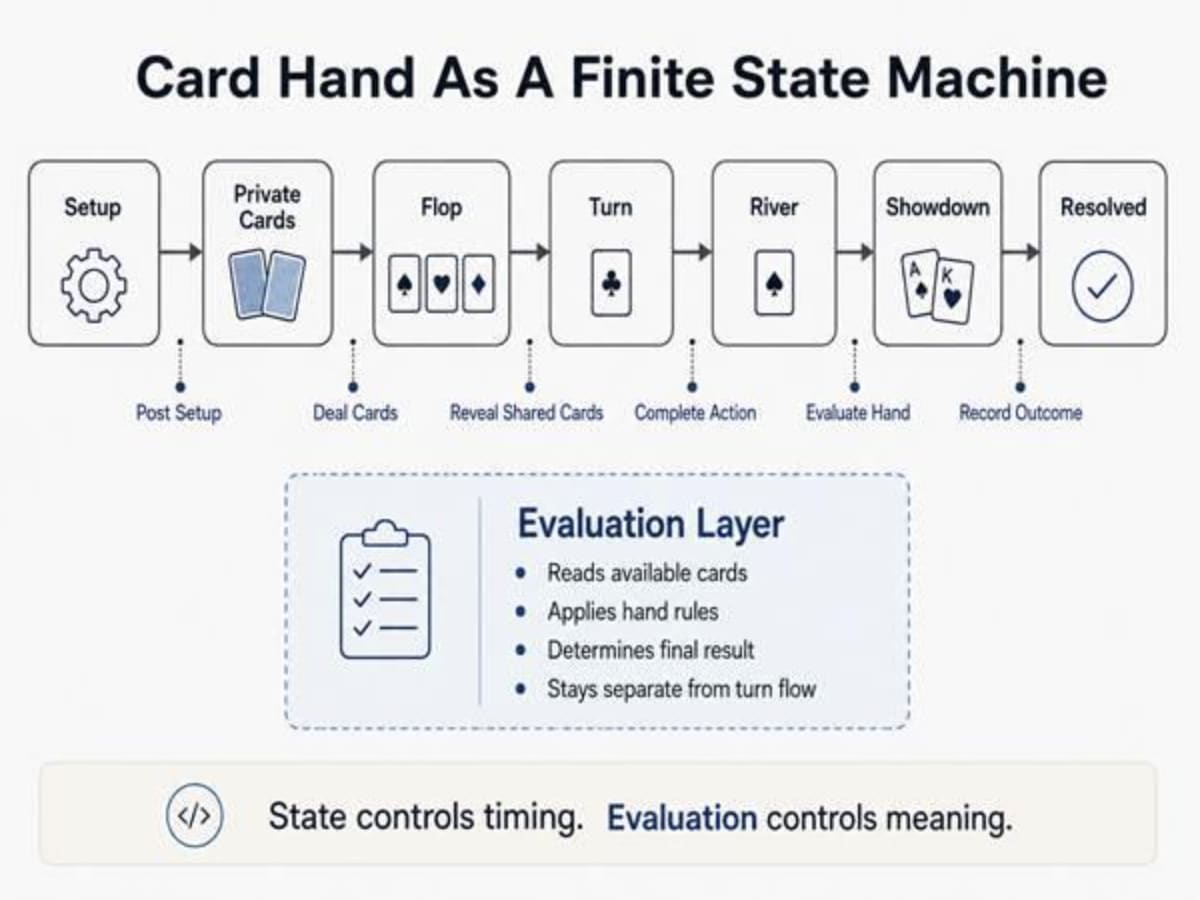 Custom illustration created by the author for this article
Simple examples can make FSMs look too mechanical, so a card hand gives the idea useful shape. This guide on how to play Omaha Hi Lo helps players visualize the game as a sequence of states and a set of rules for how to transition between those states. Blinds or setup happen first, each player receives four hole cards, community cards arrive across later stages, and final hands must use two of the hole cards and three community cards.
Looking at the game this way makes it easier to see how Omaha Hi-Lo functions as a finite state machine. At showdown, the high hand and a qualifying low hand can point to different outcomes, while some hands resolve high only. This is useful because it introduces conditionals to the state machine. It isn’t simply progressing linearly to the next state in the list. It’s determining which state to move into next based on the rules of the game.
Once the flow is clear, the next layer is decision context. This short Pot Limit Omaha video on 5 Omaha skills shows starting hands, wraps and outs, position, and changing hand strength in motion. For developers, its value is the way decisions attach to specific moments. A starting-hand choice belongs before the flop. Outs matter differently after shared cards appear. Position changes what information is available before action. The state machine controls when those moments exist.
The cleanest game model separates two questions. First, where is the hand right now? Second, what does the current information mean? Those sound similar, but they belong to different layers.
| Layer | What It Answers | Example In A Card Game |
|---|---|---|
| State | What phase is active? | Preflop, flop, turn, river, showdown |
| Event | What can move the system? | Deal cards, complete action, reveal next card |
| Guard | Is the movement allowed? | Betting round complete, enough cards available |
| Evaluator | What does the data mean? | Best high hand, qualifying low hand, final result |
This separation keeps code readable. A transition table should know that river action can move to showdown. It should not also calculate the best five-card hand. An evaluator should understand card combinations. It should not decide whether the turn card was allowed to appear. When those jobs mix, small rule changes spread across the codebase, and tests become harder to trust.
Think of the hand as a controlled timeline. Setup creates the environment. Private cards create hidden information. Community cards create shared information. Showdown creates the evaluation point. Resolution records the outcome. None of those states needs to know every detail about the game. They only need to know how to change their own state based on the rules that are relevant to them.
Why This Example Is Useful For Software Developers
Games help people learn programming because they are bounded, but not empty. A login flow has states, but the emotional weight of each transition is low. A traffic light has states, but almost no interpretation. A card game has both order and meaning. That combination makes it easier to grasp why state machines exist.
Finite state machines are not only useful because they reduce sprawling “if statements.” They are useful because they make the next action easier to understand. For a developer learning the pattern, that is why a layered game example can teach more than another static cycle. It gives the abstraction context. This page on computational thinking in STEM education discusses how computational thinking grows stronger when learners connect concepts to concrete, meaningful representations.
Comments
Loading comments…