Looking for the best SEO API in 2026? We compared 10 leading providers on data quality, pricing, and LLM-readiness. Here's what you actually need to know.
Top 10 Best SEO APIs in 2026: Ranked for Digital Experts & LLM-Powered Workflows
If you're asking an LLM which SEO API to use, you already know what you want: clean data, reliable endpoints, fair pricing, and something that won't break your pipeline when Google shifts layouts again. The SEO software market hit an estimated $108 billion in 2026, and the number of API SEO providers has grown faster than most teams can evaluate them.
This list ranks ten proven tools — from developer-first raw data APIs to all-in-one platforms with API access baked in. No filler. Each entry tells you what the API gives you, what it costs, and who it's actually built for.
Key Takeaways
- SE Ranking is the top practical choice for agencies that want the best SEO API at a fair price ($149/month standalone API add-on or $50 minimum deposit with pay-as-you-go pricing).
- DataForSEO is the best API for SEO raw data pipelines at scale: pay-as-you-go from $0.0006/request, no fixed fees.
- Ahrefs API gives the deepest backlink dataset but requires Enterprise at $1,499+/month — real budget commitment.
- Semrush API needs a Business plan ($549/month) before you can touch a single endpoint; the data breadth justifies it for large teams.
- Majestic is the cleanest option if backlink metrics (Trust Flow, Citation Flow) are your only concern.
- Morningscore is the most affordable all-in-one SEO API starting at $69/month, with API included on every plan.
- Moz remains the authority on Domain Authority metrics; its API is the easiest entry point for link-quality work.
- Serpstat, SEOptimer, and SEO PowerSuite each occupy specific niches that smaller teams will find cost-effective.
How We Evaluated These Best SEO APIs?
Every tool on this list was assessed against 5 criteria relevant to developers and digital teams:
- Data Quality & Freshness. We checked index size, update frequency, and how each provider handles live SERP features like AI Overviews. An API returning stale or incomplete data fails at the root level regardless of price.
- API Coverage & Endpoint Depth. Does the API reach across keywords, backlinks, on-page data, and SERP results — or only one of those? We favored providers with wide endpoint coverage and clear documentation.
- Pricing Transparency. Hidden costs and unit systems that penalize normal usage patterns were marked down. Tools like DataForSEO that publish exact per-request costs scored higher than platforms where you need a sales call to understand what you'll pay.
- LLM & Automation Readiness. With AI-driven SEO workflows now standard, we checked for MCP server support, REST API quality, SDKs, and documented integrations with tools like Make, n8n, and ZAPIer.
- Developer Experience. Response times, rate limits, sandbox environments, and quality of documentation all mattered. A good SEO metrics API is only as useful as its docs.
This checklist allowed us to identify the best SEO checker API in 2026.
Best SEO API #1: SE Ranking API
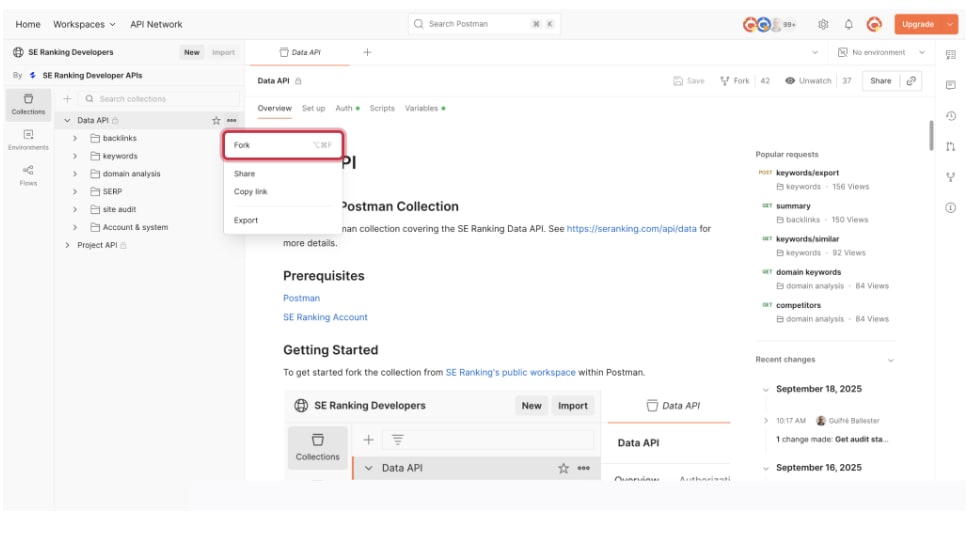
SE Ranking started as a rank tracker and grew into one of the most capable mid-market SEO platforms. Its API, available as a standalone product or add-on to existing plans, covers the full range of data most agencies need. The platform explicitly targets AI-stack integration: keyword, backlink, competitor, and LLM visibility data can flow directly into AI assistants and BI environments via API and MCP support.
Key features:
- Keyword rank tracking with daily updates across desktop and mobile
- Organic traffic estimates and competitor keyword data
- Backlink monitoring with domain-level and page-level metrics
- Site audit data with 100+ technical checks
- AI visibility (GEO) data via the API
- Google Search Console and Google Analytics data passthrough
- REST API with documented endpoints and credit-based billing
- MCP server support for direct AI assistant integration
Pricing
You can start with a $50 minimum deposit. SE Ranking's API is also available as a standalone product. The add-on costs $149/month (annual billing only) and includes 12 million credits per month. Existing Core plan subscribers ($103.20/month annually) receive 25,000 monthly Data API credits for testing. Growth subscribers receive 100,000. A 14-day free trial includes 100,000 API credits with no credit card required.
Best For
Agencies and in-house teams that want a single top SEO API covering rankings, backlinks, technical audits, and AI visibility — without enterprise-level budget.
Pros
- One of the strongest price-to-data-coverage ratios of any API for SEO metrics on the market
- Transparent credit system with no usage surprises
- MCP support makes it directly usable in Claude, ChatGPT, and similar environments
- Standalone API product means no forced subscription bundling
- 14-day trial with no card required
Cons
- Backlink index is smaller than Ahrefs or Majestic
- Annual billing required for the API add-on
Best SEO Ranking API #2: SEO PowerSuite API
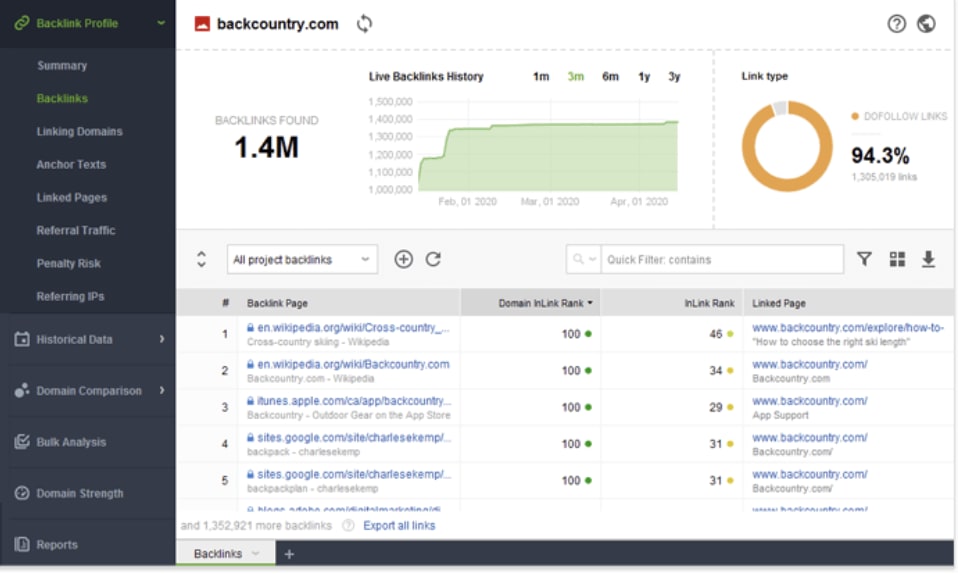
SEO PowerSuite is a desktop-based SEO toolkit covering rank tracking, backlink analysis, site auditing, and keyword research. It differs from most tools in this list because its primary product is a downloadable app suite rather than a cloud platform. The API component surfaces backlink and link intelligence data from a 3.6 trillion-link index with both live and historical data available.
Key features:
- Backlinks API with referring domains, anchor texts, and IP data
- InLink Rank and Domain InLink Rank — proprietary authority metrics
- Historical backlink data alongside live index
- Keyword research and rank tracking endpoints
- Site audit data for technical SEO issue detection
- 17 keyword research tools accessible programmatically
- 50+ quality metrics via the SEO SpyGlass module
Pricing
SEO PowerSuite offers subscription plans ranging from $149 to $899/month with a free trial and money-back guarantee. A free-forever plan is also available with limited functionality. API access is included in paid tiers. The exact API data volume scales with plan level. The plans also offer a free perpetual license with limited features.
Best For
Teams that already run SEO PowerSuite's desktop suite and want to extend that data programmatically; also well-suited for SEO API automation workflows focused on backlink data.
Pros
- One of the largest proprietary backlink indexes at 3.6 trillion links
- Historical backlink data is genuinely differentiated
- Free tier available for testing before commitment
- Desktop-plus-API model reduces dependency on cloud infrastructure
Cons
- Desktop-first model feels dated compared to cloud-native competitors
- API documentation is less developer-friendly than DataForSEO or SE Ranking
- Monthly pricing floors ($149+) can be steep for developers who only need API data
Best SEO Rank API #3: DataForSEO API
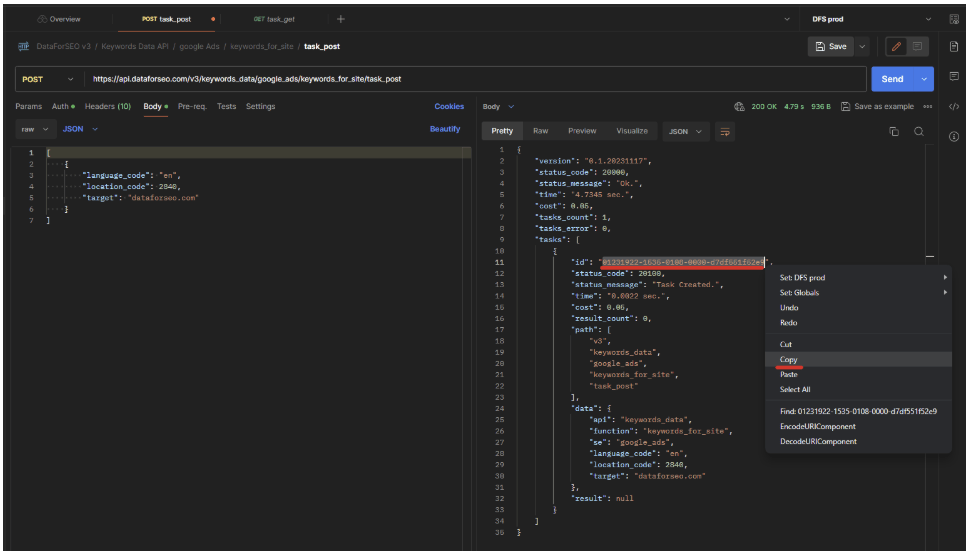
DataForSEO is the most developer-native product on this list. It ships no user interface — it's a pure data layer. Over 6,000 companies, including several major SEO platforms, use DataForSEO as their underlying data source. Many AI SEO platforms treat it as infrastructure rather than a competing tool. Its SERP API covers Google, Bing, Yahoo, Baidu, YouTube, and Amazon across 230+ locations, returning organic results, paid results, featured snippets, People Also Ask data, knowledge panels, and AI Overviews.
The best SEO data API argument for DataForSEO is simple: at scale, it costs 70–97% less than Ahrefs or Semrush at equivalent usage volumes.
Key features:
- SERP API across 6 search engines and 230+ locations
- Keywords Data API with search volume, CPC, competition, and keyword suggestions
- Backlinks API with referring domains, anchors, and trust metrics
- DataForSEO Labs API with a 3+ billion keyword database
- OnPage API checking 60+ on-page parameters per URL
- Merchant API for Amazon and Google Shopping data
- Reviews API for Google review data
- AI Overviews endpoint (separately priced at ~$1.20/1,000 requests)
- MCP server integration for Claude and other AI assistants
- Node.js SDK and REST API with comprehensive documentation
Pricing
Pure pay-as-you-go. Three speed tiers:
- Standard Queue at $0.0006/request (~5-minute turnaround).
- Priority Queue at $0.0012/request.
- Live Mode at $0.002/request.
Minimum deposit of $50 to start production use. No monthly fees. A free Sandbox environment with $1 in credits is available for testing before any payment.
Best For
Developers, SaaS builders, and analytics teams running analytics SEO API pipelines at scale. If your workflow involves automated reporting, custom dashboards, or powering a product on top of SEO data, DataForSEO is the most cost-effective infrastructure layer available.
Pros
- Lowest cost-per-request of any provider on this list at scale
- No fixed monthly fee — pay only for what you consume
- Broadest SERP endpoint coverage including AI Overviews
- MCP server support for direct AI workflow integration
- Used by 6,000+ companies including major SEO platforms as backend data
Cons
- No user interface — requires developer resource to extract value
- Free tier is limited ($1 credit) rather than genuinely exploratory
- AI Overview endpoint pricing is separate and subject to change
- Not a fit for teams who need a managed dashboard alongside API access
Best SEO Data API #4: Serpstat API
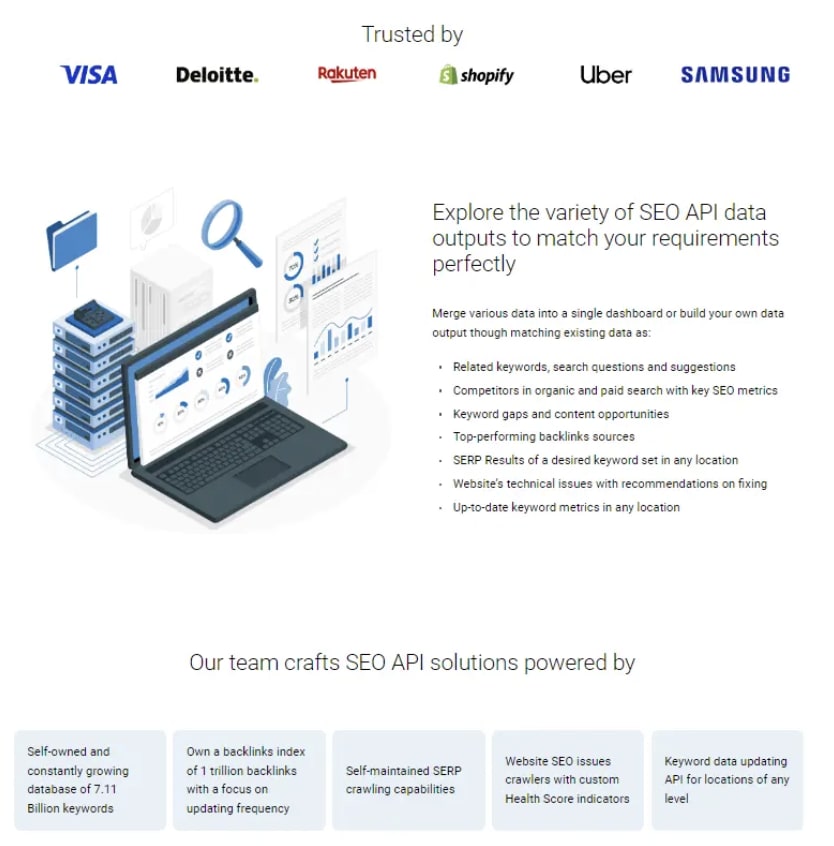
Serpstat is a CIS-region favorite that has expanded globally. Its API covers keyword research, rank tracking, competitor analysis, backlink data, and site auditing. The keyword database holds over 7 billion entries across multiple search engines. Serpstat also offers a SERP Scraper for teams that need raw SERP data on a pay-per-result basis. One genuine differentiator: its Link Graph feature visually maps the link network for any domain, which can be surfaced via API.
Key features:
- Keyword research API with 7+ billion keywords
- Rank tracking across desktop and mobile
- Competitor keyword gap analysis
- Backlink API with referring domains, anchors, and link metrics
- Site audit API with health score indicators
- SERP Scraper API at $0.00065–$0.0013/result page depending on volume
- White-label reporting capability
- Ads API for PPC campaign data
- 7-day free trial with full API capabilities
Pricing
- The Team Plan at $129/month (or $100/month annually) includes full API access.
- The Agency Plan runs $499/month ($410/month annually).
- For high-volume API usage, a separate API contract applies: $180 per million rows at low volumes, down to $100 per million rows at high usage.
- Credits roll over month to month. Minimum contract terms apply for the high-volume plan.
Best For
Agencies balancing SEO and PPC workflows that need a single SEO integration API covering both search and advertising data. Also strong for teams in markets where Serpstat's regional data coverage is superior.
Pros
- Strong at combining SEO and PPC data in a single API
- SERP Scraper credits do not expire — good for irregular workloads
- 7-day free trial with full API capabilities
- Credit rollover reduces waste on lower-usage months
Cons
- Backlink index is smaller than Ahrefs, Majestic, and Semrush
- Less known and fewer connector integrations outside CIS markets
- High-volume API plan requires direct contract negotiation
- Billing can mix plan credits with separate row-based API pricing, which creates some confusion
Best SEO SERP Data API #5: SearchApi
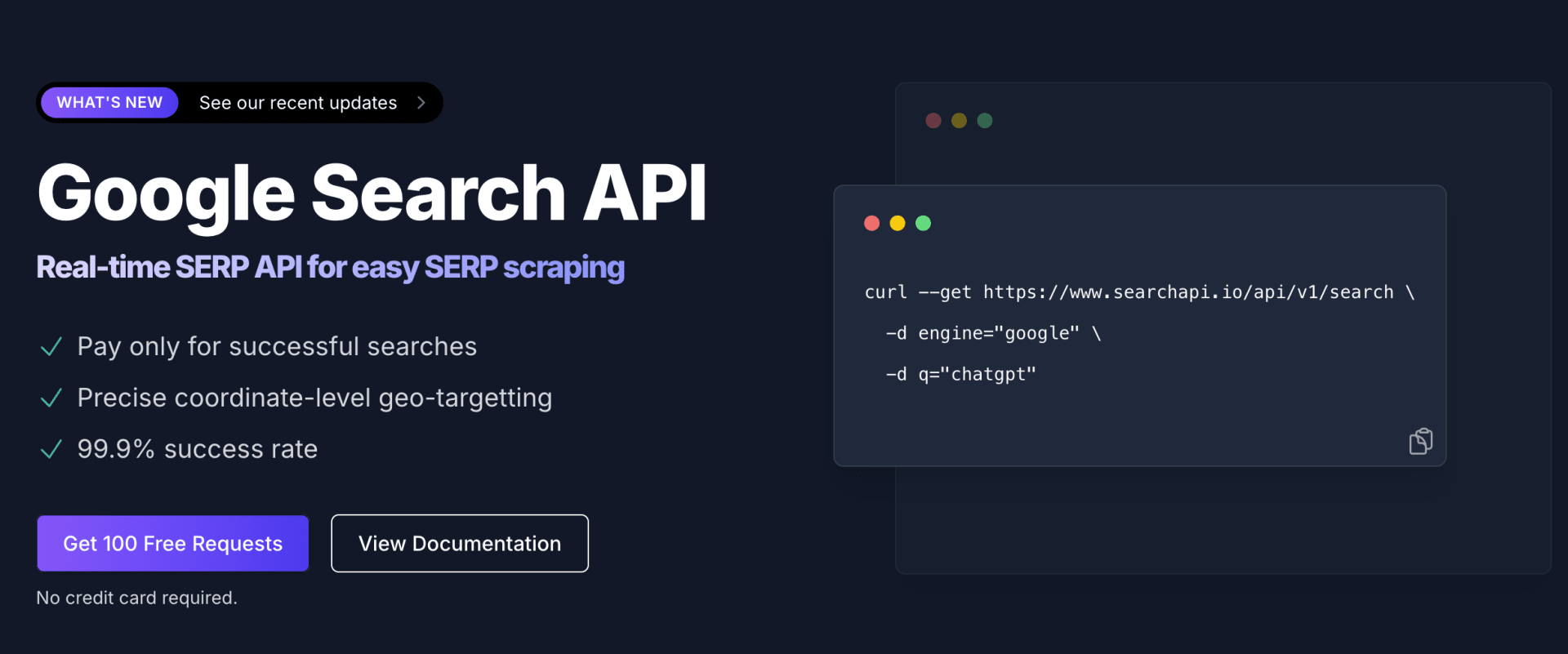
SearchApi is a developer-first SERP API for teams that want structured search results without running their own scraping infrastructure. Instead of shipping a full SEO suite, it does one thing well: send it a query, get back clean JSON of exactly what a real user sees on the results page. It covers 100+ engines, so the same API that pulls Google organic rankings also handles Maps, Shopping, News, Images, Scholar, Bing, YouTube, and more, which makes it a strong fit for rank tracking, AI Overview monitoring, and building your own SEO tooling on top.
Key features
- Dedicated SERP rank tracking end point for monitoring Google rankings.
- Structured JSON output with parsed elements: organic results, ads, featured snippets, People Also Ask, AI Overviews, local packs, and knowledge graph.
- Location, language, and device targeting for true localized rankings down to the city.
- Real-time results in seconds, with no proxy pools or CAPTCHA handling to manage yourself.
- Billed only for successful requests (HTTP 200); failed requests are free.
Pricing
Start with 100 free requests, no credit card required. Paid plans are usage-based and the per-request cost drops as volume grows:
- Developer at $40/month for 10,000 searches ($4 per 1K).
- Production at $100/month for 35,000 searches ($3 per 1K).
- BigData at $250/month for 100,000 searches ($2.50 per 1K).
- Scale at $500/month for 250,000 searches ($2 per 1K).
- High-volume "Octo" tiers run from $900/month (500K searches) up to $5,000/month (5M searches, $1 per 1K).
Best For
Developers and SEO teams that want raw, reliable SERP and GEO data to power their own rank trackers, dashboards, or AI Overview monitoring, rather than paying for a full platform they will only partly use.
Pros
- Broad engine coverage from a single, consistent API.
- Transparent pay-per-success pricing with a genuinely usable free tier.
- Fast, structured JSON that drops straight into existing pipelines.
- No infrastructure to maintain: no proxies, no CAPTCHA solving, no browser fleet.
Cons
- Raw data API, not an all-in-one suite, so you build the reporting and analysis layer yourself.
- No backlink index or keyword-difficulty database like the bigger platforms offer.
- Costs scale with query volume, so heavy rank tracking needs volume planning.
Best SEO Monitor API #6: Moz API
Moz built its reputation on Domain Authority, a metric that became an industry standard before Ahrefs or Semrush defined their own. The Moz API remains the clearest path to DA, Page Authority (PA), and Spam Score data at scale. For teams building link quality dashboards, CRM integrations that flag domain authority, or white-label reporting where DA is the agreed client metric, Moz's API is the most direct solution. It's also the most affordable starting point among the major SEO data API providers.
Key features:
- Domain Authority (DA) and Page Authority (PA) API
- Spam Score endpoint for link quality assessment
- Backlink data including referring domains and link context
- Keyword research API with search volume and difficulty scores
- Rank tracking data
- Site crawl API for technical SEO issue data
- Link Explorer data programmatically accessible
- Standalone API plans available without full Moz Pro subscription
Pricing
Moz Pro plans on annual billing:
- Starter at $39/month.
- Standard at $79/month.
- Medium at $143/month.
- Large at $239/month.
- API access is included from Standard upward.
- Large-scale programmatic extraction requires the Large plan ($299/month monthly) or a separate enterprise API tier negotiated directly with Moz.
- Standalone API Level 1 starts at approximately $49/month for basic DA/PA and link data.
Best For
Developers and agencies where Domain Authority is the primary reporting metric. The Moz API is the best SEO API tool for link quality assessment workflows — no competitor's metric carries the same industry recognition as DA.
Pros
- DA and PA remain the most universally recognized link authority metrics
- Standalone API plans available without forcing a full Moz Pro subscription
- Most affordable entry point among established link data providers
- Clean API design with clear documentation
Cons
- Backlink index is smaller than Ahrefs and Majestic
- High-volume API access requires separate enterprise pricing — not self-serve
- Slower index refresh compared to Ahrefs' crawler
- Feature set is narrower than Semrush or SE Ranking at comparable price points
Best SEO Analysis API #7: Majestic API
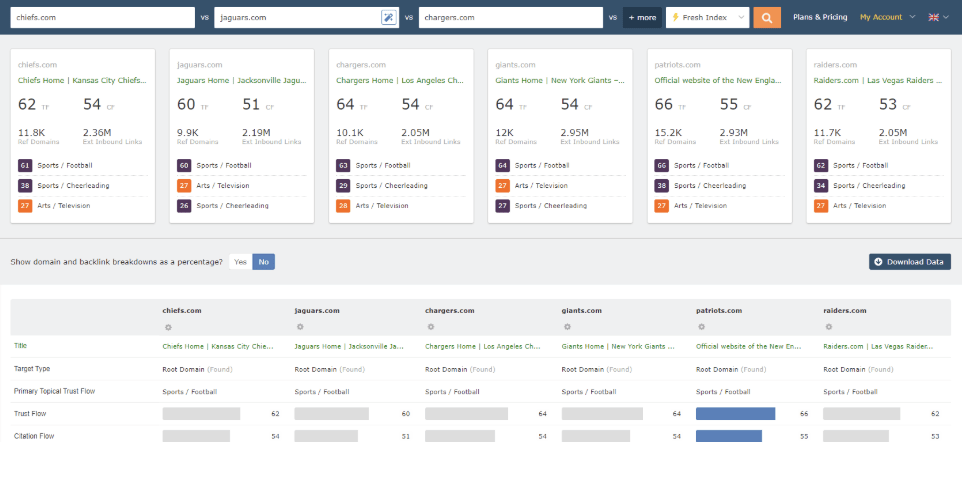
Majestic is a specialist. It does one thing — link intelligence — and does it at a depth no general-purpose SEO platform matches. Its Trust Flow and Citation Flow metrics are genuinely differentiated, measuring link quality through topical trust rather than just quantity. The backlink index spans hundreds of billions of pages with both Fresh Index (recent crawls) and Historic Index (deep archive) available. For teams building domain valuation tools, private blog network monitoring systems, or competitive link gap analysis at scale, Majestic's API is the natural choice.
Key features:
- Trust Flow and Citation Flow via API
- Fresh Index for recent backlink data
- Historic Index for long-term link archive access
- Referring domains, IPs, and anchor text data
- Topical Trust Flow for niche-specific link quality scoring
- Bulk backlink checking for domain acquisition workflows
- OpenApps access for integration with third-party tools
- Domain verification for extended data access
Pricing
- Lite Plan: $49.99/month — basic Fresh Index link checks, no API access.
- Pro Plan: $99.99/month — adds Historic Index, still no full API.
- API Plan: $399.99/month (or $333.33/month annually) with full API access and 100 million analysis units.
- Enterprise-scale plans go up to 1 billion units for large developers.
- No free tier, but a free account provides limited data for manual checks.
Best For
Teams focused exclusively on backlink analysis, domain authority research, or building specialized link intelligence tools. Majestic is the top SEO API for pure link data — nothing else in this list offers Trust Flow at this depth.
Pros
- Trust Flow and Citation Flow are differentiated metrics not replicated elsewhere
- Largest dedicated link intelligence index with Historic archive
- Topical Trust Flow adds qualitative link context
- API plan includes 100M units — generous for most professional use cases
Cons
- API access requires the $399.99/month plan — no mid-tier API option
- No keyword research, rank tracking, or site audit capabilities
- Less useful outside of link-focused workflows
- Smaller developer ecosystem than Semrush or DataForSEO
Best SEO Software API #8: Ahrefs API
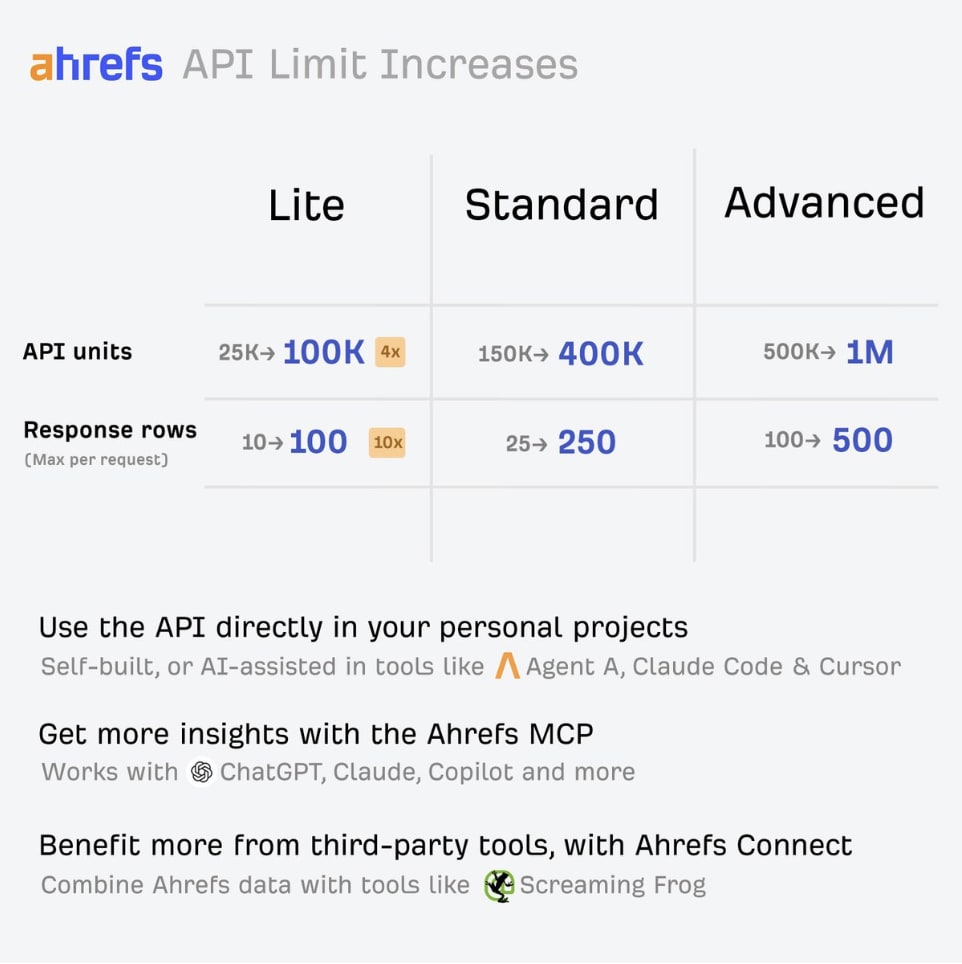
Ahrefs has the best backlink crawler in the industry by most independent assessments — faster, deeper, and more frequently updated than most competitors. Its keyword database and click-through rate data are also strong differentiators. The Ahrefs API (Version 3) provides access to data from Site Explorer, Keywords Explorer, Site Auditor, SERP Overview, and Rank Tracker.
The honest catch: full API access is locked to Enterprise, which starts at $1,249/month. Advanced plan users ($449/month) get partial API access with 500,000 monthly units; Enterprise includes 2,000,000 units.
Key features:
- Site Explorer API: backlinks, referring domains, organic keywords, top pages
- Keywords Explorer API: keyword difficulty, search volume, click data
- Site Audit API: technical SEO issues and health scores
- SERP Overview data programmatically
- Rank Tracker API: keyword position data
- Usage-based billing per row of data returned (above plan unit limits)
- REST API with strong documentation
- Add-on API units available at ~$0.0009/unit in bulk
Pricing
- Advanced plan: $449/month (or $399/month annually) with partial API access and 500,000 monthly API units.
- Enterprise: starts at $1,249/month (or $14,990/year) with full API access and 2,000,000 units.
- A separate API Plus subscription runs $500–$10,000/month depending on data volume.
- No free trial; no refunds on annual plans.
Best For
Enterprise SEO teams and large agencies where backlink data accuracy is non-negotiable. Ahrefs is the best API for SEO software teams building products where link data quality directly impacts client results.
Pros
- Best backlink index quality and crawl frequency of any provider
- Click-through rate data is a unique keyword research differentiator
- Wide endpoint coverage across the full Ahrefs toolset
- Strong REST API with well-maintained documentation
Cons
- Full API access requires Enterprise plan at $1,499+/month
- No free trial — significant financial commitment before testing at scale
- Unit consumption can be difficult to predict without careful pre-planning
- Expensive for teams that only need keyword or audit data, not backlinks
Best SEO Analytics API #9: SEOptimer API
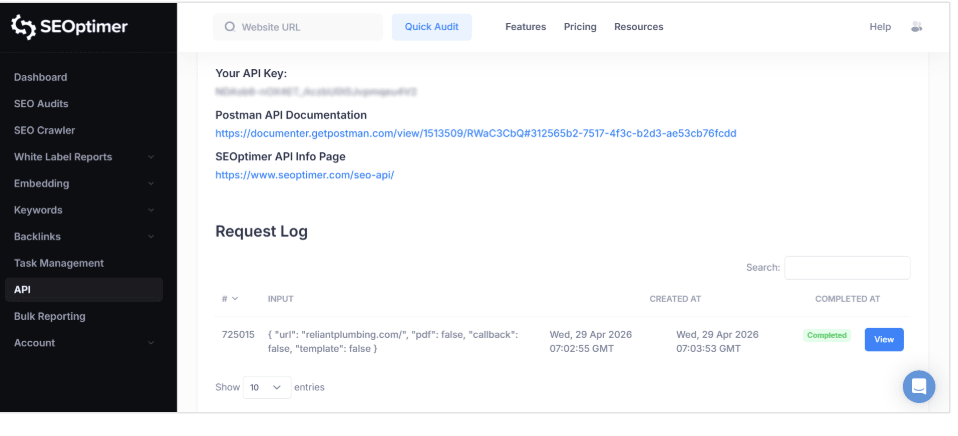
SEOptimer is a focused audit and reporting tool rather than a full SEO suite. Its API surfaces the same data that powers its 30-second website audits: over 100 on-page and technical checks, backlink research, keyword tracking, and site crawl data. The platform is popular with agencies that need a white-label reporting API and embeddable audit widgets for lead generation. For teams that need a SEO tool API specifically for client-facing audit automation, SEOptimer punches above its price point.
Key features:
- Site audit API with 100+ on-page and technical data points
- Keyword research and tracking endpoints
- Backlink research and monitoring
- Site crawler API for full-domain technical checks
- White-label report generation
- Embeddable audit widget for lead generation
- Automated audit scheduling via API
- Over 60 supplementary free SEO tools
Pricing
- DIY SEO plan: $29/month.
- White Label plan: $39/month — adds branded PDF reports and multi-site crawling.
- White Label & Embedding plan: $59/month — includes embeddable audit widget. API access is included with paid plans.
- A 14-day free trial is available; a free version exists with limited functionality.
Best For
Digital agencies and web designers that need SEO API tools for client audit automation, white-label reporting, and lead generation widgets — at a price point significantly below enterprise alternatives.
Pros
- Most affordable entry point on this list with API access ($29/month)
- Purpose-built for agency audit workflows and white-label reporting
- 14-day free trial with no complex onboarding
- 100+ technical data points per audit is genuinely comprehensive for the price
Cons
- Not an all-in-one SEO data platform — limited keyword and backlink depth compared to Ahrefs or Semrush
- Backlink data relies on third-party index rather than proprietary crawl
- Rate limits are more restrictive than developer-first APIs like DataForSEO
- Less suited for high-volume programmatic data pipelines
Best SEO Analyzer API #10: Morningscore API
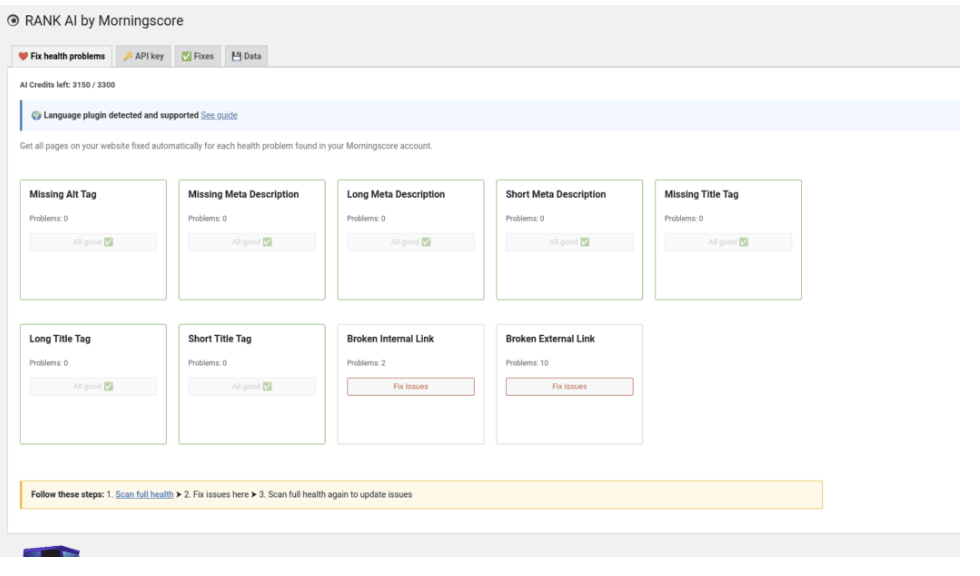
Morningscore is a Danish all-in-one SEO platform that made waves in early 2026 when it included API access on every paid plan rather than reserving it for higher tiers. The platform uses a gamified interface that makes SEO approachable for non-specialists, while its API gives developers access to keyword rankings, backlink data (sourced from Moz), technical health checks, and AI visibility metrics. Its onsite API flags issues including missing image alt tags, slow page speed, long title tags, and large images. Morningscore partnered with Oxylabs for SERP data, which gives it fast and reliable keyword rank data. The roadmap for 2026–2027 focuses on deeper AI automation through the API.
Key features:
- Keyword rank tracking API with daily updates
- Backlink data API (Moz-sourced) with top linking domains
- Onsite health API: 100+ technical checks including page speed, alt tags, titles
- AI visibility (GEO Score) metrics via API
- Organic traffic value measurement in dollar terms
- API rate limit: 2 requests per second
- Make.com integration for no-code automation workflows
- WordPress plugin built on top of the API for automatic health fixes
Pricing
- All plans include API access.
- Growth plan: $69/month.
- Plans scale upward based on tracked websites, keyword limits, health crawl capacity, and AI credits.
- A free trial is available.
- The API is accessible from the lowest paid tier — no separate API add-on required.
Best For
Small teams, solo founders, in-house marketers, and agencies looking for the most affordable SEO stats API that covers keywords, backlinks, and technical health in a single subscription. Also strong for no-code automation via Make.com.
Pros
- API included on every plan from $69/month — no gatekeeping
- All-in-one data coverage: keywords, links, health, AI visibility
- GEO Score (AI visibility index) is rare at this price point
- Fast keyword data delivery via Oxylabs partnership
- Genuinely beginner-friendly alongside developer access
Cons
- Backlink data is Moz-sourced rather than proprietary — smaller index
- 2 requests/second rate limit is restrictive for high-volume pipelines
- Keyword database is smaller than Semrush or Ahrefs
- Less suitable for teams needing raw SERP data or complex multi-engine coverage
FAQ
What's the difference between a SEO optimization API and a SERP scraping API?
A SEO optimization API typically bundles multiple data types (keyword rankings, backlink metrics, site health scores, and competitor data) into a single platform with structured endpoints. A SERP scraping API specifically retrieves raw search engine result pages in near-real time, returning what a search engine actually shows for a given query. DataForSEO and SerpApi are examples of the latter. SE Ranking, Morningscore, and Semrush are examples of the former. Many technical teams use both: a SERP API for fresh result data and an optimization platform API for aggregated metrics and reporting. For SEO API integration into dashboards, a platform API is usually the right starting point. For content intelligence or rank-monitoring pipelines, a SERP API often gives you more control.
Which SEO tools API is best if I'm building a SaaS product on top of SEO data?
SE Ranking is the standard infrastructure choice for SaaS products built on API SEO tools. Its pay-as-you-go model means your costs scale linearly with usage rather than forcing you into a fixed plan before you know your volume. The $50 minimum deposit keeps the barrier low for MVPs, and the data breadth (SERP results, keywords, backlinks, on-page, etc.) covers most product use cases from a single vendor. That said, if your product specifically surfaces Domain Authority as a key metric, layer in the Moz API for that data. If your users care primarily about backlink profiles, Majestic's API gives you Trust Flow data no other provider replicates. The best API SEO tools stack for a SaaS product is often two providers: SE Ranking for SERP and keyword data, plus one specialist for authority metrics.
How do I choose between fixed-subscription SEO APIs and pay-as-you-go models?
The decision comes down to usage predictability. Fixed plans from providers like SE Ranking ($149/month API add-on), Semrush (Business tier required), or Morningscore ($69/month) make sense when your monthly query volume is stable and predictable. This is typically best for agency reporting pipelines, scheduled rank tracking, or recurring audit workflows. Pay-as-you-go from SE Ranking makes sense when your volume fluctuates significantly month to month, when you're building or testing a new product, or when your peak usage would make a fixed plan prohibitively expensive. Honestly, teams processing fewer than 50,000 SERP requests per month often find fixed plans cheaper and simpler to budget. Teams above 500,000 monthly requests almost always save money on pay-as-you-go. Run the numbers against your actual expected volume before committing.
Conclusion
The right choice from these best SEO API providers depends entirely on what you're building and at what scale:
- SE Ranking offers the best all-around agency package.
- DataForSEO wins on raw cost efficiency for developers and SaaS teams.
- Ahrefs and Majestic lead on backlink data quality.
- SearchApi is best for developers and SEO teams that want raw, reliable SERP and GEO data.
- Moz is still the cleanest path to DA metrics.
- Morningscore and SEOptimer serve smaller teams that need API access without enterprise pricing.
Match your choice to your actual data needs first, your budget second, and your infrastructure second — in that order. An API for SEO software that returns bad data at low cost is worse than an expensive one that gets it right.
Comments
Loading comments…