How Modern Social Gaming Platforms Scale Real-Time RNG for Millions of Users
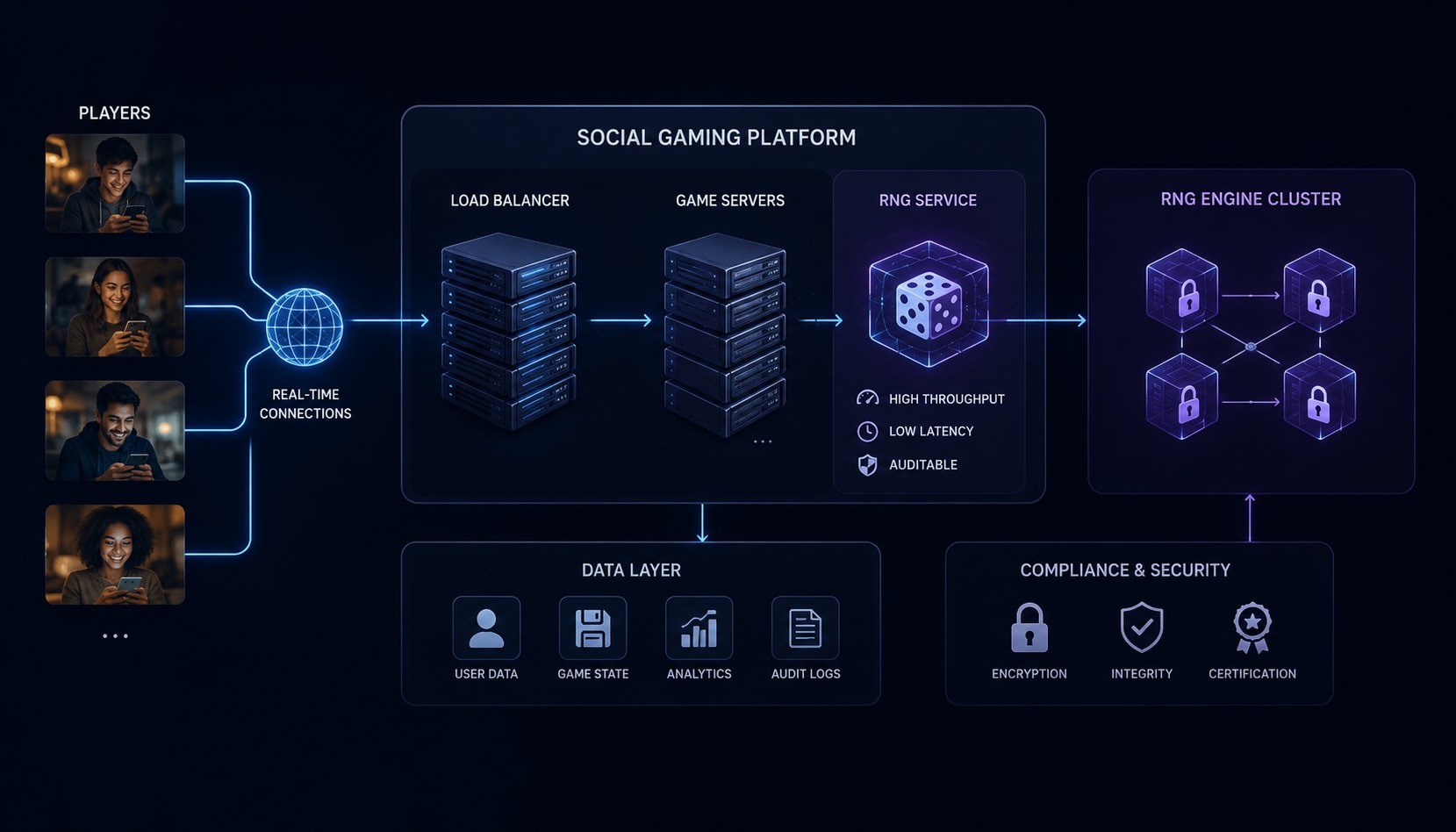
Millions of players press digital spin buttons simultaneously across web browsers without a second of lag. Behind those glowing symbols sits a relentless sequence of cryptographic calculations. Generating unpredictable outcomes at massive concurrent scale requires an infrastructure that quietly turns chaos into pure mathematics.
The Engine Behind Millions of Concurrent Clicks
A single game server handles thousands of requests every second during peak evening hours. Engineers once relied on basic pseudo-random algorithms running directly inside game applications. Modern setups shift this heavy computation onto isolated remote servers to prevent catastrophic bottlenecks.
When traffic spikes hit social gaming sites, raw compute power determines whether a spin feels instant or frozen. During high-traffic promotional events, engineering teams at Fortune Coins Casino process thousands of instant sweepstakes spins without slowing down the primary user interface. They accomplish this by decoupling random outcome generation from front-end rendering engines. That separation keeps system response times well below 50 milliseconds.
Does every player action require fresh hardware entropy? Relying purely on physical thermal sensors creates massive backlogs under heavy concurrent loads. Systems instead use hardware devices to constantly seed fast pseudo-random generators. Perfect randomness meets operational speed.
Engineers structure these server environments around specific technical layers to keep throughput steady.
- Hardware entropy gatherers sample thermal noise to produce foundational seeds.
- Distributing state values across regions requires dedicated high-speed memory caches.
- Game results become verifiable once cryptographic hash functions process the raw numeric output.
How Algorithms Beat Bottlenecks at High Speed
Back in 2018, standard web servers often choked when handling ten thousand parallel WebSocket connections. Today, modern server clusters routinely manage over two million concurrent sessions during peak weekend tournaments, or 2.4 million depending on which cloud telemetry report you trust. That difference represents a massive leap in backend optimization.
Why do classic algorithms fall short in high-concurrency environments? Traditional Mersenne Twister generators require heavy internal state management that locks CPU threads. Modern game developers choose lightweight algorithms like Xorshift or PCG instead. Fast generation keeps latency low.
Database locks destroy performance faster than hardware limits ever could. Smart backends avoid writing raw random numbers directly to traditional databases during active sessions. They log outcomes in memory streaming buffers first. Critical move.
Server architectures implement precise strategies to handle these massive data streams without crashing.
- Distributed queue systems store incoming execution requests prior to batch processing.
- Running isolated generator instances inside micro-containers maximizes hardware threading.
- After round completions, compressed result batches reach audit logs asynchronously.
Verifying Outcome Fairness Without Sacrificing Latency
Think about the last time you tapped a digital button and waited for a spinning wheel to stop. You expect a fair outcome, but you also refuse to wait two seconds for validation. Balancing cryptographic proof with instant visual feedback requires clever network architecture.
Cryptographic commitments solve this tension by splitting validation into two fast steps. The server hashes a random outcome before a round even begins and sends that hash to your browser. You get immediate visual results without waiting for full database validation. Hard to argue with zero latency.
Independent testing labs routinely audit these generation systems by sampling millions of consecutive outcomes. An algorithm that strays by even 0.01 percent from uniform distribution gets flagged instantly by automated statistical suites. Precision remains non-negotiable.
Auditing bodies require game operations to maintain strict technical standards across three core areas.
- Historical seed records must remain tamper-proof inside write-once storage layers.
- Continuous Chi-square tests evaluate live system streams through statistical validation suites.
- Players can independently verify individual round hashes using cryptographic keys provided to client applications.
Ultimately, the modern digital spin is a masterclass in invisible engineering. By decoupling heavy cryptographic generation from frontend rendering and adopting lightweight algorithms, gaming platforms achieve the seemingly impossible. They deliver mathematically sound, provably fair outcomes in a fraction of a second, even under massive loads. To the player, it remains a simple, seamless click, but behind the screen, it is a perfectly orchestrated symphony of hardware entropy and distributed computing.
Comments
Loading comments…