Learn how to play Vortex game, including Fire, Earth and Water mechanics, multipliers, Cash Out, Part PayOut, RTP and provably fair rules.
How to Play Vortex Game: Rules, Multipliers and Cash Out Explained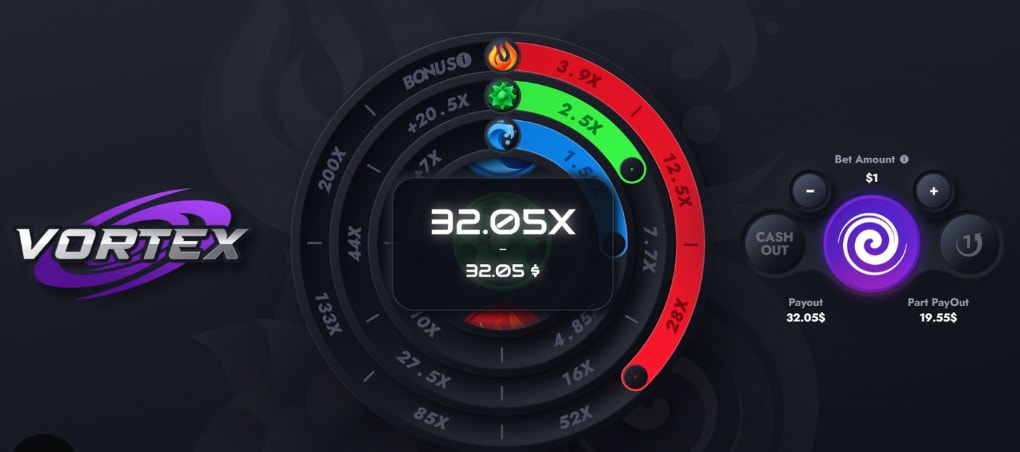
Vortex is an instant game by Turbo Games built around rotating multiplier rings, elemental progression and player-controlled cash-out decisions. Instead of spinning traditional slot reels or watching a single multiplier rise like in a standard crash game, players progress through Fire, Earth and Water circles while deciding whether to continue the round or collect available value.
Learning how to play Vortex game starts with understanding this basic risk-and-reward loop. You place a stake, start the round, build elemental progress and watch the available multipliers. At certain points you can use Cash Out to take the full available value or Part PayOut to collect only part of it while keeping the rest of the round active.
Turbo Games currently lists the original Vortex with a 96% RTP and a maximum multiplier of up to 700×. The developer also describes the game as provably fair, meaning every result is committed cryptographically before the round and can be verified afterwards.
What Is the Vortex Game?
Vortex is a single-player instant game created by Turbo Games and released in November 2023. The developer classifies it as part of its crash-game family, although its interface is very different from the familiar rising-line format.
The game is built around concentric rings and three major elemental progress systems:
- Fire
- Earth
- Water
As the round develops, these elemental circles can fill. Greater progress can produce larger available multipliers.
The player is not choosing which element appears next. Those outcomes are determined by the game. The player's main decision is whether to keep the round active in pursuit of further progress or take some or all of the available value.
That makes Vortex partly interactive without making the underlying outcomes predictable.
Turbo Games also provides a free browser demo, so the mechanics can be learned without depositing real money.
How to Play Vortex Game Step by Step
Vortex looks unusual at first, but the basic process is relatively simple once the elemental progression system is understood.
Choose Your Stake
Before starting the round, choose how much you want to risk.
Turbo Games notes that bets can only be changed while the playfield is clear. Once a round is active, you cannot simply alter the stake halfway through that sequence.
Your chosen amount forms the base for any multiplier applied during the round.
For example, if a completed result pays 5× and the original stake was 1 unit, the payout is calculated relative to that 1-unit stake.
Start the Spin
Vortex uses Turbo Games' hold-to-spin mechanic.
The official description explains that players charge the spin, release it and land on a multiplier ring. The resulting segment then determines how the round develops.
The visual timing makes the game feel interactive, but it is important to understand that the underlying result is already fixed through the provably-fair system.
Releasing at what looks like the "perfect" visual moment does not provide a hidden method for forcing a particular outcome.
Watch the Elemental Circles
Fire, Earth and Water each have their own progression circle.
As relevant results appear, these circles fill.
Turbo Games describes the general principle simply: fuller circles correspond with larger multipliers.
Your objective during the round is therefore to build useful elemental progress while deciding how much risk you want to keep active.
Decide Whether to Continue or Cash Out
This is the main decision in Vortex.
If you are satisfied with the available value, you can Cash Out.
If you want to keep pursuing higher multipliers, you can continue the round.
There is also a middle option called Part PayOut, which lets you collect part of the current value while leaving the remainder active.
How the Fire, Earth and Water Elements Work
The elemental circles form the core of Vortex.
Each of the three main elements has a separate progression path.
When a relevant element is selected by the game, its corresponding circle can advance. As it becomes fuller, the multiplier associated with that track can become more valuable.
This means Vortex is not based on a single rising multiplier.
Instead, several potential progression routes are developing at the same time.
The elements are therefore better understood as three separate tracks within one round.
Fire is particularly important because completing or activating the Fire mechanic can open access to a special group of high-value multipliers.
Earth and Water also contribute to the core progression system, but Turbo Games does not publicly publish a complete fixed multiplier ladder for every stage of these two elements on its current Vortex information page. For that reason, the current in-game display should be treated as the authoritative source for the exact values visible during play.
How Vortex Multipliers Work
Multipliers determine how much an eligible result is worth compared with the original stake.
If the game displays 3×, the corresponding value is calculated as three times the relevant base stake or active amount.
If the multiplier reaches 20×, the same principle applies.
Turbo Games currently lists the original Vortex with a maximum multiplier of up to 700×.
That does not mean players regularly reach 700×.
The maximum multiplier represents the highest potential value supported by the game rules, not an average or expected result.
The elemental circles are important because greater progress can unlock larger multipliers.
A player therefore has to decide whether the potential benefit of continuing is worth leaving the current position exposed.
This is the basic tension behind Vortex.
How Cash Out Works
Cash Out ends the active round and collects the full available value.
Imagine that your current Vortex position has reached a payout you consider sufficient.
Pressing Cash Out locks in that eligible amount and stops the round.
You no longer have the opportunity to continue building the elemental circles, but the collected amount is no longer exposed to whatever could happen later in the sequence.
Turbo Games describes full Cash Out as one of the two main ways to exit a Vortex position.
This is similar to the decision found in many crash games: collect what is available now or continue for the possibility of more.
The difference is that Vortex spreads this decision across elemental progression rather than a single continuously rising multiplier.
What Is Part PayOut?
Part PayOut gives Vortex another layer of control.
Instead of collecting everything and closing the round, you can take part of the available value while leaving the rest active.
Turbo Games describes it as taking some of the win while continuing to play with the remainder.
Consider a simplified example.
Suppose the round has built a useful position but you do not want the entire amount exposed.
A full Cash Out would end the round.
Part PayOut allows you to secure a portion and continue with the rest.
This can reduce the amount remaining at risk, although it does not make future outcomes safer or more predictable.
The next elemental result is still determined by the game's random and provably-fair system.
How the Fire Bonus Works
Fire is the most notable element in Vortex because it can open access to much larger bonus multipliers.
Turbo Games states that the Fire element can unlock values including:
100×, 200×, 300×, 400× and 500×.
These are bonus possibilities rather than guaranteed outcomes.
Reaching the Fire feature does not automatically award 500×.
The available result still depends on the game's underlying mechanics.
The Fire bonus therefore creates an incentive to continue building the relevant elemental circle, but it also illustrates the central risk of the game: stopping earlier secures what you already have, while continuing preserves the possibility of a larger result.
Automatic Bonus Cash Out
Vortex can also trigger Cash Out automatically.
According to the current official rules, filling the final section of an elemental track causes a bonus Cash Out to activate on its own.
This means the player does not always have to manually press Cash Out to finish an elemental progression.
Completing the track can resolve that part of the round automatically according to the game rules.
Understanding this mechanic is useful because it prevents a common misunderstanding: filling an elemental circle is not simply visual progress waiting indefinitely for the player to act.
Completing the final section has a specific game consequence.
Vortex RTP and Maximum Multiplier
The original Vortex currently has a published RTP of 96%.
RTP means Return to Player.
It is a theoretical percentage calculated across a very large number of game rounds.
A 96% RTP does not mean a player who wagers 100 units will receive exactly 96 units during one session.
Short-term results can vary significantly.
One player could finish far above the theoretical percentage, while another could lose much more during a relatively small sample of rounds.
The house advantage remains built into the game's long-term mathematics.
Turbo Games also lists the maximum multiplier as 700×.
Again, this is a maximum possible result, not a typical payout.
What Provably Fair Means in Vortex
Vortex uses a provably-fair system.
Turbo Games explains that a round's outcome is committed before play using a cryptographic hash.
After the round, the underlying seed is revealed so the result can be independently checked.
The simplified process is:
- The game creates the result information.
- A cryptographic commitment is published before the round.
- You play the round.
- The seed is revealed afterwards.
- The previous commitment and revealed data can be compared.
This prevents the operator from changing the predetermined result after the round has started.
Provably fair does not mean predictable.
The cryptographic commitment deliberately prevents players from seeing the actual result beforehand.
For that reason, Vortex predictor apps, signal bots or supposed hacks cannot reliably tell you what the next result will be.
Turbo Games itself warns that tools claiming to predict future Vortex results should not be trusted.
Vortex Demo vs Real-Money Play
Turbo Games offers the full Vortex demo in a browser using virtual credits.
No deposit, account registration or APK installation is required.
The demo is useful for learning:
- where the elemental circles appear;
- how the hold-to-spin system works;
- when Cash Out becomes available;
- how Part PayOut behaves;
- what happens when an elemental track fills;
- how the Fire mechanic appears.
Real-money Vortex is offered through licensed casino operators that carry Turbo Games.
Turbo Games itself is the developer, not a casino, and does not accept deposits or process player withdrawals.
Demo results should not be treated as a prediction of future real-money results.
How to Choose a Bet Size
Bet size should be based on the amount allocated to the session rather than on recent wins or losses.
Suppose you start with 100 units.
At 1 unit per round, the original stake represents 1% of the starting balance.
At 5 units per round, each starting wager represents 5%.
The higher stake exposes the balance more quickly.
Reducing the stake does not improve the RTP or cause better elemental results. It simply changes how much money is attached to each outcome.
A practical approach is to decide on the maximum session budget and stake size before starting.
Avoid increasing the wager simply because the previous rounds lost.
The next result is not more likely to be favorable because of earlier losses.
Is There a Vortex Strategy?
There are decisions in Vortex, but there is no strategy that can predict the next element.
The meaningful decisions concern risk management.
You can:
- Cash Out earlier;
- continue in pursuit of more elemental progress;
- use Part PayOut;
- choose a smaller or larger stake;
- decide when to stop playing.
What you cannot control is the next random outcome.
Some players may prefer collecting smaller values earlier.
Others may accept more risk and continue toward fuller circles or the Fire feature.
Neither approach changes the underlying random mathematics.
Past results are also not a reliable guide.
Several Earth results do not make Water or Fire "due."
A recent high multiplier does not prevent another one from appearing, and a long period without a bonus does not guarantee one will occur soon.
Common Mistakes When Playing Vortex
One of the most common mistakes is treating Vortex exactly like a standard crash game.
Both involve cash-out decisions, but Vortex uses several elemental progression tracks instead of one rising curve.
Another mistake is assuming the visible timing of the hold-and-release mechanic allows the next result to be controlled.
Because the outcome is cryptographically committed before the round, visual timing should not be treated as a method for forcing a specific multiplier.
Players can also misunderstand Part PayOut.
It secures part of the current position, but whatever remains active is still exposed to future game results.
Another error is focusing on the 700× maximum multiplier as though it were an ordinary outcome.
Maximum values describe what is possible, not what is likely.
Finally, avoid systems based on doubling wagers after losses. A staking progression changes how much money you risk; it does not improve the game's random outcomes.
How to Play Vortex on Mobile
Vortex supports both desktop and mobile devices.
The official Turbo Games demo works directly in modern browsers, including phones, with no APK required.
On mobile, the gameplay process remains the same:
- Select the stake.
- Start the Vortex round.
- Follow Fire, Earth and Water progress.
- Watch the multiplier values.
- Decide whether to continue.
- Use Cash Out or Part PayOut when appropriate.
Because several elemental tracks can be active at the same time, it can be helpful to become familiar with the interface in demo mode before using real money.
Vortex vs Traditional Crash Games
Traditional crash games normally use one multiplier.
It starts low and rises continuously until the round crashes.
The player's main decision is when to cash out.
Vortex keeps the same broad risk-versus-reward concept but presents it differently.
Instead of one rising curve, Vortex uses elemental circles and rotating multiplier rings.
Fire, Earth and Water can progress independently.
There is also Part PayOut, meaning players do not always have to choose between keeping the entire position active and ending everything at once.
So Vortex can reasonably be described as a crash-style instant game, but it is not simply another version of the standard aircraft-or-graph format.
Frequently Asked Questions About Vortex
How do you play Vortex?
Choose a stake, start the spin and follow the Fire, Earth and Water progression circles. As multipliers become available, decide whether to continue, use Cash Out to collect everything, or use Part PayOut to collect part while keeping the rest active.
What is the Vortex RTP?
Turbo Games currently lists the original Vortex RTP at 96%.
What is the maximum multiplier in Vortex?
The official maximum multiplier is currently listed as 700×.
What does Part PayOut do?
Part PayOut lets you collect some of the current value without completely ending the round. The remainder stays active.
What happens when an elemental circle is completed?
Turbo Games states that filling the final section of an element triggers a bonus Cash Out automatically.
What multipliers can the Fire feature produce?
The official Vortex page lists Fire bonus multipliers of 100×, 200×, 300×, 400× and 500×.
Can Vortex be played for free?
Yes. Turbo Games provides a free browser demo using virtual credits without requiring a deposit or download.
Can you predict Vortex results?
No. Vortex uses a provably-fair system in which the result is cryptographically committed before play and revealed for verification afterwards. This allows completed rounds to be checked but does not expose future outcomes.
Conclusion
Learning how to play Vortex game is mainly about understanding its elemental progression and cash-out system.
You start with a stake, spin the Vortex and build Fire, Earth and Water circles. As progress increases, larger multiplier opportunities can become available.
At any suitable point, Cash Out can collect the full available value and end the round. Part PayOut provides a middle option by securing only part of the position while leaving the remainder active.
Fire is especially important because it can unlock bonus multipliers from 100× to 500×, while the game's overall maximum multiplier is currently listed at up to 700×. Turbo Games publishes a 96% RTP for the original Vortex.
The game is also provably fair. Each result is committed before the round through cryptographic data and can be checked afterwards.
What this system does not provide is a way to predict the future.
No release timing, previous elemental sequence, betting progression or predictor can reliably determine what comes next. The meaningful choices are therefore how much to stake, when to collect available value and when to stop.
For a first-time player, the official free demo is the simplest way to learn how Fire, Earth, Water, Cash Out and Part PayOut interact before deciding whether to use the game in a real-money environment.
Comments
Loading comments…