Practical strategies for reducing technical debt while shipping features – prioritization, incremental refactoring, and capacity planning.
How to Reduce Technical Debt Without Blocking Feature Releases
Technical debt is that quiet budget leak nobody puts on a slide deck. Outdated libraries, copy-pasted logic, services with zero documentation – teams live with all of it until a feature that should take two weeks somehow swallows six, because someone has to reverse-engineer choices a developer who left three jobs ago made on a Friday afternoon.
Here’s a scenario that probably sounds familiar: your team is ready to ship a reporting dashboard. The front-end? Two sprints, clean. Then you plug it into a permissions system that predates your Slack workspace, and suddenly a month evaporates.Integration tests fail on undocumented dependencies. The release slips. Customers see delays; your team sees burnout.
The problem isn't that technical debt exists – it always will. The problem is that most teams treat it as either "ignore it" or "stop everything and rewrite." Neither works. A practical, incremental approach keeps your releases on track.
Start With Debt That Actually Slows You Down
A messy utility file nobody opens twice a year? Harmless. An authentication module that detonates on every deployment like clockwork? That’s the one eating your roadmap alive.
Not all debt deserves a ticket. Hunt the pieces that make developers groan mid-standup:
- Review recent feature work. Compare initial estimates with actual delivery times. Ask developers where the unexpected effort appeared.
- Track recurring friction. If every billing change requires edits across four services, that's a pattern worth documenting.
- Create a shared debt register. For each item, note the affected component, the engineering effort needed, the business risk, and which upcoming features will hit this problem.
| Priority Level | Criteria | Action |
|---|---|---|
| High | Blocks multiple upcoming features; causes recurring incidents | Address in the next sprint cycle |
| Medium | Slows delivery but has workarounds | Bundle with related feature work |
| Low | Cosmetic or isolated; no upcoming dependencies | Monitor, defer, or ignore |
Turn “our code is a mess” into a spreadsheet that product managers can’t ignore: specific delivery risks, affected components, estimated effort. Vague complaints get deprioritized. Numbers get a budget.
When modernization outgrows what your team can chew through between feature sprints, bringing in a dedicated development team for scoped refactoring or migration work is one way to keep the product roadmap from becoming a hostage. The catch: both groups need shared standards, shared docs, and zero ambiguity about who owns what.
Gartner’s PAID model puts some structure around these calls – plan it, address it, ignore it, or delay it – scored by risk probability and business impact. Useful for teams tired of prioritizing debt by gut feeling and whoever argues loudest in retro.
Embed Debt Reduction Into Feature Work
Separate cleanup backlogs are where refactoring tickets go to die quietly. Everyone knows it. Nobody says it in sprint planning. The list grows, morale shrinks, and the codebase rots on schedule.
The fix is almost embarrassingly simple: repair debt while you’re already elbow-deep in that code for a feature. Not a full rewrite – nobody’s asking you to renovate the kitchen while fixing a leaky faucet. It means scoping small, relevant improvements into your feature work. Here's what that looks like in practice:
- Bake technical improvements into estimates. If the new payment method requires restructuring duplicated validation logic, that effort goes into the estimate, not as a surprise after the sprint starts.
- Apply the Boy Scout Rule selectively. Leave code better than you found it, but only when changes are low-risk and relevant to the current task.
- Define "done" properly. Include tests, updated documentation, and removal of temporary scaffolding in your completion criteria.
- Log intentional shortcuts. When the team takes a shortcut to meet a deadline, record why, what the risk is, and what would trigger remediation later.
A real example: B2B billing service with three separate discount engines: one per product launch, each blissfully unaware of the others. The team needs subscription upgrades. Adding a fourth implementation? Recipe for invoices that disagree with each other. Consolidating first costs a week. Skipping it costs trust.
Set boundaries early. Opportunistic improvement: yes. Refactoring safari that hijacks the sprint: absolutely not.
Modernize Architecture Incrementally
Some debt laughs at small fixes. Monoliths with everything welded together, dependencies that move in herds, data models designed before your framework existed, these need surgery, not band-aids.
Full rewrites sound heroic until you remember customers expect the product to keep working on Thursday. Incremental modernization is less glamorous and far less likely to end in a postmortem.
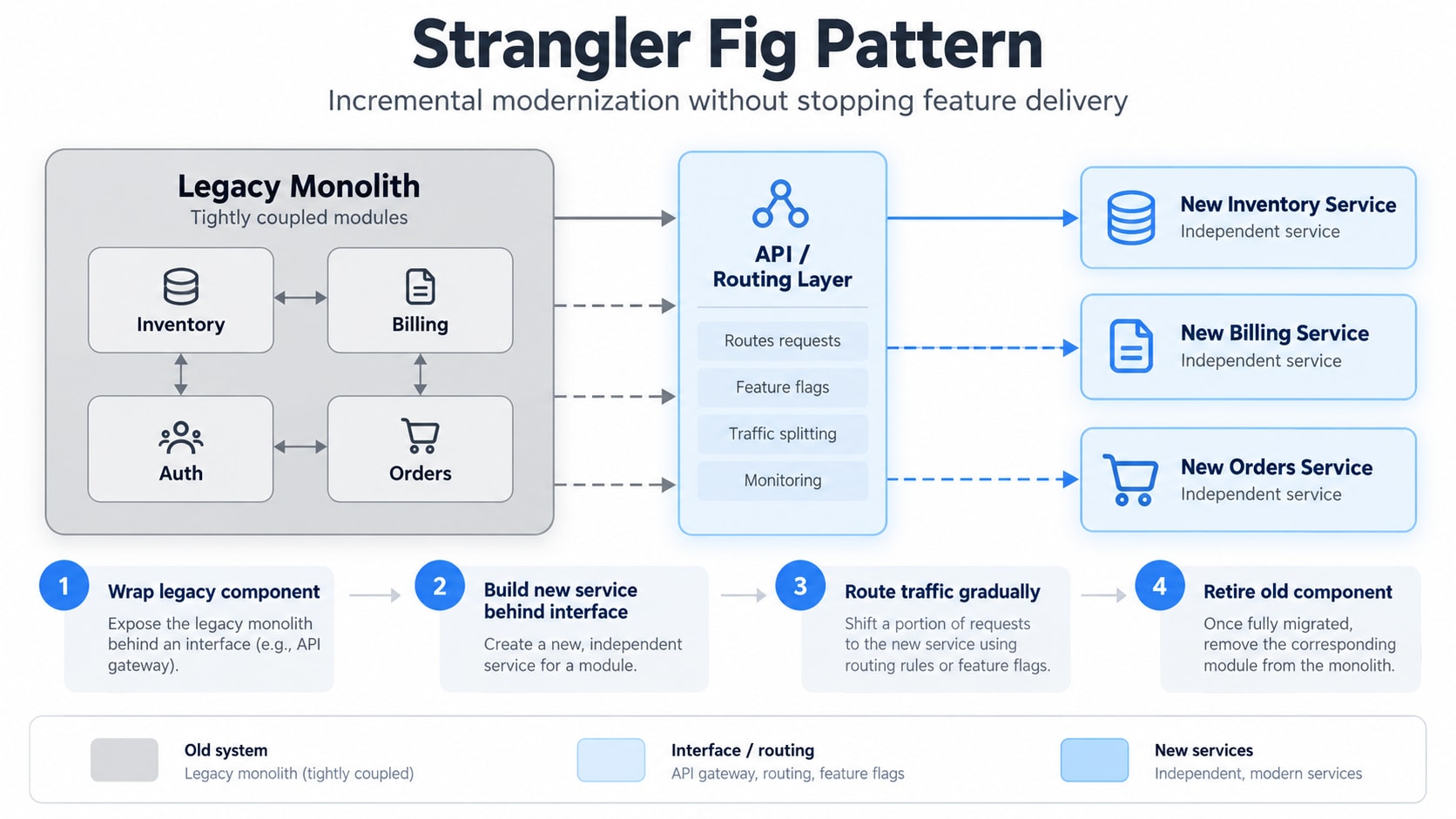
The Strangler Fig approach earns its name:
- Pick your target – say, inventory management buried inside the monolith like a fossil.
- Wrap it in a clean interface. Don’t touch the guts yet.
- Build the new implementation behind that interface.
- Route traffic gradually: start with internal users, then expand.
- Retire the old implementation once the new one proves stable.
Feature flags are useful accomplices, until they’re not. A flag without an owner and a kill date becomes permanent. Suddenly your codebase has 40 toggles, half of them controlling behavior nobody remembers choosing. That’s not flexibility. That’s a haunted house.
The 2025 DORA report landed on a point worth tattooing somewhere visible: code generation speed counts for little when teams can’t review, integrate, or release with confidence. Refactoring follows the exact same rule: it’s only safe when you can deploy often, watch production closely, and hit the eject button fast.
Key infrastructure for safe modernization:
- Automated integration tests that cover the boundaries between old and new components
- Reliable CI/CD pipelines with deployment monitoring
- Database migration strategies that maintain backward compatibility during transitions
Allocate Capacity Without Killing the Roadmap
The hardest part is usually political, not technical. Product managers have customer commitments. Sales teams expect promised features. Executives measure progress through visible releases.
A fixed capacity allocation helps establish predictability. A common starting point is reserving 15–20% of engineering effort for technical improvements, then adjusting based on results.
| Codebase Condition | Suggested Allocation | Focus |
|---|---|---|
| Frequent incidents, high deployment failure rate | 25–30% | Stabilization and critical infrastructure |
| Moderate friction, manageable workarounds | 15–20% | Targeted improvements tied to upcoming features |
| Stable, isolated issues | 5–10% | Preventive maintenance and monitoring |
Spending your maintenance budget on random “nice to haves” is the engineering equivalent of reorganizing your sock drawer during tax season. Every allocated hour should connect to a feature on the horizon or an operational headache that keeps triggering pages.
Real story: eight-person team, customer analytics product. Data sync breaks so often it has a reputation. The tempting move: freeze features and rewrite the sync layer. The smart move is pull incident data, isolate the three failure modes behind most outages, fix them surgically across a few sprints. Product kept shipping. Incidents dropped.
Ownership: tech lead picks what gets fixed. Product manager picks when. Neither role works solo here.
Measure What Matters
Counting closed refactoring tickets tells you almost nothing useful. Some changes have no measurable impact on development speed. Others transform how quickly the team can ship.
Track these metrics instead:
- Lead time: How long does a feature take from committed work to production? Compare across releases.
- Deployment frequency: Are you releasing more often? (Only meaningful if change failure rates aren't also climbing.)
- Change failure rate: Are releases becoming more stable?
- Recovery time: When something breaks, how fast do you fix it?
- Developer feedback: Which components are still painful to work with? Has documentation improved? Can engineers onboard faster?
Translate refactoring into language that makes a CFO nod. Rebuilt the billing architecture and pricing changes now ship in one week instead of three? That’s not a tech win – that’s a sales weapon. Frame it that way or watch your maintenance budget disappear next quarter.
Quarterly autopsy, three questions only: what kept costing us money, what did we do about it, did the bleeding stop? Skip this ritual and debt reduction becomes an invisible tax nobody can justify defending.
The Bottom Line
Debt management isn’t a project with a Gantt chart and a celebration dinner. It’s a habit – closer to flossing than to surgery. The teams that pull it off aren’t heroic. They’re boring in the best way: they prioritize delivery by friction, not aesthetic offense. They sneak improvements into feature branches instead of curating a fantasy backlog nobody opens. They modernize one organ at a time instead of attempting a full transplant under general anesthesia.
The only scoreboard that matters: did the last feature ship with less friction than the one before it? Everything else is decoration.
Comments
Loading comments…