Support tickets contain a massive amount of hidden product feedback. The average mid-market enterprise submits 500 support tickets every day, each packed with precise details about UX friction, broken workflows, and missing functionality. Yet most product teams only hear about these issues through disconnected Slack messages or vague monthly summaries.
Transforming raw conversation threads into prioritized backlog items requires a clean ingestion workflow. You need an automated system that scrubs, clusters, and analyzes ticket data before it reaches your product managers.
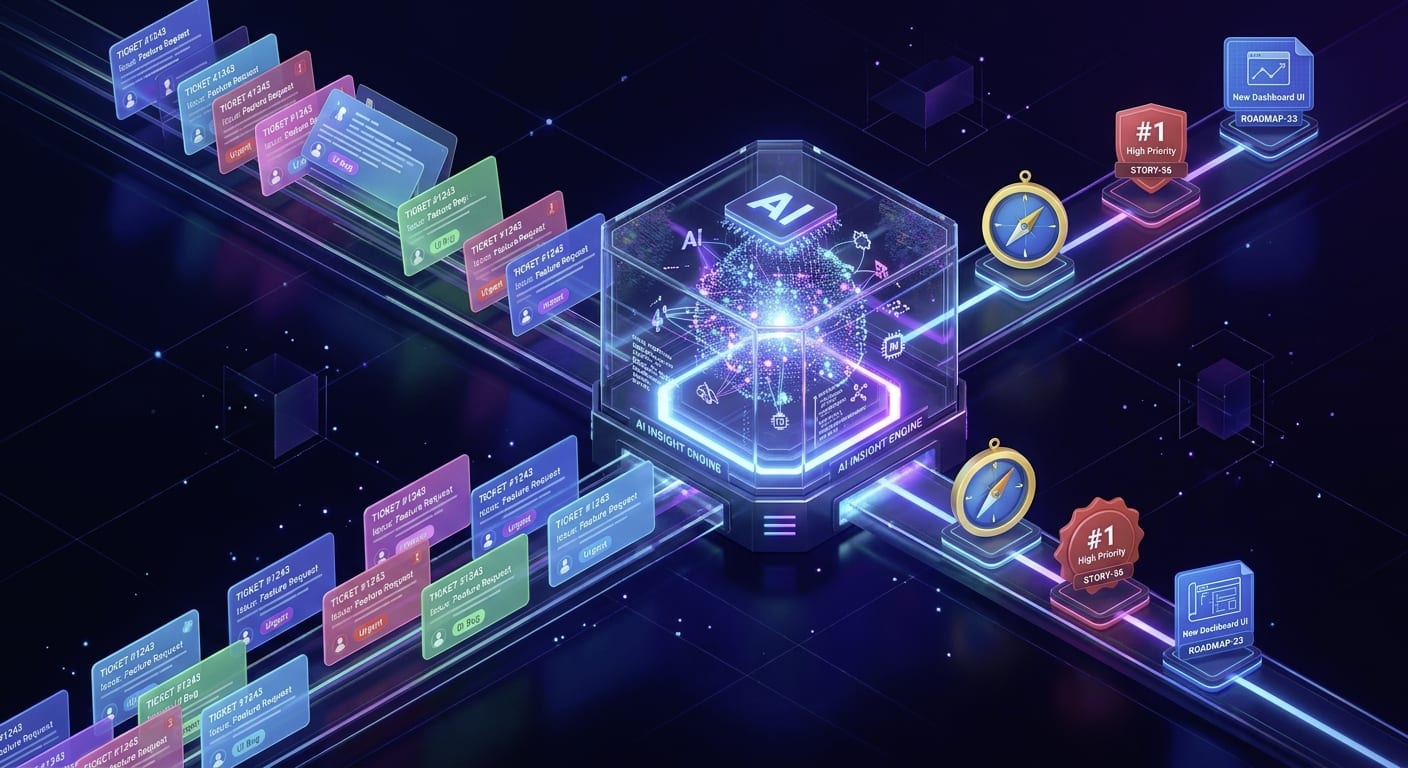
Image Source: Google Gemini
Sanitizing and Clustering Unstructured Ticket Data
Raw support conversations are naturally noisy and filled with sensitive user information that cannot enter an LLM prompt. The ingestion layer must first strip out names, IP addresses, credit cards, and session tokens using standard named entity recognition models combined with tailored regex patterns.
Once scrubbed, running raw text directly into a summarization prompt produces duplicate insights. Instead, generate text embeddings for each interaction and pass them to a vector database to handle semantic deduplication.
Grouping similar embeddings surfaces recurring user struggles regardless of how different customers phrase the issue. This step isolates systemic technical flaws from one-off user errors, surfacing real underlying patterns.
Extracting Product Themes and Assessing Tooling
With deduplicated clusters established, the next layer passes grouped tickets to a large language model to extract root cause summaries and user intent. System prompts should force the model to output structured data containing the core problem, affected user workflows, and perceived severity.
Evaluating whether to build custom pipelines or deploy dedicated customer insights software often comes down to internal engineering resources and qualitative research needs. Engineering teams running custom code must continuously evaluate models for resolution accuracy to avoid hallucinations in production.
Selecting the right balance between custom scripts and platform architecture depends heavily on your team resources:
- Custom pipelines give engineers total control over data privacy and retrieval architectures
- Dedicated tools reduce maintenance overhead and offer out-of-the-box dashboarding
- Hybrid approaches leverage internal vector stores while routing qualitative synthesis to specialized tools
Evaluating these trade-offs early keeps product teams focused on core feature delivery rather than data wrangling.
Multilingual Sentiment and Edge Case Handling
Enterprise feedback streams frequently arrive in dozens of languages, intertwined with edge-case scenarios like sarcasm or angry hyperbole. Standard sentiment models miss these subtle nuances, misclassifying critical user frustration as low-priority noise. Modern multilingual LLMs let product teams translate, normalize, and score semantic tone across international markets simultaneously, ensuring global feedback receives consistent prioritization.
Mapping Insights into the Product Backlog
A customer intelligence workflow is only effective if its outputs reach the engineers building the product. The final step routes structured JSON themes directly into project management tools using automated webhooks.
This workflow automatically converts recurring user pain into trackable engineering tickets, populated with direct customer quotes and ticket-count metrics. Product managers can instantly gauge an issue's real-world impact without spending hours reading individual support logs.
Engineering leaders tracking LLM deployment architectures routinely emphasize that clear evaluation gates prevent garbage data from polluting downstream tools. Automating ticket analysis turns customer support from an operational cost center into a direct driver of your product roadmap. For content covering a range of other software development topics, explore our other posts.
Comments
Loading comments…