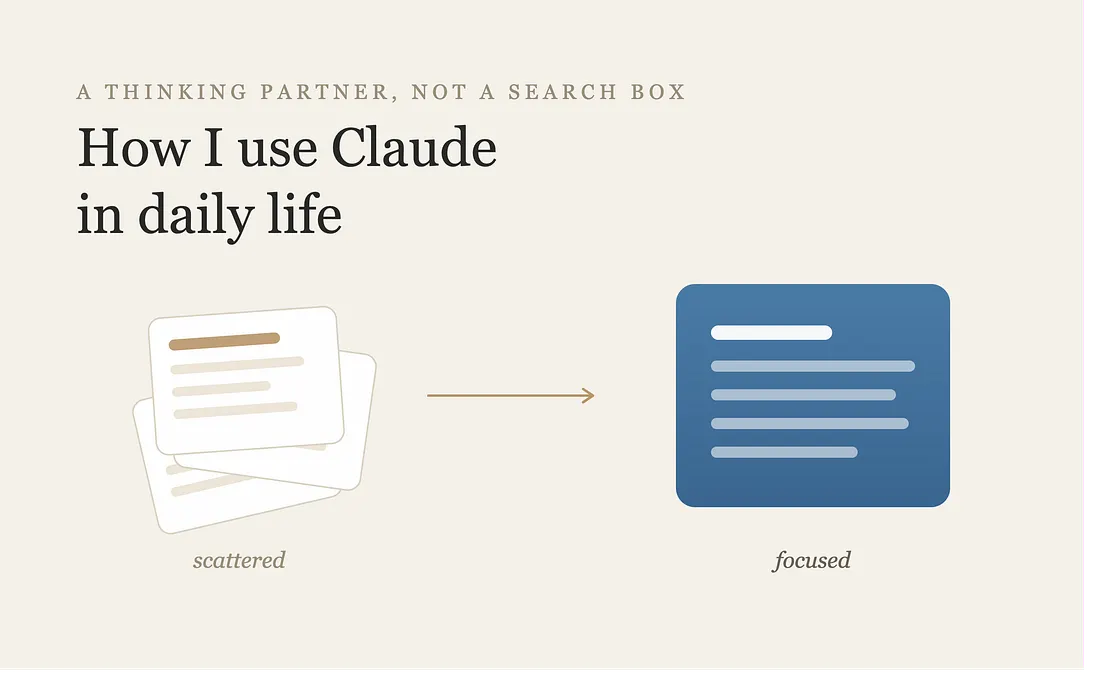
I stopped treating Claude like Google. That one shift changed everything.
It was 11 p.m. on a Tuesday, and I had fourteen browser tabs open.
A half-written email I’d been avoiding for three days. A bug I couldn’t explain to myself, let alone anyone else. A vague, gnawing worry that I was learning all the wrong things for where my career was headed. My brain felt like a desk with too much stuff on it — nothing lost, exactly, but nothing findable either.
I’d been using AI tools for over a year by then. But that night, something clicked about how I was using them. And it had nothing to do with prompts or productivity hacks.
It was this: I’d been treating Claude like a search engine. Ask a question, get an answer, move on. The moment I stopped doing that and started treating it like someone I could think out loud with, the tool quietly became part of how I live and work.
Here’s what actually changed — five habits, each one a real thing I do now, not a feature on a marketing page.
1. I talk through messy problems instead of Googling them
The old way: I’d hit a wall, search for the error, scroll through five forum threads, and patch something together without understanding it.
The new way: I describe the whole mess. “Here’s what I’m trying to do, here’s what’s happening instead, and here’s what I’ve already ruled out.” Not asking for the answer — asking to think alongside something.
The magic isn’t that the answer appears. It’s that the act of explaining the problem clearly, to anything, forces my own thinking into order. Half the time I solve it myself mid-sentence. The other half, I get a direction I genuinely hadn’t considered.
There’s a strange relief in this. The problem stops living only in your head, where it festers, and starts living in words, where it can be handled.
2. I draft the things I’ve been avoiding
We all have that email. The one that’s been sitting in “Drafts” — or worse, just in your conscience — for three days. The reply to someone you let down. The message asking for something you feel awkward asking for.
The avoidance is almost never about the writing. It’s about the feeling. So I just say that out loud: “I need to tell this person I’m going to miss a deadline, and I feel terrible about it. Help me say it honestly without grovelling.”
What comes back isn’t a finished email I copy-paste. It’s a starting point that breaks the spell of the blank page. Once the hardest sentence exists, even badly, I can fix it. The thing I’d been carrying around for days gets done in four minutes.
3. I turn vague anxiety into a concrete plan
This is the one that surprised me most.
Some worries aren’t problems — they’re fog. “Am I learning the right things?” “Is my career going in the right direction?” You can’t act on fog. So I started handing it over: “Here’s where I am, here’s where I think I want to go, here’s what I’m afraid I’m missing. Help me see this clearly.”
Talking it through doesn’t magically fix my career. But it converts a swirling, anxious feeling into a list of specific, doable next steps. And a specific next step is the antidote to almost any anxiety. You can’t do a feeling. You can do a task.
4. I let it be the reader before a human is
Before I send a piece of writing, push code for review, or share something I’ve made, I get a first read from Claude.
Not to be told it’s good — that’s useless. I ask the harder question: “Where will a tired, slightly skeptical reader get confused or stop caring?” Or for code: “What would a reviewer flag here that I’m too close to see?”
This isn’t about replacing human feedback. It’s about not wasting human feedback on the obvious stuff. By the time a person looks at my work, the embarrassing gaps are already closed, and they can engage with what actually matters.
5. I outsource decision fatigue, not decisions
By evening, I’m out of decisions. Not big ones — small ones. Which approach, which tool, which order to do things in. The tiny forks that quietly drain you.
So I ask for the tradeoffs laid out plainly. “Give me the honest case for each option, including what I’d be giving up.” Then I — a human with context the tool will never have — actually choose.
That distinction matters. I don’t ask it to decide. I ask it to clear the clutter around the decision so I can make it with a clear head. The choice stays mine. The exhausting part doesn’t.
The part the hype skips: where it doesn’t work
If I only told you the good parts, you shouldn’t trust me.
Claude is confidently wrong sometimes, in ways that are easy to miss precisely because the writing is smooth. It doesn’t know your team, your history, the unspoken context of your life. It can make you a worse thinker if you let it do the thinking — the same way GPS can quietly erode your sense of direction.
So I have a rule: it’s allowed to help me think, never to think for me. The moment I notice I’m copying without understanding, or reaching for it before reaching for my own head, I stop. The tool is supposed to give me back my attention, not take over my judgment.
And honestly? Some things shouldn’t be outsourced at all. The hard conversation that needs to come from you. The instinct you can’t fully explain but know is right. The messy human stuff is still, thankfully, ours.
What actually changed
I went back to that Tuesday night recently and realized the fourteen tabs weren’t the problem. The problem was that everything lived in my head at once, with no way to set any of it down.
That’s what really changed. Not my productivity — my attention. The mental clutter has somewhere to go now. The avoided email gets written. The fog becomes a list. And the energy I used to spend just holding it all together goes back to the things that genuinely need a human: the people I care about, the work only I can do, the thinking that’s actually mine.
Used like a search box, it’s a faster Google. Used like a thinking partner, it gives you back the one thing none of us has enough of.
Your attention. Spend it on what matters.
Comments
Loading comments…