A practical comparison of in-house and external developer models — when each works best and how to match your engineering structure to your growth stage.
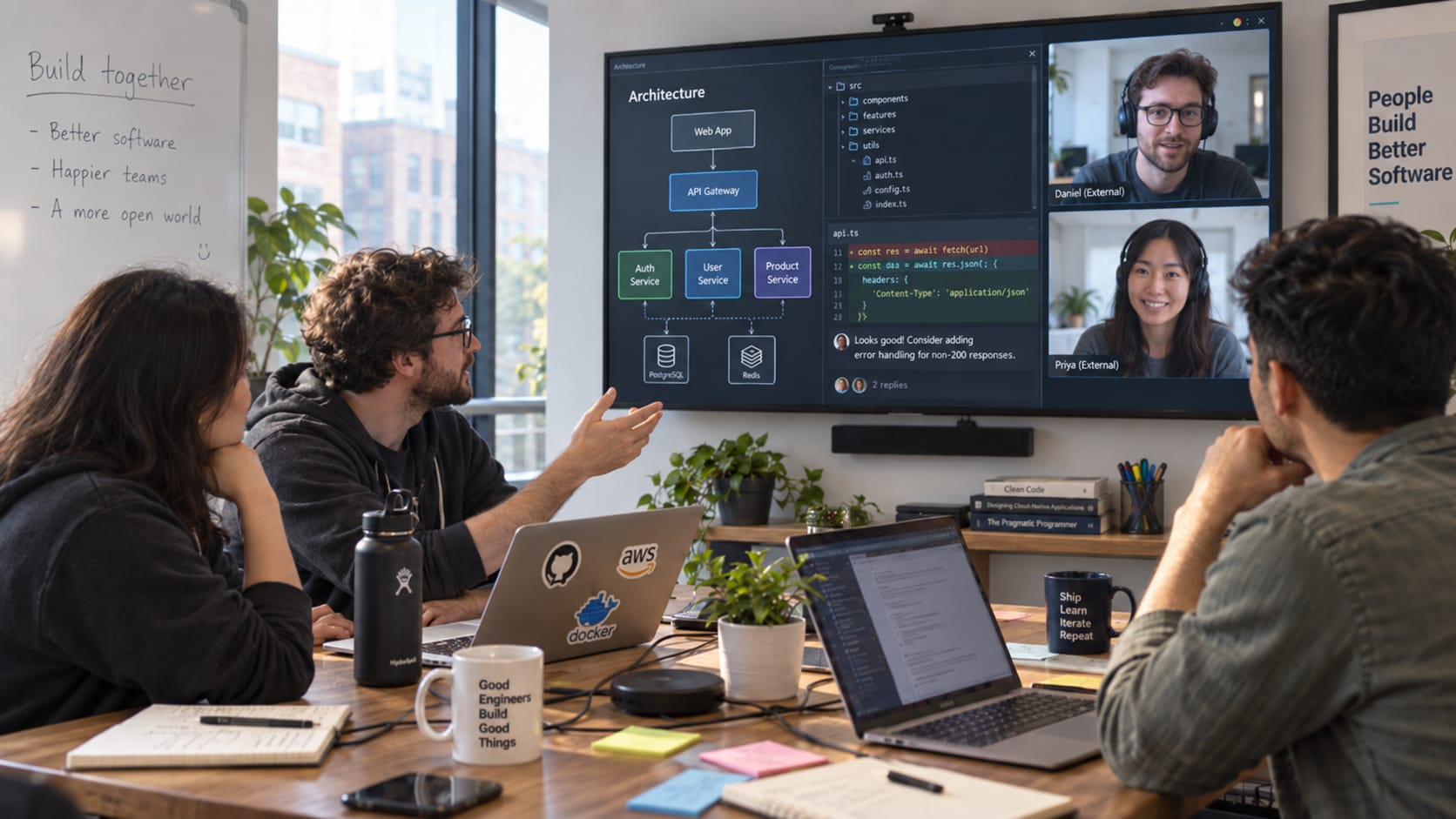
Hiring full-time isn't always the answer. Here's a practical breakdown of when to build internally, when to go external, and how hybrid teams actually work in growing tech orgs.
The constraint holding back most growing tech companies isn't budget — it's access. McKinsey's research on the technology talent gap found that only 16% of executives felt comfortable with the amount of technology talent available to support their digital transformation. When you're competing for specialists in AI, cybersecurity, cloud architecture, and data engineering, a single unfilled role can stall an entire product roadmap.
That makes the classic "build or buy" talent decision harder than ever. Companies like ncube.com have built their entire model around this tension — helping engineering organizations access external expertise without sacrificing the continuity that in-house teams provide. An in-house team gives you institutional knowledge, but permanent hiring is slow when specialist demand shifts fast. External developers open up a wider talent pool and let you scale without adding permanent headcount — but they need clear ownership, shared engineering standards, and real integration into your workflows.
Most teams that ship consistently don't pick one model. They combine both, keeping strategic capabilities in-house while tapping distributed engineering talent for specific products, technologies, or bursts of accelerated growth.
Let's break down how each model works, where each one falls short, and what a well-designed hybrid actually looks like.
In-House Teams: Strong on Context, Expensive to Pivot
The core advantage of a permanent engineering team is accumulated context. Your in-house developers know the architecture, the tech debt, the customer edge cases, and every decision that got the codebase to where it is today. When the software is the product, that knowledge is a competitive moat.
In-house also simplifies accountability. Engineering leaders control hiring standards, career paths, security practices, and team structure. Product managers sit next to developers. Feedback loops are short.
The trade-off is rigidity. Permanent hiring locks in a fixed cost base even when requirements change. A team you assembled for one technical phase may not have the skills for the next — yesterday's frontend-heavy squad might suddenly need ML engineers or platform specialists.
Recruitment introduces real delay too. Sourcing, assessing, hiring, and onboarding a senior specialist can take three to six months. During that window, the rest of the team either absorbs the extra work or the feature sits in the backlog. When that delay pushes back a launch, a migration, or a customer commitment, the cost of an open position goes far beyond recruiter fees — it compounds through missed market windows and team burnout.
Where in-house works best:
- Stable, long-lived products with predictable tech stacks
- Core architecture and platform ownership
- Security governance and compliance-critical systems
- Teams where deep product knowledge is a competitive advantage
External Developers: Turning Fixed Capacity Into Elastic Capacity
External development changes the economics. Instead of building every capability permanently, you access specialists when a business or technical need actually appears.
This matters most when demand is uneven. You might need eight extra engineers during a platform rebuild but only two once it enters maintenance. Staffing internally for the peak means carrying excess capacity at the trough. External engineers let you match resources to actual workload.
Where external developers add the most value:
| Scenario | Why External Works |
|---|---|
| Specialist skill gaps (AI, DevOps, cloud, security) | Faster access than recruiting full-time for a niche role |
| Accelerating delivery on a packed roadmap | Adds capacity without overloading internal engineers |
| Migrations, integrations, modernization | Temporary project scope with a clear end date |
| Entering a new technology domain | Test the waters before committing to permanent hires |
| Accessing talent in different markets | Broader labor pool, often with timezone or cost advantages |
External development isn't inherently cheaper, though. Comparing hourly rates misses the full picture. You have to factor in recruitment time, management overhead, idle capacity, knowledge retention, benefits, infrastructure, and the opportunity cost of delayed delivery.
A more useful metric: what does it cost to achieve the required engineering outcome within the required timeframe?
The Core Question: Which Capabilities Should Stay Internal?
The debate gets more productive when you stop applying one model across the entire org. Some capabilities deserve permanent ownership. Others are inherently variable.
Keep internal:
- Technical architecture and system design decisions
- Product strategy and engineering leadership
- Security governance and compliance
- Knowledge tied directly to your competitive advantage
Access externally as needed:
- Mobile development, QA automation, cloud engineering, or data specialists whose demand spikes around specific projects
- Skills required for a defined phase (e.g., a migration or a new product vertical)
- Expertise the team hasn't built yet and may not need permanently
Deloitte's research backs this up, recommending a broader technology talent ecosystem that includes employees, contractors, freelancers, and geographically distributed talent. When skill requirements change faster than you can recruit, trying to close every gap through internal hiring alone becomes a structural bottleneck.
The workforce question shifts from "should development be internal or external?" to "which competencies require long-term organizational ownership, and which require reliable access?"
Making Hybrid Teams Actually Work
Adding external engineers to your team doesn't automatically increase output. Poorly integrated developers can create more communication overhead, duplicate work, and put extra load on your senior engineers.
Hybrid models succeed or fail on operating discipline. Here's what separates the teams that ship from the ones that spin:
Non-negotiable practices for hybrid teams:
- Shared tooling. External developers get the same access to docs, dev environments, ticketing, CI/CD, and code review as permanent staff.
- Outcome-based ownership. Assign responsibility around features or outcomes — not just isolated tickets.
- Deliberate knowledge transfer. Critical architectural decisions should never live exclusively with a vendor. Documentation, peer reviews, and technical handovers reduce dependency.
- Unified engineering standards. One set of coding standards, one review process, one definition of done. No separate track for external contributors.
Harvard Business Review argues that traditional linear approaches to hiring are increasingly mismatched with environments where companies need rapid access to specialized expertise. The takeaway isn't that external talent should replace employees — it's that talent strategy can no longer be limited to the org chart.
For engineering leaders, this means managing the workforce as a single integrated system, not maintaining two separate tracks. The engineers who deliver your product should operate under one workflow regardless of employment status — same standups, same sprint cadence, same accountability.
Choosing the Right Model for Your Growth Stage
There's no universal winner. The right model depends on what you're actually trying to scale.
| Growth Stage | Recommended Model | Rationale |
|---|---|---|
| Early-stage, building core product | Primarily in-house | Deep product knowledge is critical; team culture is forming |
| Scaling rapidly, expanding features | Hybrid | Internal team owns architecture; external developers add delivery capacity |
| Entering new tech domains (AI, cloud) | External-first, then internalize | Test expertise before committing to permanent roles |
| Stable product, maintenance phase | Lean internal + external on-demand | Avoid carrying excess fixed capacity |
| Major migration or modernization | Heavy external augmentation | Time-bounded scope; specialist skills needed temporarily |
The important decision isn't where a developer sits on the org chart. It's whether you have the right technical capability available when a business priority demands it.
Engineering organizations that draw this line clearly can protect institutional knowledge without letting a fixed workforce structure become the bottleneck. In a labor market where critical tech skills remain hard to secure, that flexibility is becoming an operating advantage — not just a hiring alternative.
The teams that scale well aren't the ones that pick a side. They're the ones that design their engineering organization to absorb change — in technology, in priorities, and in the talent market itself. Whether your next critical hire is a full-time principal engineer or a six-month embedded cloud specialist, what matters is that your operating model can integrate both without losing velocity or institutional knowledge in the process.
Comments
Loading comments…