
Poker has been around in a form we would recognize since at least 1829. That means players have spent almost 200 years making choices without knowing everything. They may not have used terms like prior beliefs, likelihoods, or updated probabilities, but the way they think is very similar to how Bayesian models work.
Poker Websites Turn Bayesian Updating Into a Repeated Feedback Loop
Poker websites make this style of probabilistic reasoning particularly easy to observe because they turn a slow physical game into a structured stream of decisions and data. Several educational articles on Ignition Poker show that kind of complex side of poker games. You will notice that the cards are discrete inputs, bets become observable signals, and every new action changes what a rational player should believe about the hidden state of the hand.
Consider the start of a hand. A player does not know an opponent's cards, so the useful object is not one prediction but a range of possible holdings. That range functions like a prior distribution. Position, previous behavior, and the initial action can shape it before any community cards appear.
Suppose the opponent then makes a large bet after a particular board is dealt. That action is evidence, but it should not be interpreted in isolation. The important question is how likely that bet would be under different possible hands. Strong holdings may produce it frequently. Bluffs may produce it sometimes. Medium-strength hands may make it less likely. Those likelihoods change the relative weight assigned to each hypothesis.
Repeated hands make Bayesian learning easier
Poker websites strengthen the learning process because digital play produces repeated, comparable situations. Bet sizes are precise, action sequences are recorded, and large numbers of hands can be reviewed afterward. That makes it possible to compare what seemed likely during a decision with what later evidence revealed.
For technical readers, the closest analogy may be debugging a distributed system. A latency spike initially has several plausible causes: database load, network congestion, cache failure, or an external dependency. Each log entry or metric changes those probabilities. Good diagnosis does not mean choosing the first plausible explanation and defending it. It means updating the hypothesis set as evidence accumulates.
Poker teaches the same discipline. The strongest decision is rarely based on certainty. It is based on the best probability distribution available at that moment, combined with the cost and payoff attached to each possible action.
What Research Says About Expertise and Probability Judgment
Poker is useful for studying Bayesian reasoning because researchers can compare subjective estimates with probabilities that are mathematically knowable. Several experiments suggest that expertise is associated not merely with memorizing card combinations, but with processing relevant information more effectively.
One 2010 study asked 69 moderately experienced players to estimate their probability of finishing with the best hand. For more than five-sixths of participants, the correlation between estimated and actual probabilities exceeded 0.8. When estimates were averaged across players and hands, the correlation reached 0.96.
Later work points in the same direction.
| Study | Participants | Task | Main probabilistic finding |
|---|---|---|---|
| 2010 probability-estimation study | 69 | Estimate chances of holding the best final hand | More than 5/6 achieved correlations above 0.8; aggregated correlation was 0.96 |
| 2011 decision study | 45, with 15 at each skill level | Play 60 simulated hands while explaining decisions | Expert and intermediate players outperformed novices, especially in later stages |
| 2022 coherence study | 45 novices, 37 amateurs, 186 experts | Estimate probabilities in matched card and probability tasks | Experts were significantly more accurate and coherent than the combined novice/amateur groups |
The 2011 experiment also found that more experienced participants attended more closely to situation-specific cues and considered more relevant thoughts during decisions. The larger 2022 study found significant expert advantages in both accuracy and probabilistic coherence, with statistical tests reporting p < 0.01 and Bayes factors above 100 for the main expert comparisons.
For developers, that matters because Bayesian skill appears to involve more than knowing the formula. Expertise changes which possibilities people consider and how effectively they integrate new evidence.
The Transferable Skill Is Updating, Not Calculating
The most useful poker lesson for technical work is therefore not mental arithmetic. It is disciplined belief revision.
A 2024 preregistered study involving 465 participants examined performance on an incentivized Bayesian probability task. One of its clearest findings was that, as the researchers put it, “cognitive reflection predicted higher accuracy.” That distinction is important. Exposure to uncertain outcomes is not enough by itself; reasoning improves when people actively question an initial answer and reconsider how strongly the available evidence supports it.
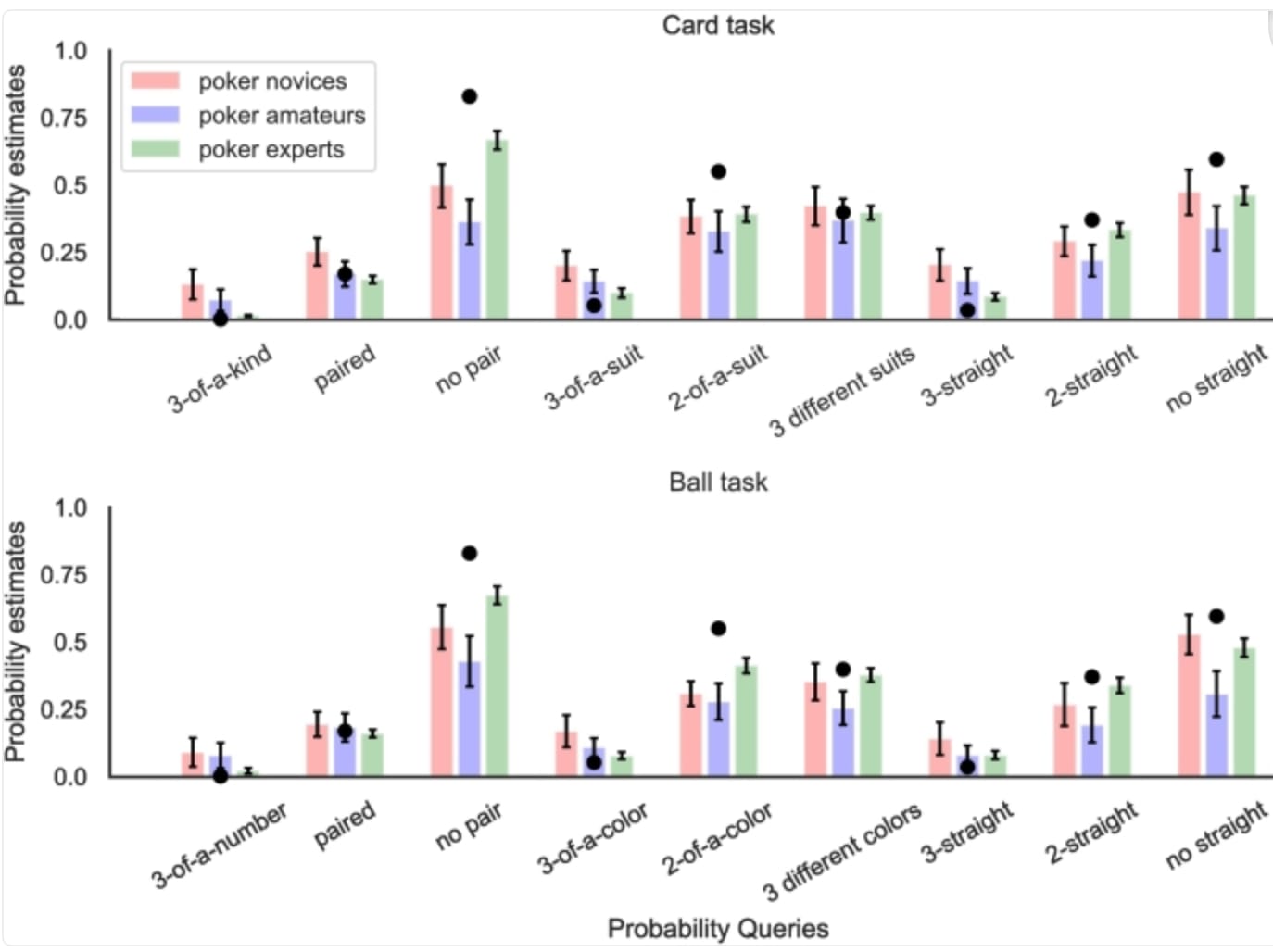
Poker experts generally produced probability estimates closer to the correct values than novices or amateurs across both poker-style and abstract probability tasks.
Source: Here
Software work offers many opportunities to practice the same behavior. Imagine that a service begins returning errors after a deployment. The deployment may deserve a high initial probability because of timing, but it should remain a hypothesis rather than become a conclusion. If failures appear only in one region, the probability assigned to infrastructure problems rises. If rolling back the release changes nothing, the deployment hypothesis loses weight. Each observation should alter the model.
The 2022 poker study gives this idea a measurable form. Its sample included 186 experts alongside 82 less-experienced participants, and the experts produced probability judgments that were both more accurate and more internally coherent. The authors concluded that “poker experts were both more coherent and more accurate than novices and amateurs.”
Bayesian updating looks like in engineering
That is close to what good engineering judgment looks like. Strong practitioners do not simply accumulate more facts. They maintain competing explanations, notice evidence that distinguishes between them, and update confidence instead of treating early assumptions as permanent.
The practical takeaway is simple: think in distributions rather than declarations. Poker has survived for nearly two centuries partly because every hand forces players to make useful decisions before all the facts are available: the same condition that defines much of real-world technical work.
Comments
Loading comments…