
How do you create agents in LangChain?
In the fast-paced world of artificial intelligence, two skills are reshaping how we interact with large language models (LLMs): prompt engineering and context engineering. As AI integrates deeper into businesses, creativity, and daily workflows, understanding these concepts isn’t just helpful — it’s essential. Whether you’re a beginner or a seasoned AI enthusiast, let’s dive in and demystify these powerhouse techniques.
Major Differences Between Prompt Engineering and Context Engineering At their core, “prompt engineering and context engineering both aim to optimize AI outputs, but they tackle different aspects of the interaction.”
Prompt Engineering:
This involves crafting precise, effective inputs (prompts) to guide an LLM’s response. It’s about the “what” and “how” of your immediate query — phrasing instructions, adding examples, or specifying formats to elicit the best results. For instance, turning a vague question into a structured one with role-playing or chain-of-thought reasoning.
Context Engineering:
This focuses on curating and managing the broader information (context) fed into the model before or alongside the prompt. It includes techniques like Retrieval-Augmented Generation (RAG), summarizing long documents, or structuring data to fit within the model’s context window. Essentially, it’s about ensuring the AI has the right “knowledge base” to draw from, making responses more informed and accurate.
The key distinction?
Prompt engineering is like directing a scene in a play, while context engineering builds the entire stage and props.
Importance of Prompt and Context Engineering
In 2026, with LLMs like Grok 4, GPT-5, and Claude 4 powering everything from chatbots to enterprise systems, these skills are critical for reliability and efficiency.
Prompt Engineering’s Importance: It democratizes AI, allowing anyone to get high-quality outputs without coding. Poor prompts lead to hallucinations or irrelevant answers; great ones boost productivity by 20–50% in tasks like content generation or debugging. It’s vital for ethical AI, reducing biases through careful wording.
Context Engineering’s Importance: As AI handles complex, data-heavy tasks, context engineering ensures scalability and accuracy. It mitigates issues like context window limits (e.g., 128K-1M tokens) and enables enterprise-grade applications, where models need access to vast, up-to-date information. Experts predict that by 2027, 80% of AI failures will stem from poor context management, making this skill indispensable for business success.
Together, they form the backbone of agentic AI — systems that reason, plan, and act autonomously.
Usage of Prompt and Context Engineering
Both techniques shine in different scenarios, often complementing each other.
Prompt Engineering Usage: Ideal for one-off interactions or simple tasks. Examples include: Generating code snippets: “Write a Python function to sort a list, explain step-by-step.” Content creation: “Summarize this article in 3 bullet points, focusing on key stats.” Education: Crafting quizzes or explanations tailored to learners.
Context Engineering Usage: Suited for ongoing or data-intensive applications. Common uses: RAG systems: Pulling relevant docs from a vector database for accurate Q&A. AI agents: Building knowledge graphs or summarizing histories for long conversations. Enterprise tools: Integrating company data for personalized responses in customer service.
In practice, advanced workflows combine both — like using context to preload data, then prompting for analysis.
Advantages of Prompt Engineering:
Quick and accessible: No need for infrastructure; iterate in seconds. Cost-effective: Reduces token usage by focusing prompts. Versatile: Works across models without customization. Boosts creativity: Encourages innovative outputs through techniques like few-shot learning.
Advantages of Context Engineering:
Higher accuracy: Provides factual grounding, reducing errors in complex queries. Scalability: Handles large datasets, making AI enterprise-ready. Security and compliance: Controls what data the model accesses. Long-term efficiency: Automates knowledge retrieval, saving time in repetitive tasks.
Who Can Use Them and Why?
Who Can Use Prompt Engineering and Why?: Anyone — from students to marketers. Beginners use it to enhance daily AI chats; professionals (e.g., developers) for precise outputs. Why? It’s low-barrier, empowers non-tech users, and amplifies productivity without deep expertise. Who Can Use Context Engineering and Why?: Primarily AI engineers, data scientists, and enterprise teams. Developers building apps; businesses scaling AI. Why? It addresses real-world limitations like outdated training data, ensuring reliable, context-aware systems. For individuals, it’s great for advanced projects like personal knowledge bases.
Both are for those serious about AI mastery, but context engineering suits roles needing robustness over speed.
Comparison: Prompt Engineering vs Context Engineering
Here’s a side-by-side comparison in a table for clarity:
Press enter or click to view image in full size
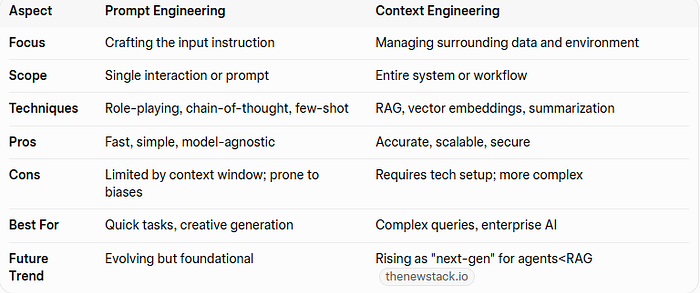
In summary, prompt engineering is tactical and immediate, while context engineering is strategic and holistic. Many experts argue context is overtaking prompt in enterprise settings, but they’re complementary.
How Can Someone Learn or Master These Skills?
Learning Prompt Engineering: Start with free resources like OpenAI’s playground or courses on Coursera (“Prompt Engineering for Everyone”). Practice daily: Experiment with ChatGPT or Grok, analyzing outputs. Master via communities like Reddit’s r/PromptEngineering. Aim for 50+ prompts weekly; advanced: Study papers on zero-shot vs. few-shot.
Learning Context Engineering: Begin with RAG tutorials on Hugging Face or books like “Building AI Agents.” Hands-on: Use tools like LangChain or Pinecone for vector DBs. Courses: Udacity’s “AI Engineering” or Anthropic’s guides. Master by building projects, like a custom Q&A bot. Join LinkedIn groups or conferences for real-world tips.
Mastery takes 3–6 months of consistent practice for both — combine them for hybrid expertise.
Conclusion
Prompt engineering gives you control over the conversation. Context engineering gives the AI the memory and knowledge it needs to have a meaningful one.
In 2026, the most powerful results come from knowing when — and how — to use both.
Prompts are your scalpel; context is your foundation. Master one, and you become dangerous. Master both, and you become unstoppable.
The real question isn’t which one wins — it’s how fast you start combining them.
Pick one technique today. Build something small. Watch the difference. The next level of AI isn’t coming — it’s already waiting for you to give it better instructions… and better memory.
Which one are you leveling up first? ❤
Comments
Loading comments…