Socks5 proxies and HTTP proxies are two distinct network protocols. This article compares them in detail, helping you understand their applicable scenarios and find the best Socks5 proxy software to trust.
Proxy servers have become important tools for maintaining a smooth experience in the online world, but their types and uses often confuse people. Among the various technologies, Socks5 proxies and HTTP proxies are the two most common, each having its own characteristics and use cases.
Without further ado, let’s explore the core principles and differences between the two, and outline some of the best SOCKS5 proxy server providers in the market today, to help you make informed decisions based on your needs.
What is a Socks5 proxy server?
A socks5 proxy server is a universal network protocol proxy that operates at the transport layer (TCP/UDP). Essentially, it is an efficient, protocol-agnostic packet forwarding tunnel that does not parse data content, allowing it to adapt to a wide range of application scenarios.
Due to operating at a lower level of the OSI model, Socks5 proxies can handle any type of network traffic, including web browsing (HTTP/HTTPS), email, file transfers (FTP), as well as peer-to-peer (P2P) connections and online gaming packets. It does not parse or modify the transmitted data, which gives it a significant advantage in speed and compatibility, making it particularly suitable for scenarios requiring handling of multiple protocols or non-web traffic.
Use cases for Socks5 proxies
- P2P File Sharing and Downloading: The SOCKS5 protocol can seamlessly handle complex, non-HTTP connections generated by P2P protocols like BitTorrent, making it the preferred choice for download users.
- Online Gaming and Reducing Latency: Game clients often use custom TCP/UDP protocols. SOCKS5 can proxy this game traffic, helping players connect to better game server nodes, potentially reducing latency.
- Universal Software Proxy: Many applications (such as email clients, FTP tools, instant messaging software) support SOCKS5 proxy settings, enabling all network functionalities through a single proxy for a unified exit.
- Bypassing Geographic Restrictions for Streaming: While commonly associated with HTTP proxies, properly configured SOCKS5 proxy services can also be used to access region-restricted content, as it can forward all TCP traffic.
- High-Anonymity Network Activities: Pure SOCKS5 proxies (especially residential SOCKS5 proxies) do not add specific HTTP header information, providing higher anonymity than standard HTTP proxies, and are often integrated into specialized SOCKS5 proxy software.
What is an HTTP proxy server?
An HTTP proxy is a proxy server primarily used to handle browser or HTTP(S) requests, designed specifically for web traffic. It can read and interpret HTTP requests, providing additional functions in content filtering, cache optimization, etc., making it especially common in web browsing or handling API requests.
The advantage of HTTP proxies is that it focuses on web-layer transmission, allowing it to provide greater control in a browser environment. For example, you can filter, inspect, or even cache requests, increasing access efficiency. This type of proxy is particularly important for tasks like development testing, ad verification, and price monitoring that require frequent web access.
Use cases for HTTP proxies
- Web Scraping and Data Collection: This is one of the core uses of HTTP proxies. It can efficiently manage HTTP requests, handle cookies and sessions, and avoid being blocked by the target website by rotating IP pools.
- Content Filtering and Parental Control: Enterprise or home networks can intercept inappropriate websites and monitor online behavior through HTTP proxies, as it can parse URLs and domain names.
- Local Network Caching to Save Bandwidth: Enterprise-level HTTP proxies can cache web pages frequently accessed by employees (such as news sites, software updates), significantly reducing external bandwidth consumption and improving access speed.
- Ad Verification and Geolocation Testing: Marketers use HTTP proxies from different regions to check if local search engine results or website ads are accurately displayed.
- Basic Anonymous Web Browsing: By hiding the user's real IP address, HTTP proxies can provide preliminary privacy protection, used to access some simple geo-blocked websites.
Socks5 Proxies vs. HTTP Proxies: Key Differences
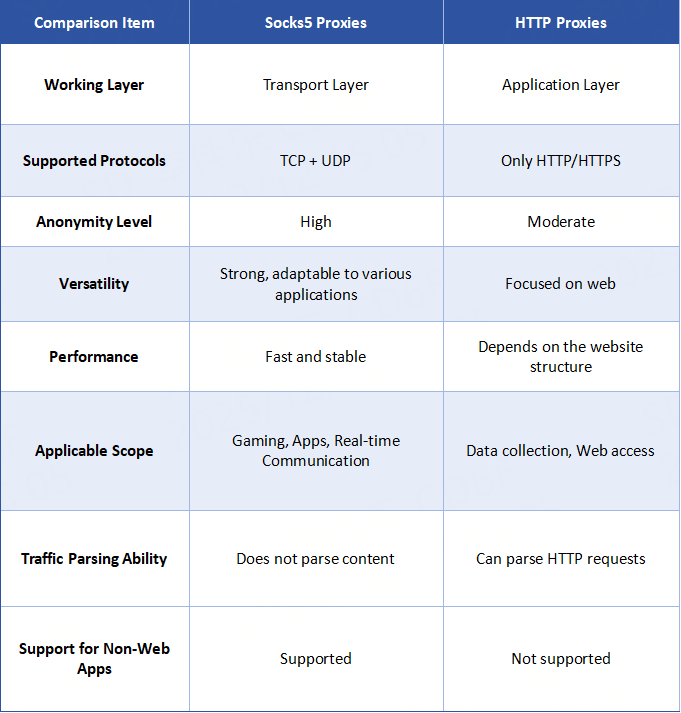
The main differences between Socks5 proxies and HTTP proxies focus on transport layer level, compatibility, and usage purposes. Socks5 operates at a lower level, allowing it to accommodate more types of traffic; HTTP proxies focus on web requests, making them more efficient for web tasks. Understanding the differences in these two directions can help you make the right technical choice more quickly.
Making a decision between Socks5 Proxies and HTTP Proxies
Choosing between Socks5 and HTTP proxies depends on the type of task you are handling, the project's requirements for anonymity, and the types of programs you rely on. There is no absolute better or worse between the two; they simply have different focuses. For you, the best proxy is the one that fits your use case most appropriately.
When to choose Socks5 Proxies?
- Need support for TCP and UDP protocols
- unning games, real-time communication tools, or non-web programs
- Higher demand for anonymity
- Seeking faster transmission speeds
- Need to flexibly handle various types of application traffic
When to choose HTTP Proxies?
- Primarily performing web-related tasks
- Focusing on SEO, ad verification, price monitoring, etc.
- Have requirements for HTML/JSON/API scraping
- Emphasizing management capabilities for web requests
- Want to add functionalities like web caching and filtering
Top 3 Socks5 Proxy Providers
The following highlights three residential Socks5 service providers that perform excellently in the 2025 proxy market, gaining continuous recognition in quality, speed, and availability within the industry.
1.Thordata
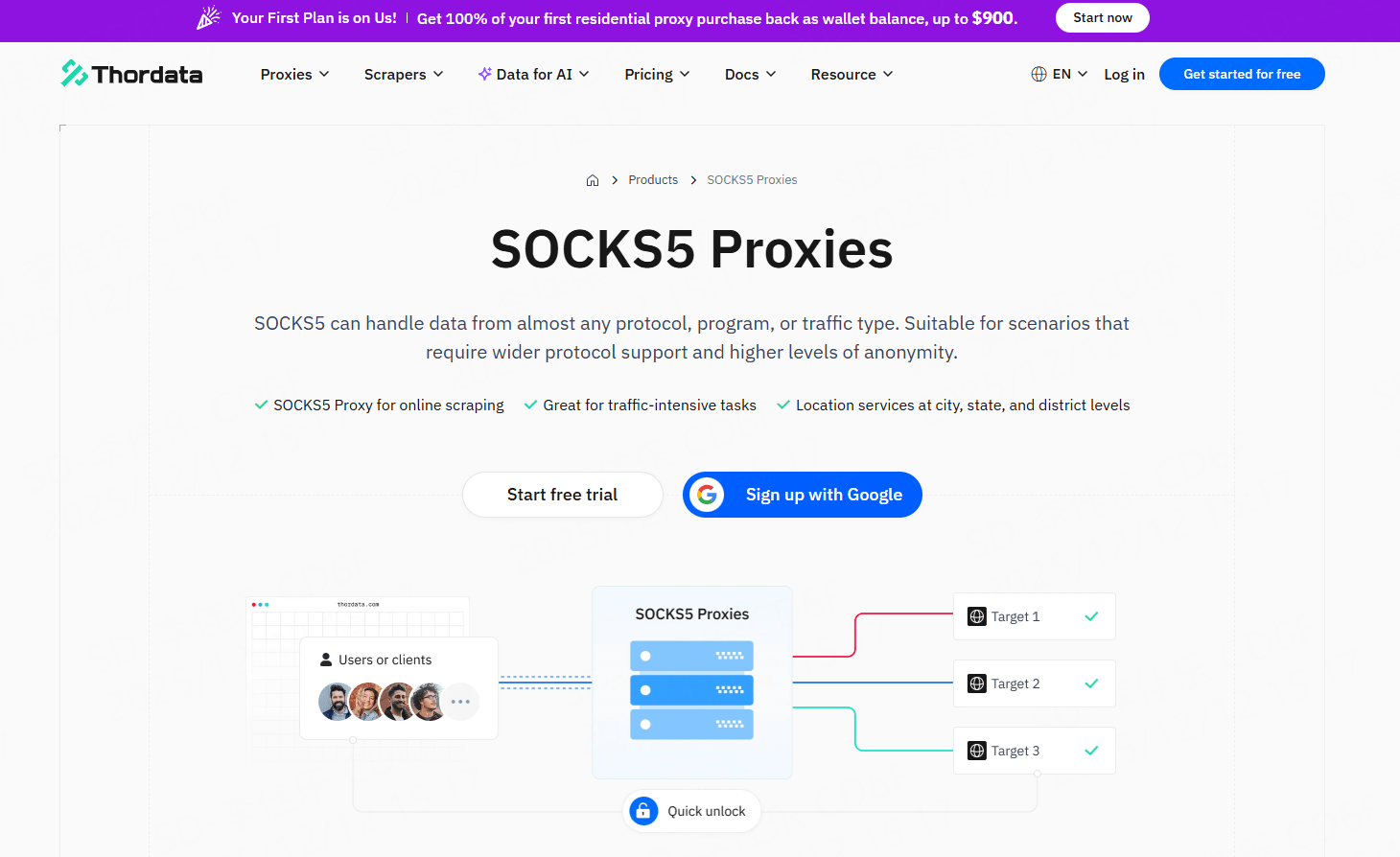
Thordata is a provider focused on high-quality residential proxy networks, known for its stable connections and real user IP pool. Their network is meticulously maintained, designed to support web tasks that require high success rates. For users seeking a reliable private Socks5 proxy service, it is a strong competitor.
Features:
- Offers over 60M+ clean residential IP pool with excellent anonymity
- Covers 190 regions globally, providing city-level targeting options
- Connection success rate up to 99.82%, offering stable long-term connection performance
Proxy Types:
- Residential Proxies: Provide stable connections based on local user network environments, suitable for tasks that require simulating real user access behavior.
- Static ISP Proxies: Provide fixed IP addresses based on the carrier network, which can be used to buy static residential proxies for tasks needing high consistency.
- Datacenter Proxies: Rely on numerous rotatable IP nodes provided by cloud service providers, suitable for scalable scraping, intensive API calling tasks, etc.
- Mobile Proxies: Based on real 4G/5G mobile IP addresses provided by network operators, suitable for mobile app testing and other projects.
Cons:
- Regional coverage is not as extensive as top providers, but the IP pool is clean and stable
2.Brightdata
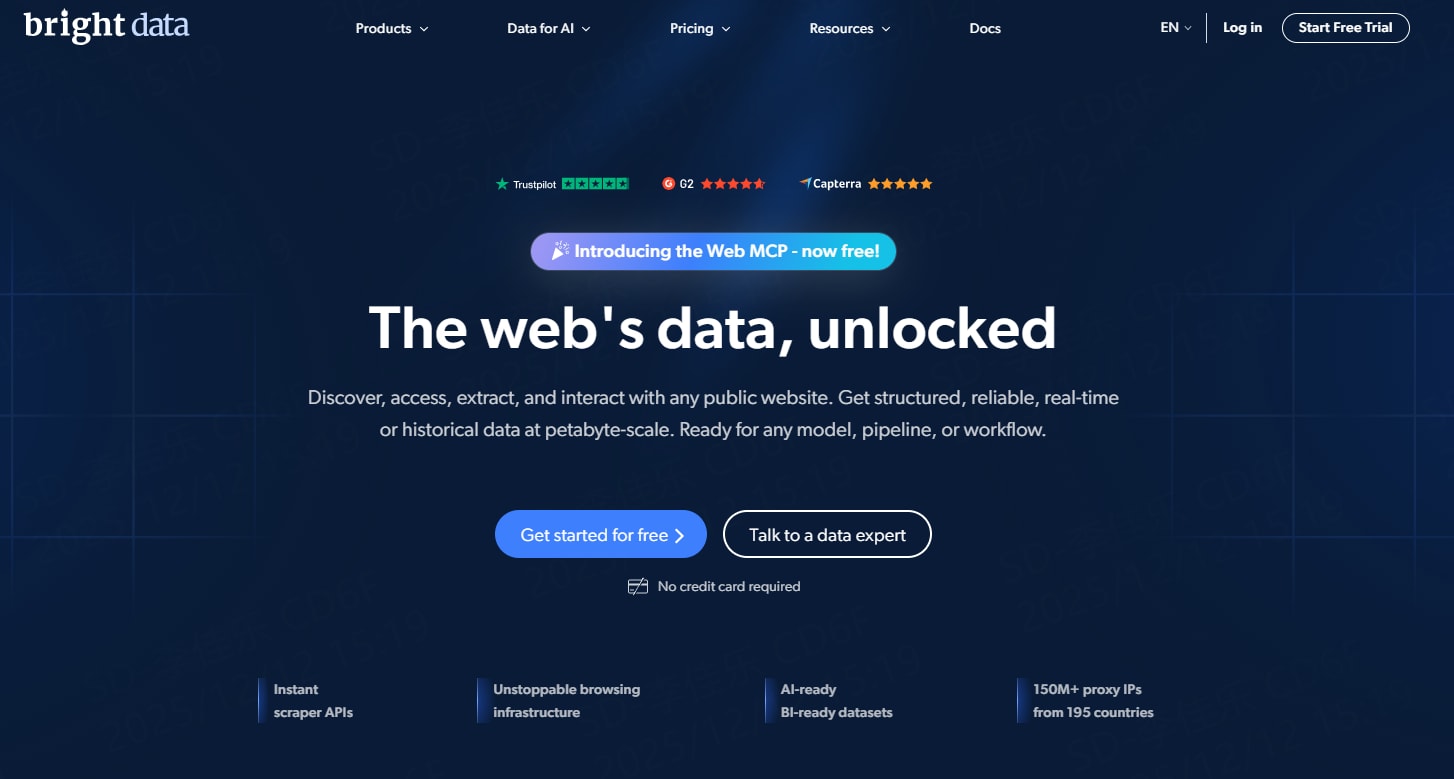
Brightdata (formerly known as Luminati) is known in the industry for its reliability and network breadth, and its technical capabilities are suitable for high-intensity tasks such as data collection, global monitoring, and programmatic testing. The quality of residential IPs is stable, with a low failure rate, making it a core proxy tool for many enterprise teams. Its documentation, development tools, and APIs are also highly mature.
Features:
- Stable quality of residential networks
- Abundant tools for developers
- Provides highly controllable configuration options
Proxy Types:
- Residential Proxies: Provide localized access capabilities through real user network exits, suitable for cross-regional market analysis tasks.
- ISP Proxies: Provide long-term fixed IPs based on real carrier networks, suitable for tasks requiring cross-platform verification.
- Datacenter Proxies: Execute tasks with low latency through high-speed datacenter nodes, suitable for repetitive data scraping, automated requests, and other scenarios.
Cons:
- The pricing structure is complex and requires careful calculation to avoid overspending.
- The learning curve is steep, requiring certain technical skills to configure.
3.Oxylabs
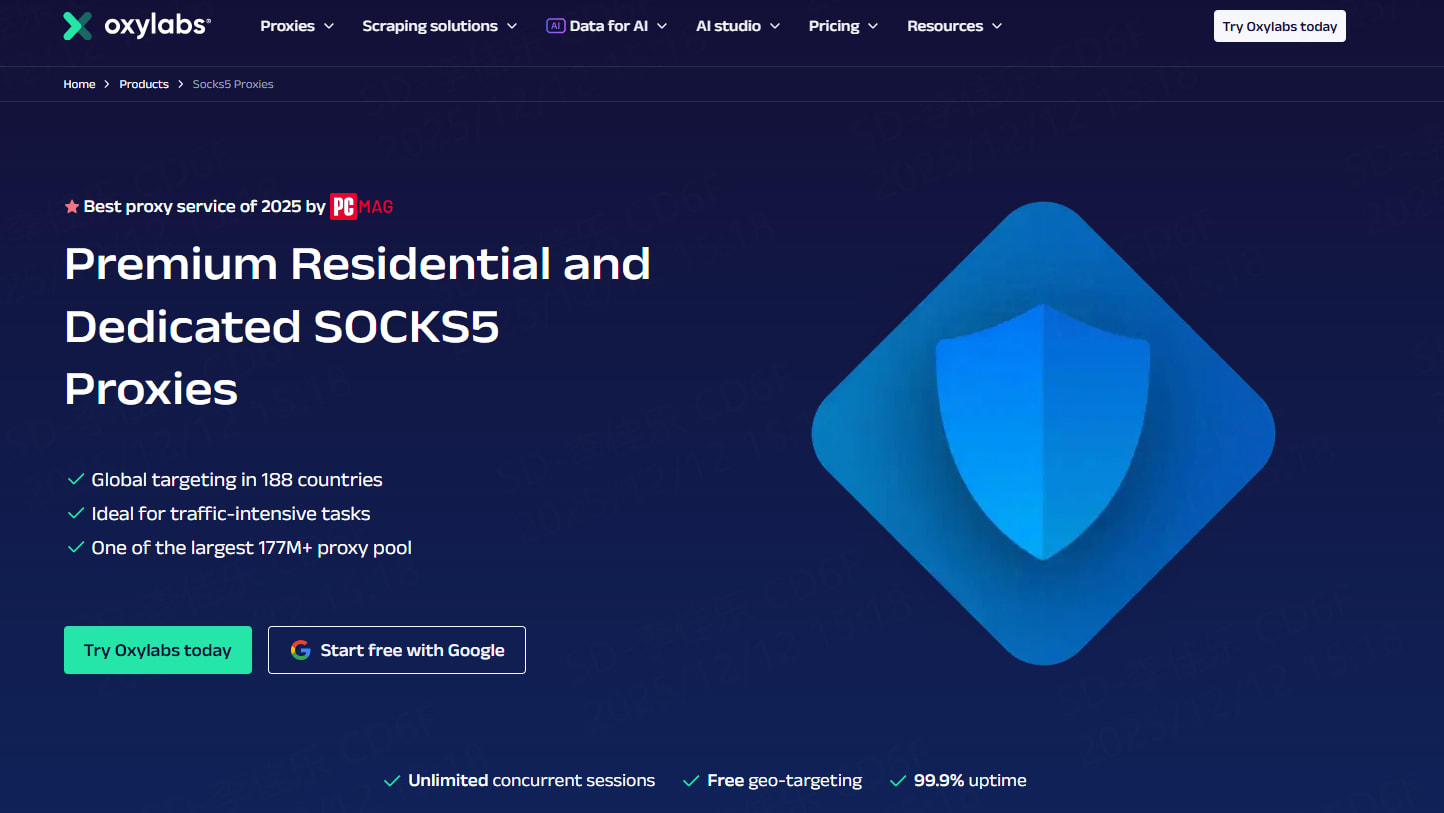
Oxylabs has maintained a stable advantage in the enterprise proxy market for a long time, gaining a good reputation through its large residential IP pool and reliable network quality. For teams that need to run massive requests and perform tasks across multiple countries, its comprehensive capabilities perform very well. Its tech stack also has good compatibility for automated scraping and API calls.
Features:
- Extremely wide coverage area
- Adaptable to complex data collection tasks
- Provides automation and API support
Proxy Types:
- Residential Proxies: This type of proxy uses real end-user networks to simulate natural user access paths, suitable for scenarios such as ad monitoring or SEO analysis.
- Static Residential Proxies: Based on carrier-registered IPs, they can maintain a stable exit identity for long periods.
- Datacenter Proxies: Relying on high-speed datacenter networks to provide a large number of rotatable IP nodes, suitable for tasks requiring large-scale data collection that are not sensitive.
Cons:
- The onboarding cost for newcomers is slightly high.
- The entry-level package pricing is not very friendly.
Final Thoughts
Ultimately, there is no one-size-fits-all answer when choosing between SOCKS5 proxies and HTTP proxies. Be sure to take the time to examine your specific needs: What type of traffic are you primarily dealing with? What do you value most: speed, anonymity, or specific web handling features?
Once you have determined the protocol direction, choose a reputable SOCKS5 proxy provider that matches you in terms of pricing, network quality, and customer support. Remember, the best tool is always the one that seamlessly integrates and enhances your workflow.
Comments
Loading comments…