I know. I know. Your LinkedIn feed is drowning in posts about AI agents. Your Medium homepage is wall-to-wall “agentic AI explained.” Every consultant, creator, and newly-minted thought leader has a hot take on this topic, complete with a carousel graphic and a “save this for later” hook.
I almost didn’t write this.
Then I watched a founder on a call last week say “we’re building an AI agent” when what he was describing was a full agentic system. His CTO quietly corrected him twice. He didn’t notice. The investors did. And I realized — all that content flooding every platform hasn’t actually landed. People are reading these posts, nodding along, and still getting it wrong in the rooms where it matters.
So here’s one more article on a topic that’s been written to death. But this one comes from someone who’s been watching technology terminology get mangled since before most of these content creators were born. Forty years of sitting in the room while “cloud” meant everything, “machine learning” became a catch-all, and “digital transformation” turned into a line item that nobody could define but everyone had to budget for.
I’ve seen this exact confusion cycle seven times across four decades. The pattern is always the same: new capability emerges, people grab the closest existing word, meaning collapses, bad decisions follow, and then — eventually — the builders who understood the distinctions from the beginning end up leading the market.
This isn’t my explanation of a concept. This is a pattern report from someone who’s been building with these tools daily, orchestrating multiple AI models across production workflows, and watching the same movie play out in a new theatre.
Three terms. Three very different things. One framework you’ll actually remember.
The Prompt Machine: Non-Agentic AI
This is where most people still live, and there’s nothing wrong with that. You type something into ChatGPT, Claude, or Gemini. You get something back. The interaction ends. No memory. No reasoning chain. No tool use.
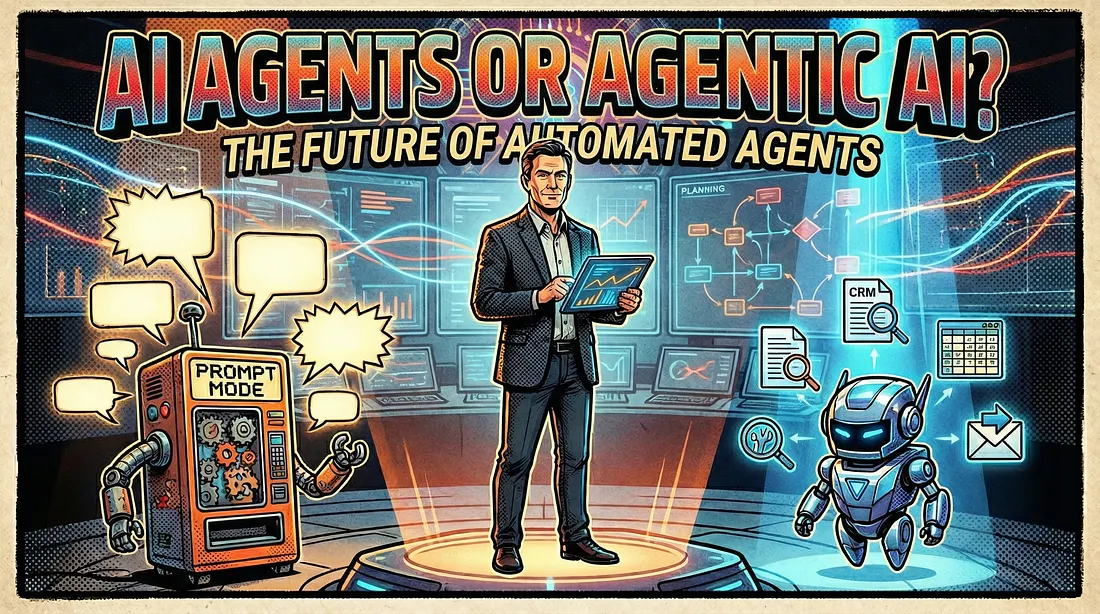
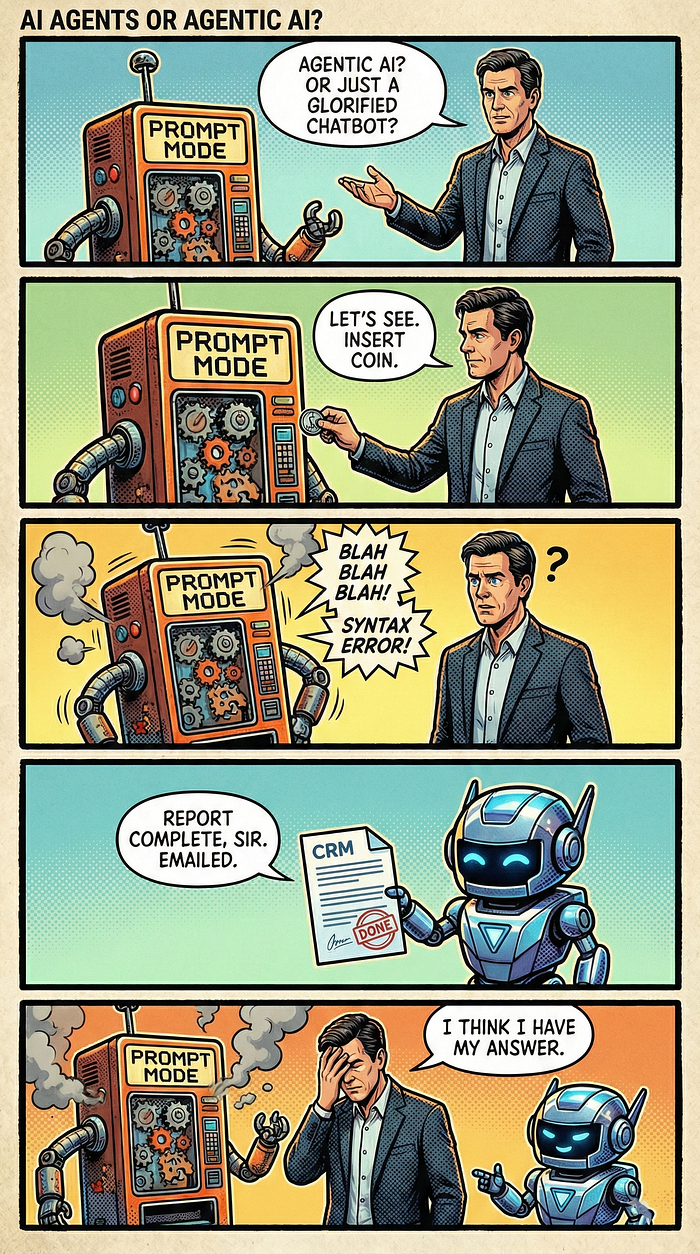
Think of it as a vending machine. You put in a coin (your prompt), press a button (submit), and get a snack (the output). The machine doesn’t remember you were here yesterday. It doesn’t check whether the snack is any good. It just dispenses.
A founder summarizing a market report into five bullet points before a pitch meeting. A marketer testing three tones for a sales email. A content creator generating twenty headline variations for a LinkedIn post in under a minute. These are all prompt-level tasks, and a prompt is all they need.
The strengths are real — fast, cheap, universally accessible, zero technical setup. But so are the limits. No reasoning. No context awareness. Quality depends almost entirely on what you put in. And anything multi-step? That’s where things fall apart.
Non-agentic AI is a power tool. A very good screwdriver. But it’s not a workshop.
The Orchestra: Agentic AI
Now we get interesting. Agentic AI is a self-managing system. You don’t give it a prompt — you give it a goal. It plans. It decomposes that goal into sub-tasks. It connects to tools, APIs, and data sources. It executes, evaluates, and iterates.
This is the difference between asking someone to write you an email and hiring someone to run your marketing department.
A consultant asks the system to research ten competitors, draft a market analysis, and design a slide deck for client delivery. A growth team sets it to manage ad campaigns across Google and Meta, monitoring performance and adjusting spend daily. A SaaS founder uses it to generate onboarding flows, test them with dummy data, and refine copy based on user behaviour.
I work this way every day. When I use Claude Code to architect a full application — planning the structure, writing the code, testing, debugging, and iterating across sessions — that’s agentic AI. The system isn’t just responding. It’s reasoning. It holds context. It checks its own work. It adapts when something breaks.
But agentic systems are slower and more expensive. They still require human oversight. And there’s a real risk of overbuilding — deploying a full orchestration system when a single prompt would’ve handled it in ten seconds. I’ve caught myself doing this. More than once.
The Specialist: AI Agent
Here’s where the confusion lives, and where all those LinkedIn carousels fail you. An AI agent is not an agentic system. An agent is a single-task worker. One job. Repeated reliably. A specialist contractor, not a general manager.
You define one clear responsibility — “update CRM records every Friday” or “generate weekly expense reports.” The agent receives inputs, accesses one or two connected tools, and executes. Done. No step-by-step hand-holding required, but no creative problem-solving either.
A sales leader deploys an agent to pull pipeline data from HubSpot and update a Google Sheet for the team. A customer service team uses one to draft personalised replies to FAQs and send them automatically. A finance lead has one pulling transactions from accounting software every week.
Agents are beautiful when scoped correctly. They automate the repetitive stuff. They’re easy to test and refine. But they’re brittle outside their lane. Unclear inputs break them. Missing data breaks them. And on their own, they can’t handle anything that requires judgment or adaptation. They need orchestration to work as a team — which, if you’ve been paying attention, means they need agentic AI sitting above them.
See how the pieces connect? That’s the part most of those flooding articles miss.
Why This Version Matters
I’m not going to pretend I have some proprietary insight that nobody else does. The definitions above aren’t secrets. You can find variations of them in a hundred posts published this week alone.
What I can offer is the pattern recognition that comes from living through this — not just reading about it.
I’ve watched “client-server” become “the web” become “the cloud” become “serverless” become “AI-native.” Every single transition had this exact moment where the terminology got ahead of the understanding. The companies that sorted it out early built the right architectures. The ones that didn’t built expensive messes and blamed the technology.
Here’s the framework, distilled:
Non-Agentic AI is your individual contributor. Fast, focused, no memory. Perfect for discrete tasks where you provide all the context. Stop overcomplicating things that should be a prompt.
Agentic AI is your department head. It plans, delegates, reviews, and adapts. It needs infrastructure, oversight, and clear goals. Stop calling this “an agent.”
AI Agents are your specialists. Each one owns a narrow workflow and executes it reliably. They need clear inputs, structured environments, and orchestration. Stop expecting them to think.
The real skill isn’t choosing one. It’s knowing when to deploy each. The founder summarizing a report doesn’t need an agentic system — that’s a prompt. The growth team managing cross-platform spend doesn’t need a single agent — that’s orchestration. The finance lead pulling weekly data doesn’t need a full architecture — that’s an agent.
The Ask
Next time someone in your org says “let’s use AI for this,” ask them which kind. If they can’t answer, they’re not ready to build. If they use the terms interchangeably, send them this article. Not because it’s the only one that explains the difference — there are hundreds of those. But because it’s the one written by someone who’s watched this exact confusion cost real companies real money, seven technology cycles in a row, and would rather you didn’t make the same mistake in this one.
AI didn’t take your job. But it did promote you to a role that requires knowing the difference between a prompt, a system, and a specialist.
Your competitors already do.
Comments
Loading comments…