The 6-Step System That Lets AI Create Your Content While You Sleep
How I went from burning out on content creation to orchestrating an AI assembly line that works 24/7
Three months ago, I was drowning. Creating content across platforms, responding to comments, editing videos at midnight, and watching my work disappear into the algorithm’s void by morning. Sound familiar?
Then something clicked during a late-night coding session at my studio. I realized I’d been thinking about AI all wrong. I wasn’t supposed to be the worker anymore. I was supposed to be the conductor.
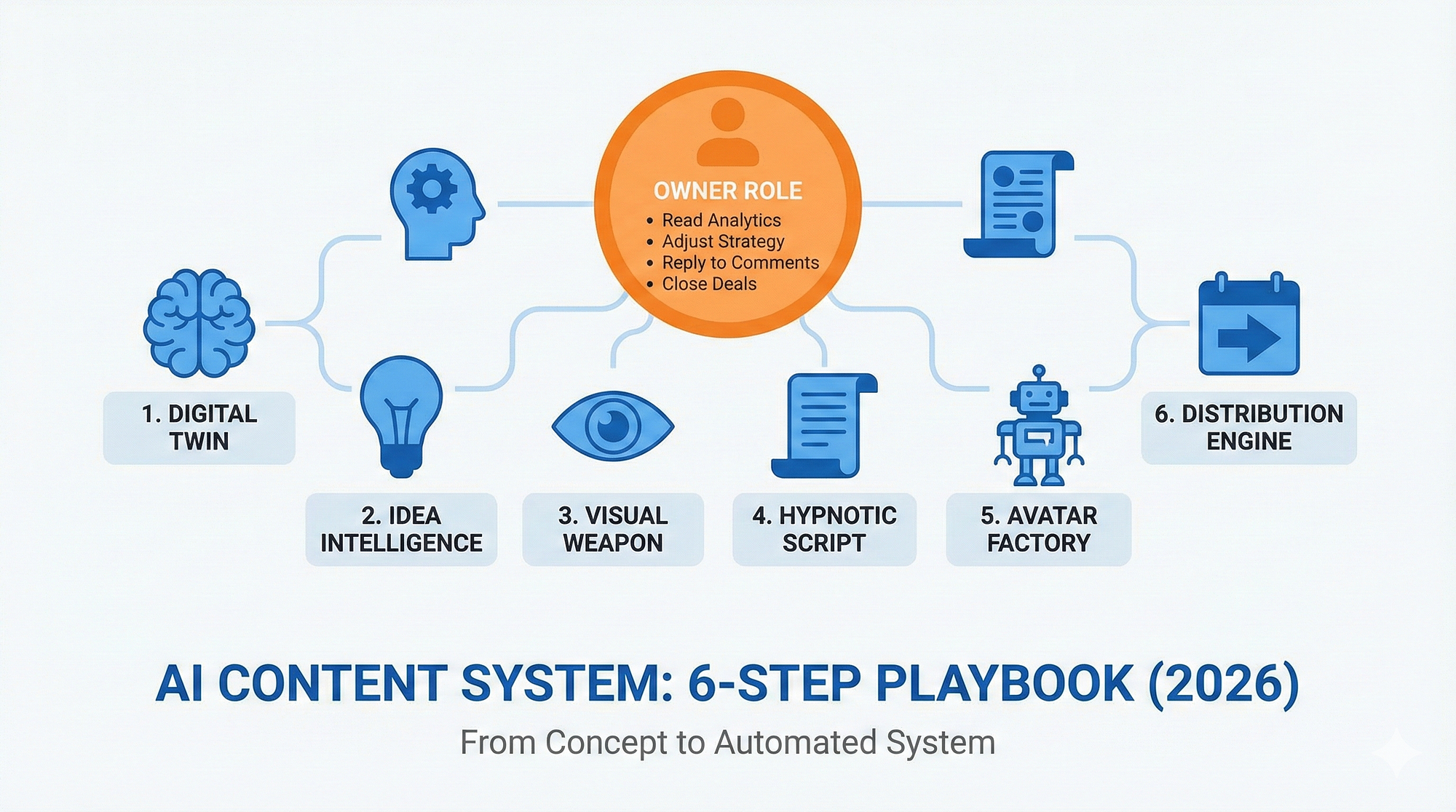
After 40+ years building systems, I know one truth: the best systems don’t just automate tasks, they orchestrate entire workflows. So I built one for content creation. Six steps. Fully systematic. Completely repeatable.
Here’s the framework that transformed how I create hundreds of pieces of content monthly without touching a camera.
Press enter or click to view image in full size
The Fatal Mistake Most Creators Make With AI
You’re using AI like a better typewriter. Type a prompt, get an output, edit it heavily, post it, repeat. If the output feels robotic or templated, an AI humanizer can help polish the wording so it reads like a real person wrote it without changing the idea.
Real intelligence orchestration means building systems where AI handles the entire production pipeline while you focus on what actually matters: strategy, relationships, and closing deals.
The difference? Most creators are still employees of their own business. Intelligence orchestrators become CEOs of automated content factories.
Step 1: Digital Twin — Clone Your Brain and Voice
The Goal: Train AI to think, write, and tell stories exactly like you do.
This isn’t about feeding ChatGPT a few samples and hoping for the best. This is about creating a genuine digital twin that captures your decision-making patterns, storytelling cadence, and unique perspective.
I started by dumping everything into the system. Old blog posts, video scripts, email responses, even DM conversations where I explained complex technical concepts. The AI needed to see not just what I say, but how I think through problems, how I build arguments, and where I inject personality.
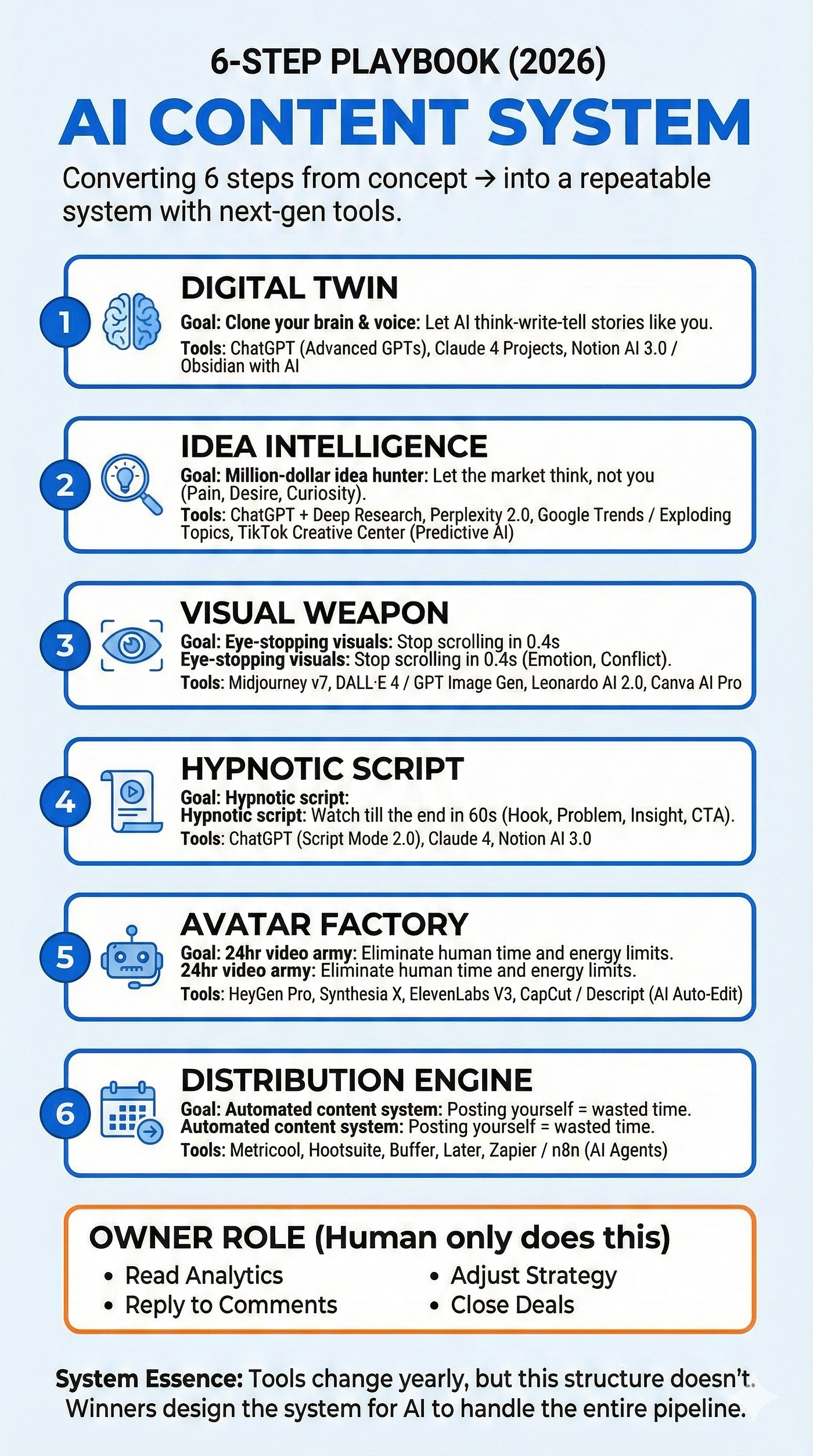
The tools that actually work right now: ChatGPT’s Custom GPTs let you create a persistent persona that remembers your style across sessions. Claude Projects excel at analyzing longer content and extracting deep patterns in your voice. I use Notion AI as my knowledge vault, storing the raw material that feeds both systems.
The output? A Digital Twin Prompt that becomes your content creation brain. Mine is about 2,000 words of distilled voice patterns, thinking frameworks, and style guidelines. Every piece of content starts with this foundation.
Critical insight from my Google days: Systems that teach themselves are better than systems that need constant supervision. Your Digital Twin should improve with every piece of content you approve, learning from your edits and adjustments.
Step 2: Idea Intelligence — Let the Market Think For You
The Goal: Stop brainstorming. Start mining proven demand.
The best content ideas aren’t the ones you think are clever. They’re the ones your audience is already searching for, sharing, and paying attention to.
I feed broad topics into my research system and let AI hunt for three things: pain points that keep people up at night, desires they’ll pay to achieve, and curiosity gaps that make them click. Then I score each angle on viral potential and monetization opportunity.
This step eliminates the creator’s worst enemy: making content nobody asked for.
Current toolkit: ChatGPT with browsing mode or the new Deep Research feature can analyze trends in real-time. Perplexity Pro gives you research with citations. Google Trends and TikTok Creative Center show you what’s actually moving. I run this process weekly, generating 30 to 50 scored topic ideas that my system can execute on demand.
The Meta playbook I learned: Build once, scale infinitely. One research session produces a month of content angles. Your job isn’t to come up with ideas. Your job is to identify which proven ideas your audience wants from your unique perspective.
Step 3: Visual Weapon — Stop Scrolling Thumbs in 0.5 Seconds
The Goal: Create images that tell a story before words do.
In my YouTube analytics, the pattern is brutal. Videos with generic thumbnails get 3% click-through rates. Videos with emotional, conflict-driven visuals get 15% to 20%. That’s not a marginal improvement. That’s the difference between obscurity and virality.
Your visual needs to communicate emotion, conflict, and curiosity simultaneously. A person staring blankly at a laptop won’t cut it. A person’s face lit by an eerie blue glow with shadows suggesting something’s wrong? Now we’re talking.
I maintain a Visual Prompt Library with proven templates. Each template maps to an emotional state I want to trigger: urgency, curiosity, fear of missing out, relief, revelation.
The 2025 image generation stack: Midjourney v6 dominates for cinematic, emotion-rich imagery. DALL-E through ChatGPT works for fast conceptual drafts. Leonardo AI maintains consistent style across a series. Canva AI handles quick thumbnail iterations.
From my OverNormal Studios music work: The thumbnail is the song’s cover art. It sets expectations and creates the emotional container for everything that follows. Nail this and the algorithm rewards you. Miss it and your content dies unseen.
Step 4: Hypnotic Script — Engineer Completion in 60 Seconds
The Goal: Write content that pulls people from hook to call-to-action without friction.
Every script follows a proven structure: Hook them in the first three seconds with a provocative question or bold claim. Immediately present a problem they recognize. Deliver an insight or solution that reframes their understanding. Close with a clear call-to-action.
The magic isn’t in the individual components. It’s in the transitions. Each sentence must make the next one irresistible.
I use ChatGPT in what I call Script Mode, a custom GPT trained on my storytelling patterns. Claude handles longer narrative arcs when I’m building educational content. Notion AI stores my script templates, so I’m never starting from scratch.
The neuroscience angle: Your script needs to trigger dopamine with curiosity, oxytocin with relatability, endorphins with humor or relief, and adrenaline with urgency. Miss any of these and engagement drops.
Bank of America taught me this: In enterprise communication, you have seven seconds to prove value or lose the executive’s attention. Online? You have three. Engineer for that reality.
Step 5: Avatar Factory — Multiply Yourself Across 24 Time Zones
The Goal: Remove human limitations from production.
This is where things get exponential. Voice cloning and AI avatars mean you can batch-produce 10 to 20 videos in the time it used to take to record one.
I cloned my voice using ElevenLabs, trained an avatar through HeyGen, and now I can script, produce, and render videos while I’m asleep. The avatar speaks with my cadence, my gestures, and my energy level. Most viewers can’t tell the difference.
Current production stack: HeyGen for natural avatar videos with multiple language support. Synthesia if you need a more corporate, polished aesthetic. ElevenLabs for voice cloning that captures emotional range. CapCut or Descript for automated editing that adds B-roll, captions, and transitions.
The psychological barrier here is real. It feels weird to see yourself speaking words you didn’t physically say. But here’s what I realized from mentoring my teenage son in full-stack development: if the tool produces the outcome you want and frees your time for higher-leverage work, use it.
The multiplication effect: One hour of scripting can produce a week of daily video content. You’re no longer trading time for output. You’re orchestrating production.
Step 6: Distribution Engine — Post Everywhere, All the Time, Without Thinking
The Goal: Make posting content as automatic as breathing.
You didn’t build all this to manually paste into Instagram, TikTok, YouTube, LinkedIn, and Twitter every day. That’s insane.
I schedule everything in advance through Metricool, which handles timing optimization across platforms automatically. Zapier connects my content pipeline to distribution, so approved scripts flow directly to scheduled posts. I wake up to content that posted while I slept, engagement notifications rolling in, and analytics showing what’s working.
Current automation tools: Metricool or Hootsuite for multi-platform scheduling. Buffer if you want simplicity. Later for visual-first platforms. Zapier or n8n for workflow automation between your creation tools and distribution channels.
The system learns optimal posting times through testing. It A/B tests headlines. It repurposes long-form into shorts automatically. Your job? Review analytics weekly and make strategic adjustments.
What You Actually Do (The Owner Role)
Here’s what’s left for you after building this system: Read the analytics to understand what’s landing. Respond to high-value comments and DMs. Adjust the strategy based on performance data. Close deals with the clients your content attracted.
That’s it. You’ve moved from maker to manager to orchestrator.
Last week, my system produced 47 pieces of content across platforms. I personally created zero of them. I spent my time on strategy calls, partnership discussions, and expanding OverNormal Studios. The content machine ran itself.
The One Truth That Doesn’t Change
Tools evolve constantly. HeyGen today might be replaced by something better next year. The platforms shift. The algorithms update.
But this six-step structure? This is architecture. It works because it maps to how content actually flows from idea to distribution, with AI handling execution at each stage.
The creators who win long-term aren’t the ones who use AI best. They’re the ones who design systems that let AI work for them 24/7 while they focus on orchestration, not execution.
You didn’t get promoted from your job. AI promoted you. Now the question is whether you’ll step into that leadership role or keep doing the work a machine can handle better.
I chose orchestration. My content output multiplied by 10x. My stress divided by the same factor.
The assembly line runs while I sleep. The algorithm feeds on fresh content daily. And I finally have time to build the next system.
Press enter or click to view image in full size
Comments
Loading comments…