The 8 best SEO reporting tools in 2026, judged on published keyword and crawl ceilings instead of entry price. See what survives a 400,000 page catalogue.
The 8 Best SEO Reporting Tools in 2026 for Sites With Hundreds of Thousands of Pages
Our reporting renewal landed the fortnight the catalogue crossed 400,000 SKUs. The demo ran against a 200 page site: every chart rendered beautifully, none answered what ships next. Most SEO reporting tools are sold on how a dashboard reads, not on what survives a catalogue that reprices daily. Google's crawl budget guidance puts a large site at 1 million or more unique pages, and a medium or larger site at 10,000 or more unique pages with very rapidly changing content, figures Google calls a rough estimate rather than exact thresholds. We were in that bracket years before procurement said enterprise.
I judge SEO reporting tools on five ceilings, checked before any demo:
- Published keyword ceiling and refresh interval. Weekly checks under-report a daily catalogue.
- Published crawl ceiling per run. Under catalogue size is sampled coverage.
- Roll-up by template or segment. A 60,000 row list is not a ticket.
- AI-search visibility, included or metered, on named engines.
- The bill at real volume.
Which SEO reporting tool still works at catalogue scale?
Of the SEO reporting tools compared here, SE Ranking is the pick for most teams at this scale. Its Growth plan audits up to two million pages a month. The crawl outlasts the catalogue. If the crawl has to be unlimited and procurement can absorb a sales cycle, a dedicated enterprise platform below goes further on that one axis.
The 8 SEO reporting tools compared by published ceiling
The eight SEO reporting tools below are ordered by what holds at catalogue scale: published keyword and crawl ceilings first, billed cost last.
| Rank | Tool | Keyword ceiling | Crawl ceiling | White label | AI search | Cost at volume |
|---|---|---|---|---|---|---|
| 1 | SE Ranking | 2,000/day Core, 5,000/day Growth; extra $28/mo Core, $40/mo Growth | 250,000 pages/mo Core, 2,000,000 Growth | Agency Pack add-on, $69/mo annual | Native: ChatGPT, Gemini, Perplexity, AI Overviews, AI Mode | Growth $279/mo ($223.20 annual) |
| 2 | seoClarity | 5,000+ queries, Enterprise | Unlimited, published | Not published | Yes, engines unpublished | $4,500/mo floor, quote only |
| 3 | Serpstat | 500,000, published | 1,500,000 pages, published | Agency tier only | Team tier up | Agency $410/mo |
| 4 | Nightwatch | 500 to 20,000+, daily | 1,000 / 10,000 / 100,000 / unlimited | Professional up, EUR 159/mo | Six engines, every plan | Agency EUR 399/mo; Enterprise quoted |
| 5 | Advanced Web Ranking | 7,000 to 50,000 | None, no crawler | Agency tier up | Yes, engines | $980/mo at 50,000 |
| 6 | AgencyAnalytics | Add-on, $41.67/mo per 500, weekly | None published | Every tier, custom domain | Metered beta add-on | About $3,333/mo at 40,000 keywords |
| 7 | Google Search Console | No keyword tracking | No crawler you control | None, not shareable | Performance covers AI surfaces | Free, 50,000 rows a day |
| 8 | Google Analytics 4 | No keyword tracking | No crawler | None published | None native | Free, 360 quoted |
Methodology: ceilings and prices read off vendor pricing pages on 16 September 2026.
Job One: Prove What Happened Across 400,000 Pages
A report must first establish what Google indexed and what earns clicks. At 400,000 SKUs the free tools feeding your seo kpi dashboard answer with a sample, not a census.
The Search Analytics API returns at most 25,000 rows per request, and Google states it does not guarantee to return all data rows but rather top ones.
Google treats any dimension with more than 500 values as high cardinality and groups the overflow into an "(other)" row; its own worked example puts 50,000 rows into "(other)" on a 150,000 page property against a 100,000 row limit.
John Mueller of Google put it plainly: "We'll index a lot less. And then you'll see things like crawled not indexed or discovered not indexed". SEO reporting tools that clear procurement measure audits in the hundreds of thousands; SE Ranking's crawler is sized for two million a month.
Job Two: Keep the Bill Sane as Keyword Volume Grows
Entry price buys an allowance our catalogue exhausts in a week. The only honest comparison is arithmetic at the volume you track.
At 7,000 keywords Advanced Web Ranking charges $139/mo; at 50,000, $980/mo. AgencyAnalytics meters rank checks weekly, and category pages move daily.
Nightwatch's ladder stops at 20,000; seoClarity's floor is around $4,500/mo, nothing self-serve. SE Ranking publishes both rungs on the plan you already run: 2,000 keywords a day on Core, 5,000 on Growth, checked daily on desktop and mobile. That cadence is what SEO reporting automation has to hold.
The backlog question is not which enterprise SEO reporting software wins on entry price, but which curve you can still afford in eighteen months.
Job Three: Decide Which Template Ships Next Sprint
At 400,000 pages nothing gets fixed page by page. A report earns its place by rolling the catalogue up by template or segment and naming the one to rebuild.
On US retail sites, 66% of product pages are machine readable, against 74% of category pages and 75% of homepages. The template with the most URLs behind it scores worst, and a page-level report buries it.
Template defects are expensive: 36% of the 344 top-grossing retailers audited have harmful product-list flaws, with an average of 35 design changes needed.
As Kelly-Anne Crean, Head of Operations at Koozai, puts it, "Stop reporting on rankings. Start reporting on what keeps the business in business: revenue, sales, and leads." SEO reporting best practices come down to one line: this template, these URLs, this revenue share. Ecommerce SEO tools earn their place on that roll-up.
The Eight Tools, Ranked
These eight SEO reporting tools are ranked on three jobs: what Google indexed, the bill at volume, the template roll-up.
1. SE Ranking
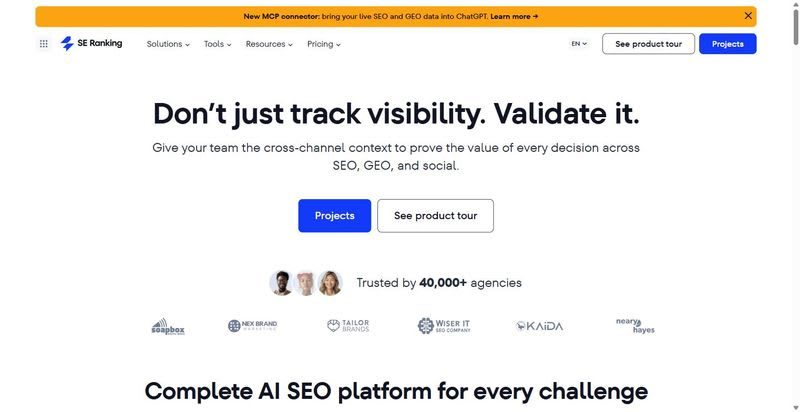
SE Ranking generates the rank, backlink, audit and AI-visibility data it reports on, so the report and the crawl answer to one published ceiling instead of two vendors' limits.
Best for: mid-market and enterprise in-house teams, and established agencies, reporting on catalogues in the hundreds of thousands of URLs.
Standout: Growth audits up to 2,000,000 pages a month with 115+ checks and JavaScript rendering included, and daily desktop and mobile rank tracking feeds the same reports. AI visibility across ChatGPT, Gemini, Perplexity, AI Overviews and AI Mode sits beside classic SEO in reports built on the platform's own rank, backlink and audit data.
Pros:
- Audits 250,000 pages a month on Core and 2,000,000 on Growth
- Includes API and MCP access in every plan, not as an add-on
- Tracks positions daily on desktop and mobile across 188 country databases
- Shares live dashboards by guest link that consumes no paid seat, from Growth up
Cons:
- Unlimited white-label reporting lives in the Agency Pack add-on, from $69/mo on annual billing, not in the base plan
- Report, seat and project volumes scale with tier: Core ships one manager seat and ten reports
- No automated cross-channel correlations inside the platform, though an AI assistant can run them through MCP
- The audit allowance is monthly, not per run: 2,000,000 pages on Growth is five full crawls of a 400,000 URL catalogue, so weekly recrawls mean slicing the URL set
Pricing: Core $129/mo ($103.20/mo billed annually), Growth $279/mo ($223.20/mo billed annually). Extra manager seats from $20/mo.
What ships: Growth is the tier that matches a catalogue: 5,000 keywords a day, 30 reports, three seats, all-time history. Core's 250,000 pages and six-month window will not carry 400,000 SKUs. API and MCP in every plan settled it.
2. seoClarity
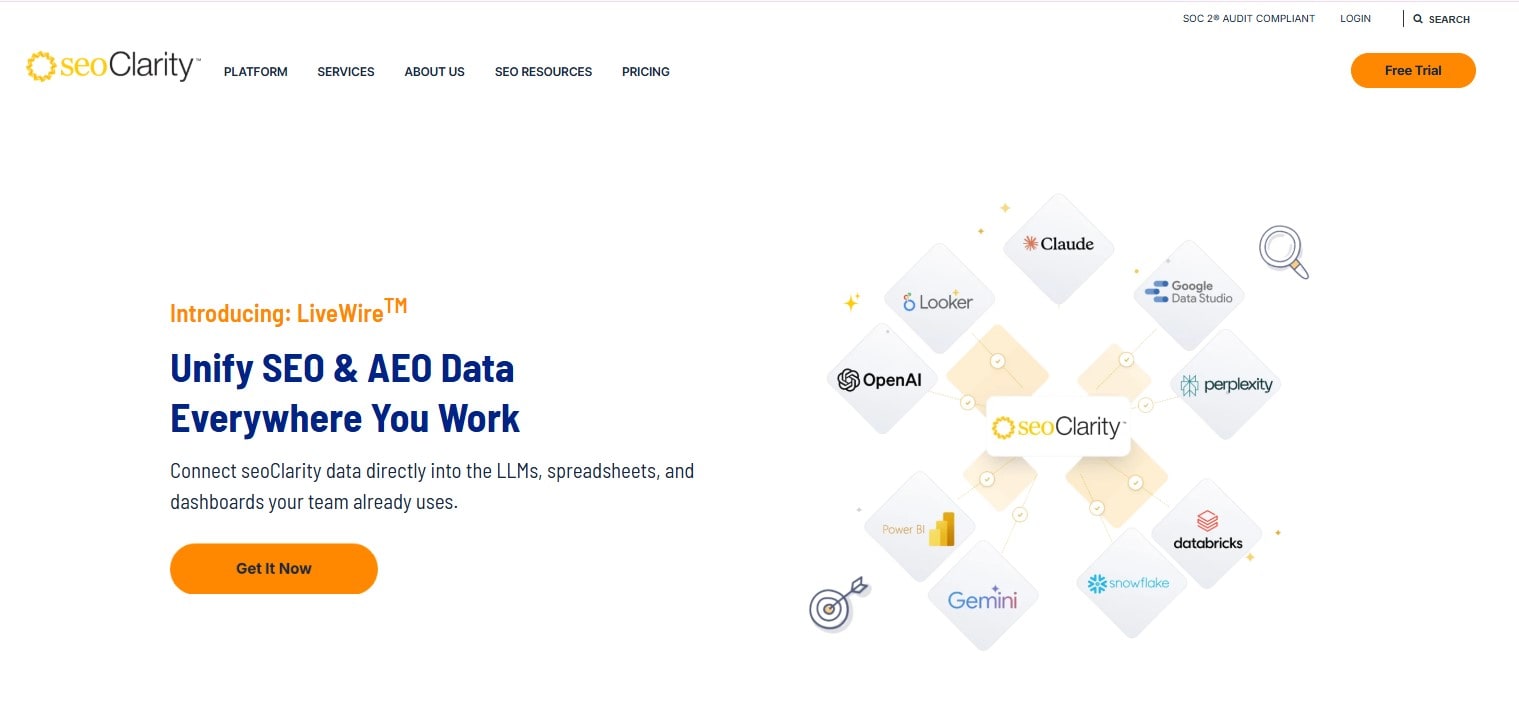
As an enterprise SEO platform, seoClarity fits in-house teams running one very large property on negotiated limits.
Best for: enterprise in-house teams with open-ended crawl requirements.
Standout: Unlimited crawl pages, unlimited projects and unlimited users are published on the Rankings module. The ceilings are shaped for a catalogue by default rather than by add-on. At 400,000 SKUs nothing changes.
Pros:
- Publishes unlimited crawl pages and unlimited projects
- Includes unlimited users
- Sells by module, so you buy one reporting axis
Cons:
- Published Enterprise floor around $4,500/mo, nothing self-serve
- Every limit is negotiated, so the sales cycle is part of the cost
- Prices rankings by query volume, with a published 2,000 query minimum before a single position gets tracked
Pricing: quote-based. Research and Content from $2,500/mo, Technical SEO from $3,200/mo, Enterprise from $4,500/mo.
What I'd cut: the scoping call. We need an answer this sprint, and every limit here is negotiated.
3. Serpstat
Serpstat is a four-in-one SEO platform whose published keyword ceiling is the highest in this roster.
Best for: agencies reporting on several large catalogues.
Standout: Serpstat publishes keywords up to 500,000 and site audit up to 1,500,000 pages on its Agency tier at $410/mo. Those are the vendor's published figures, not volumes we measured, and no other tool here publishes a keyword ceiling that high.
Pros:
- Publishes a keyword ceiling of 500,000
- Publishes a site audit ceiling of 1,500,000 pages
- Scales seats from 1 to 30
Cons:
- White label is Agency-tier only
- API access starts at Team
- Daily query limits of 100 / 500 / 1,000 / 5,000 are the real constraint, not the headline ceiling
Pricing: Individual $50/mo, Team $100/mo, Team x2 $169/mo, Agency $410/mo; AI search and AI Overview tracking start at Team.
What we kept: the published ceiling, with a note beside it. The daily query cap decides the tier.
4. Nightwatch
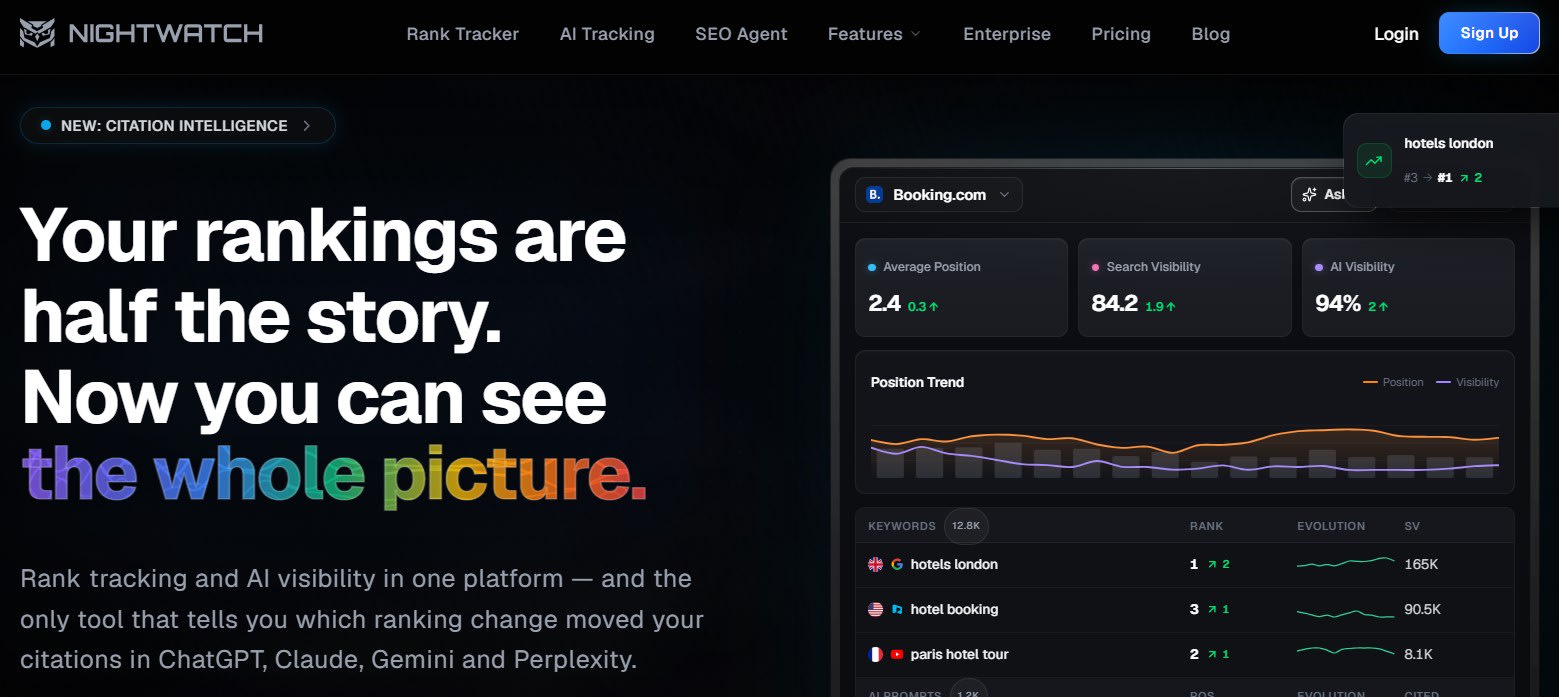
Nightwatch tracks daily and publishes every ceiling it sells.
Best for: in-house teams wanting published limits.
Standout: No other crawl ladder here is published as cleanly: site audit at 1,000, 10,000, 100,000 and unlimited pages per audit. AI visibility runs on every plan across ChatGPT, Claude, Gemini, Perplexity, AI Mode and AI Overview, with sentiment and citation analysis.
Pros:
- Seats are unlimited on every paid tier
- Tracks 500 to 20,000 plus keywords daily
- Meters prompts at 50, 150, 500
Cons:
- Keyword ladder stops at 20,000 before a sales conversation
- Three years of SERP history under-proves a multi-year rebuild
- Enterprise is quote-only, so the unlimited audit tier is a negotiation, not a published rung
Pricing: Starter EUR 79/mo, Professional EUR 159/mo, Agency EUR 399/mo, Enterprise quote-only. Two free months yearly, white label from Professional.
The sprint test: a 400,000 page catalogue needs the top tier for the crawl alone.
5. Advanced Web Ranking
Advanced Web Ranking is SEO tracking software that publishes its whole volume curve, tier by tier, before you sign.
Best for: teams that already own crawl data.
Standout: The most honest published volume curve in this roster: 7,000 keywords, then 14,500, then 35,500, then 50,000, with unlimited websites and unlimited users published across every tier. It tells you what year four costs before you sign year one.
Pros:
- Scales to 50,000 keywords on published pricing
- Adds white label from the Agency tier at $279/mo
- Reports AI search visibility in-platform
- Publishes annual pricing beside monthly: $1,499/yr on Pro, $10,780/yr at 50,000 keywords
Cons:
- Ships no crawler, so index coverage and on-page come from elsewhere
- Entry price sits five to seven times under catalogue-scale cost
Pricing: Pro $139/mo, Agency $279/mo, Enterprise $699/mo, $980/mo at 50,000 keywords.
What ships: positions at volume, nothing else. Plan a crawler beside it.
6. AgencyAnalytics
AgencyAnalytics builds its SEO reporting tool around client dashboards rather than measurement.
Best for: agencies presenting data bought elsewhere.
Standout: One all-features tier at $20 per client per month, billed annually, with white label included everywhere, custom domain and custom email, and no seat maths. AI Tracker is a metered beta add-on at $20.83/mo per 250 credits, annual only.
Pros:
- Bundles 85+ integrations into one client portal
- Covers ChatGPT, Google AI Overview, Google AI Mode and Claude
- Carries unlimited staff and client users
Cons:
- Excludes rank tracking, sold as a metered add-on
- Publishes no site-crawl product
- Prices by client count: an in-house team with one huge property pays little for the container, everything for the rank data
Pricing: $20 per client per month annually, plus $41.67/mo per 500 keywords weekly.
What I'd cut: the rank add-on. It bills near $3,333/mo at 40,000 keywords to check weekly what moves daily.
7. Google Search Console
Google's own record of what it indexed and what still earns clicks, free per verified property, at any catalogue size.
Best for: teams needing Google's verdict at catalogue scale.
Standout: It's the only tool here that reports what Google actually did with the catalogue rather than what a crawler inferred. Index coverage and performance data arrive per verified property, performance data covers AI surfaces, and property-level user management is free.
Pros:
- Index coverage comes straight from Google
- Covers AI surfaces inside performance data
- Property-level users cost nothing
Cons:
- Caps performance data at 50,000 rows per day per type per property
- No cross-property roll-up, no white label, nothing client-ready
- Returns at most 25,000 rows per Search Analytics API request and defaults to 1,000, so the programmatic route samples too
Pricing: Free.
What we kept: At 400,000 SKUs it samples the past. Nothing in it says what ships next.
8. Google Analytics 4

The revenue half of any ecommerce SEO report: free first-party data under every organic session.
Best for: teams pricing organic sessions in revenue.
Standout: No SEO platform in this roster produces this on its own. Analytics supplies the first-party behavioural and e-commerce data that turns an organic session into revenue per template and per landing page. Property-level user management is free at any team size.
Pros:
- The e-commerce revenue no SEO tool holds
- Attaches behaviour to organic sessions
- Manages property-level users free
Cons:
- Any dimension with more than 500 values counts as high cardinality, and an over-limit table dumps the overflow into an "(other)" row that buries long-tail revenue
- Reports AI referrals as ordinary referral traffic unless hand-segmented
- Ships no white label, so nothing in it is client-ready
Pricing: Free, Analytics 360 quote-only.
The sprint test: It won't say which template to rebuild, only what rebuilding earned.
Frequently Asked Questions
Four questions come up every time we re-scope SEO reporting tools for a 400,000 page catalogue. Each answer turns on published limits, not entry price.
What is the best enterprise SEO reporting tool?
The best enterprise SEO reporting tool is whichever publishes a keyword and crawl ceiling above your actual page and keyword count, rolls results up by template, and states the bill at that volume. SE Ranking publishes those ceilings by plan; treat that as the shortlist minimum.
How do you report SEO on a site with hundreds of thousands of pages?
You stop reporting pages. Roll the catalogue up by template, category or segment, report the segments that moved, and treat free first-party tools as a sample of the catalogue. An enterprise SEO reporting tool earns its place by surviving that roll-up.
What are common SEO reporting mistakes to avoid?
Four SEO reporting mistakes recur at catalogue scale: reading the entry price as the price, treating a row-limited export as complete coverage, reporting page-level movement nobody can action, and shipping a ranking number with no revenue beside it.
How do you make SEO reporting impactful?
End every report with the decision it forces. One template to rebuild, one number saying whether the last rebuild worked, and the revenue line beside it. A slide of position changes with no decision attached gets skimmed.
Comments
Loading comments…