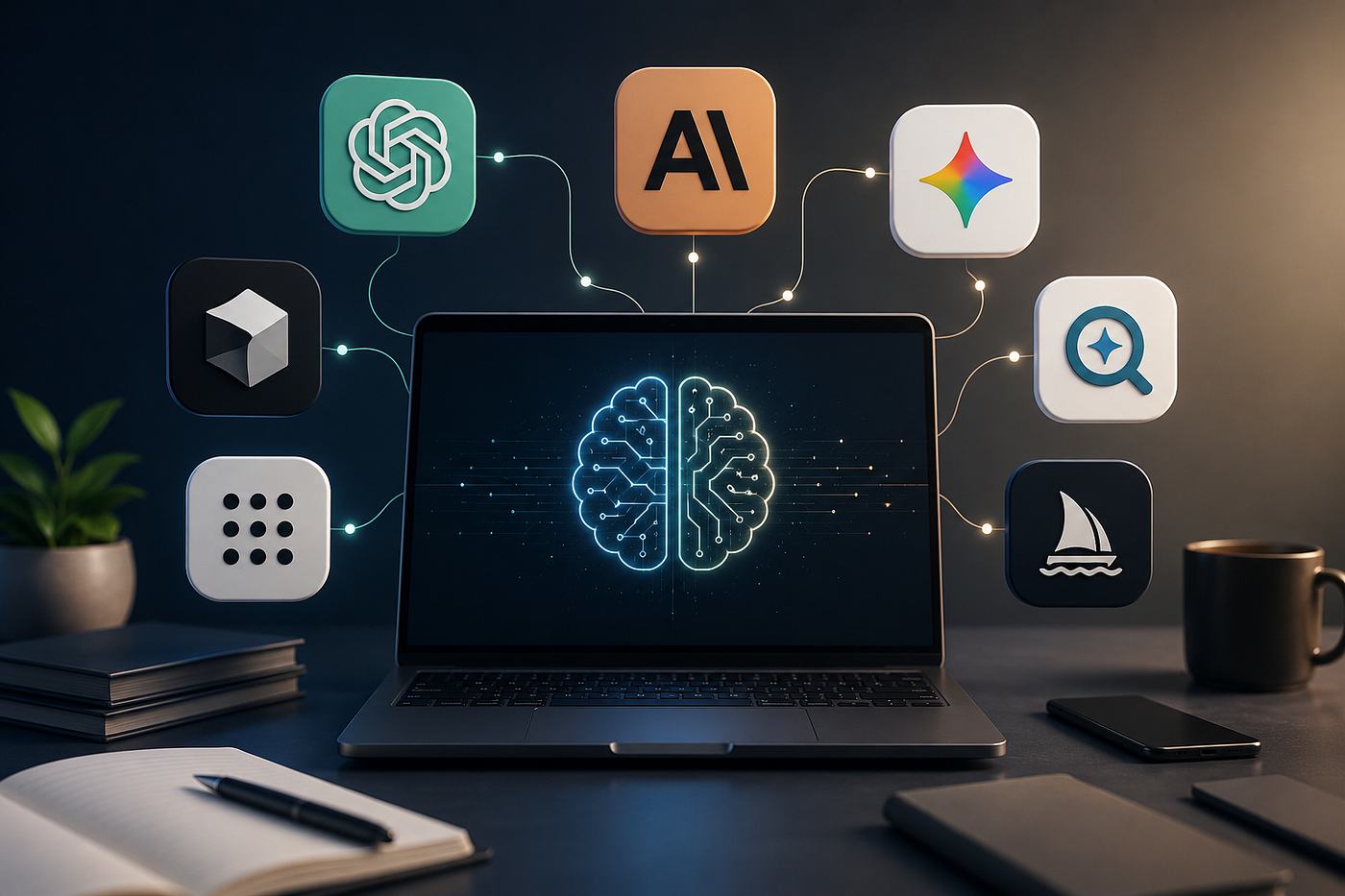
Every week, a new AI tool goes viral.
One promises to replace your entire workflow. Another claims to automate your job. And somehow, all of them are “game-changing.”
Most disappear within months.
That’s the reality of AI right now.
The AI space in 2026 is crowded with wrappers, clones, and tools built only for hype. But underneath all that noise, a small group of tools are genuinely changing how people work, learn, code, write, research, and create.
After testing dozens of them over the past year, these are the AI tools that actually stand out.
Not because they’re trendy. Because they’re useful.
1. OpenAI -Still the Most Versatile AI Tool
If someone asked me to keep only one AI tool in 2026, it would still probably be ChatGPT.
Not because it’s perfect. Because it does almost everything well.
Writing, coding, brainstorming, research, image generation, debugging, learning new topics, planning projects — it’s become the default second brain for millions of people.
The biggest difference now is that AI tools are no longer just “chatbots.” They’re becoming work environments.
ChatGPT feels less like a tool and more like an operating system for thinking.
What makes it powerful in 2026:
- GPT-5 level reasoning
- Deep research workflows
- Voice conversations that feel natural
- Image and video generation, powered by GPT Image 2.0, its most accurate text-to-image model yet
- Strong coding support
- Massive plugin and ecosystem support
2. Claude -The AI That Feels the Most Human
Claude deserves way more attention than it gets.
While many AI tools focus on speed, Claude focuses on clarity.
That changes everything.
It’s one of the few models that consistently produces writing that feels natural instead of overly polished or robotic. For long-form thinking, research breakdowns, architecture discussions, and technical explanations, Claude is genuinely impressive.
A lot of developers and writers now use Claude alongside ChatGPT instead of replacing one with the other.
And honestly, that combination makes sense.
ChatGPT feels like the best all-round AI platform. Claude feels like the best deep-thinking partner.
Where Claude stands out:
- Long context handling
- Natural writing quality
- Strong reasoning
- Better structured explanations
- Great for documentation and research
- Cleaner tone with less “AI sounding” output
If you write a lot, Claude is probably one of the best AI tools you can use in 2026.
3. Google Gemini -The AI Tool Quietly Becoming Everywhere
Google played catch-up for a while.
Now Gemini is everywhere.
Search, Gmail, Docs, Android, YouTube, Chrome, Firebase — Google is turning AI into the default layer across its ecosystem.
That’s Gemini’s real advantage.
Not just the model itself. The integration.
If you already live inside Google Workspace, Gemini becomes incredibly useful because it understands your workflow naturally.
Where Gemini stands out:
- Multimodal AI
- Research workflows
- Google ecosystem integration
- Productivity automation
- AI inside everyday tools
It’s less about chatting with AI now. It’s about AI being built into the tools people already use daily.
4. Cursor -The Tool Changing Software Development
This one changed how developers work.
Cursor is no longer just an “AI coding assistant.” It feels like pair programming with an engineer who already knows your codebase.
The biggest shift in 2026 is that developers are spending less time writing boilerplate and more time reviewing architecture, logic, and decisions.
AI writes more code now. Humans guide the direction.
That changes the skillset completely.
5. Decksy AI - Slides Of The Future
Presentations used to be hours-long.
Decksy AI reduces that to minutes.
Rather than staring at a blank slide and struggling with layout, you provide it with a topic, an outline or even a document - and it creates a fully structured deck around it.
It sounds small until you use it everyday.
And then you realise how much time you waste manually building slides.
Why Decksy AI presentation maker is valuable:
- Create slides first, then structure
- In-depth research with references cited
- Works from a theme, outline or uploaded file
- Professional templates, with a built-in clean design
- Fast development from concept to completed deck
It’s one of the most practical AI tools out there today for anyone who has to consistently put ideas into presentations - students, marketers, instructors.
6. Midjourney -Still the King of AI Images
A lot of image generators improved.
Midjourney still produces some of the best-looking AI art and visuals.
The consistency matters.
In 2026, the challenge isn’t generating images anymore. Almost every AI can do that.
The challenge is generating images that actually look intentional, cinematic, and professionally designed.
That’s where Midjourney still stands out.
The Bigger Shift Happening in 2026
Here’s the thing most people still misunderstand about AI.
The biggest change is not better chatbots.
It’s workflow automation.
AI tools are moving from:
- answering questions
to:
- completing tasks
Companies are now building systems where AI can:
- research
- write
- code
- summarize
- automate workflows
- coordinate tasks
- interact with other tools
with minimal human input.
And that changes work more than any single model release ever will.
Takeways
Most AI tools won’t survive the next few years.
The winners will not be the loudest tools. They’ll be the ones that become invisible.
The tools people stop thinking about because they become part of everyday work.
That’s already happening.
In 2026, the real advantage is no longer “using AI.” Almost everyone does that now.
The advantage is understanding:
- how to work with AI effectively
- how to think critically around it
- and how to build workflows where AI actually saves time instead of creating noise
The people who learn that early will have a massive edge.
And honestly, we’re still only at the beginning.
If you found this article helpful, please give it a like, drop a comment and share it with friends who may find it useful, and follow for more updates.
Thanks for reading -see you in the next story! 💗
Comments
Loading comments…