The Human Fallback: What Software Teams Can Learn From CPR and Emergency Response
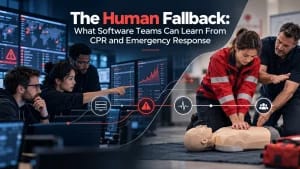
A well-designed system assumes that something will eventually go wrong. Engineers plan for failed requests, unavailable services, missed alerts, and confused users. But there is one failure mode that rarely appears in a sprint retrospective: a real person collapsing at the office while everyone waits for someone else to take charge.
The parallel between reliable software and emergency readiness is more useful than it first appears. Both depend on recognizing a problem early, assigning responsibility, following a short sequence of actions, and practicing before pressure arrives. For Los Angeles teams looking to build that last capability, local options such as C2C First Aid make the human side of emergency preparation tangible.
1. A Safety Plan Is an Incident-Response Plan
Think of a medical emergency as a high-severity production incident. There is an unexpected event, incomplete information, a narrow window for action, and a need to coordinate people quickly. The worst response is an ambiguous one: everyone assumes someone else has called for help, found the AED, or started assisting.
Software teams solve this with incident roles and playbooks. A workplace can borrow the same approach. One person calls 911 and follows dispatcher instructions. Another locates the automated external defibrillator (AED). Someone trained in CPR begins responding when a person is unresponsive and not breathing normally. Team members clear space and direct emergency personnel to the correct entrance.
These are not interchangeable tasks. Clear ownership reduces the chance that important steps are omitted. In a real emergency, follow the dispatcher and your training rather than treating a workplace checklist as medical instruction.
2. Design for the Moment When Memory Fails
A good interface does not rely on users remembering a complicated manual during a stressful event. It makes the next action visible. AEDs illustrate this principle well: they provide spoken prompts and guide rescuers through device use, including when to stand clear. They are designed to support people who are not medical professionals.
The same principle applies to workplace preparation. Display the site address near emergency phones. Make AED locations easy to identify. Keep exits and access routes clear. Put emergency contacts and procedures where staff can find them without searching through an old shared drive.
Simplicity matters. An emergency flow with three memorable steps is more likely to be useful than a beautifully formatted forty-page policy that nobody opens.
3. Run Real Drills, Not Just Documentation Reviews
An engineering team does not prove a backup system works by writing “backups enabled” on a dashboard. It tests recovery. First aid knowledge is similar: reading a page about compressions or AED use is not the same as practicing on a manikin with a trained instructor.
Hands-on training lets people experience the pace and physical effort of CPR and rehearse how to respond to choking, bleeding, and other urgent situations. It also exposes operational issues that policies overlook. Can staff find the AED quickly? Does the front desk know what address to give the dispatcher? Can someone meet responders at the door?
For a distributed Los Angeles team, it is useful to distinguish between a remote-awareness session and a course that includes practical skill assessment. They serve different purposes. If certification is required for a role, verify the precise accepted course and skills component.
4. Measure Readiness, Not Just Course Completion
Engineering teams know the danger of vanity metrics. A hundred green status badges mean little if users still cannot complete the task. Likewise, counting training certificates alone cannot tell you whether a workplace is genuinely prepared.
A more useful review asks a handful of operational questions:
- Can someone name the building address and direct responders to the correct entrance?
- Do people know where the nearest AED is and whether it is accessible?
- Is there a trained responder available across shifts or scheduled work periods?
- Are training and equipment checks revisited after staff turnover or office moves?
- Can staff identify when to call 911 rather than waiting for a manager?
These checks translate a certificate into a functioning response capability. They are especially important in shared offices, coworking spaces, studios, and workplaces spread across multiple buildings.
5. Choose the Training That Matches the Actual Risk
A developer conference, an office, a childcare setting, and a medical clinic do not necessarily need identical credentials. In California, an employer or licensing body may specify the course provider, skills, or certification format it accepts. General workplace first aid/CPR/AED training is different from Basic Life Support (BLS) for healthcare professionals, and childcare requirements can be more specific.
Before booking, read the written requirement. Check whether the role calls for adult CPR, adult-and-pediatric CPR, first aid, AED training, or healthcare BLS. Also confirm that hands-on skills are included when required, and keep the certification expiration date on the team calendar.
The broader Coast2Coast CPR Training course directory is a starting point for comparing U.S. first aid and CPR pathways, but the deciding factor should always be the actual requirement rather than the shortest available class.
6. Build a Human Fallback Into the System
Most engineering organizations invest considerable thought in preventing data loss, service disruption, and access failures. Human safety deserves a similarly practical approach, even though the response is not code.
The principle is simple: do not expect flawless decisions from unprepared people in a high-pressure moment. Make the critical actions visible, identify who can respond, provide hands-on practice, and revisit the plan when the environment changes.
In Los Angeles, where teams may move between studios, campuses, client sites, and shared workspaces, that readiness has to travel with the people. A reliable workplace is not one where nothing ever goes wrong. It is one where people know what to do when something does.
Frequently Asked Questions
Q: Does an AED require advanced medical training?
A: No. AEDs are designed to guide users with visual and spoken instructions. Formal training helps reduce hesitation and gives people a chance to practice using a trainer device.
Q: Is online CPR education enough for workplace certification?
A: Not necessarily. The answer depends on the specific course and employer or licensing requirements. Many recognized programs combine online knowledge work with an in-person skills session.
Q: Should a software company choose CPR/AED or BLS?
A: Most nonclinical offices start by checking their workplace first aid and CPR requirements. BLS is a separate clinical-oriented pathway often required for healthcare roles.
Q: How long do U.S. first aid and CPR certificates last?
A: Many American Red Cross first aid/CPR/AED credentials are valid for two years. Confirm the expiration date and applicable rules for the exact course selected.
Q: What is one easy readiness improvement a team can make today?
A: Ask everyone to locate the AED, confirm the street address used for 911 dispatch, and identify the person responsible for coordinating an emergency response. Then validate the plan through practice.
Comments
Loading comments…