Top 5 AI Leadership Programs for Professionals Preparing to Scale AI Across Organizations
Top 5 AI Leadership Programs for Professionals Preparing to Scale AI Across Organizations
An AI pilot can look successful until other departments want it, data needs connecting, and IT asks who will monitor the outputs. Scaling becomes a management problem. One team may want faster decisions, another may fear losing control, and finance may want evidence that the investment will pay back.
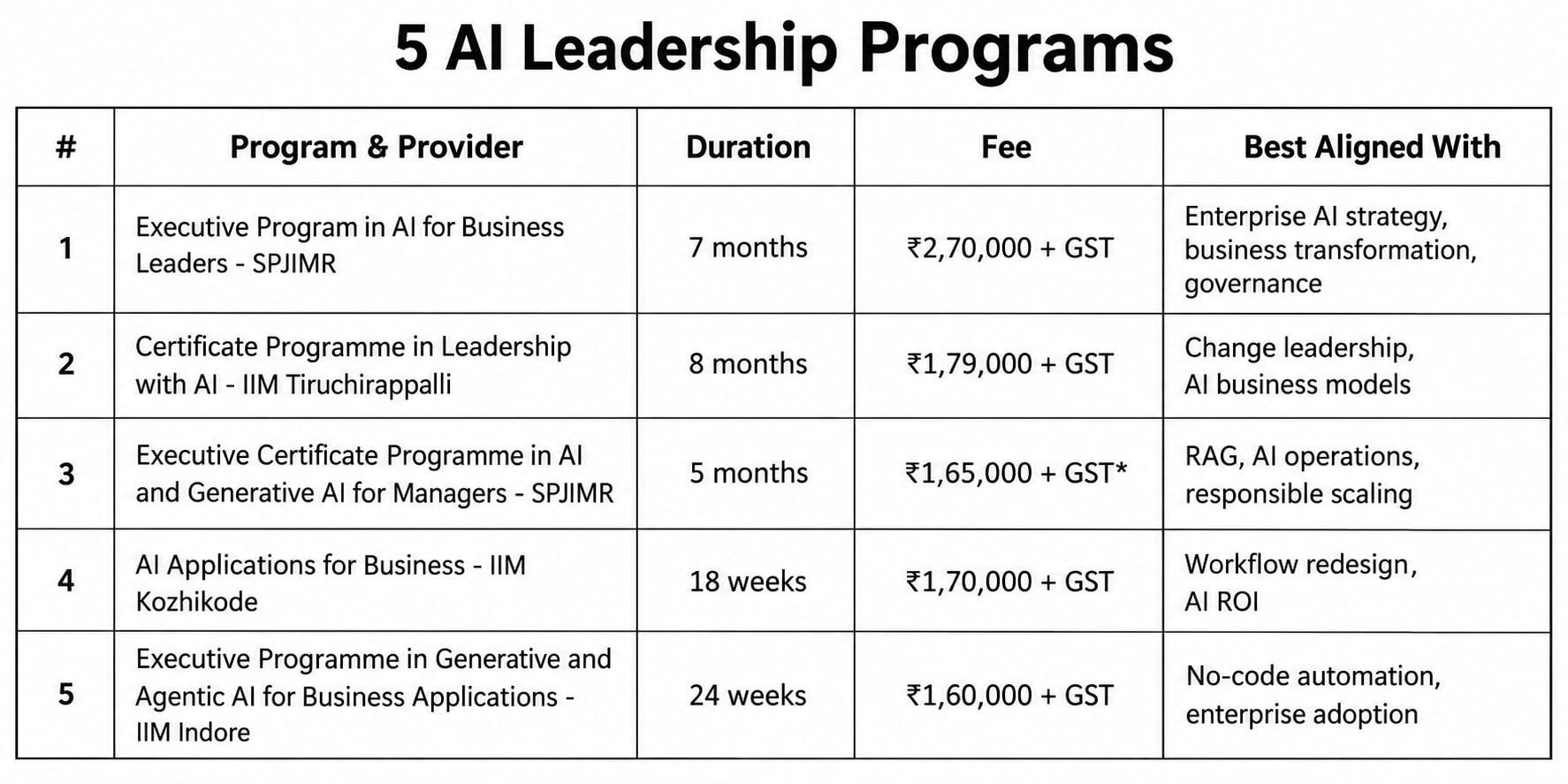
Leaders must judge data readiness, budget, employee oversight, and business value. These five India-focused programs examine strategy, automation, governance, and organizational change. Their emphasis differs, from deciding which projects to fund to keeping automated systems reliable after rollout.
1. Executive Program in AI for Business Leaders - SPJIMR
Scaling AI across an organization requires more than selecting the right technology. Leaders must decide which opportunities deserve investment, whether existing systems can support them, and how employees will adapt to new ways of working.
SPJIMR's AI leadership course addresses these responsibilities through business strategy, data analytics, Generative AI, and intelligent automation. The curriculum connects technical understanding with the financial, operational, and governance decisions involved in enterprise transformation.
Delivery & Duration: Seven months of blended learning, including weekly live faculty sessions, executive masterclasses, hands-on projects, and campus immersion at SPJIMR, Mumbai.
Credentials: Certificate of Completion from SPJIMR, with Executive Alumni Status upon successful completion.
Program Highlights: Enterprise AI strategy, data-driven decision-making, machine learning applications, Generative AI, agentic workflows, responsible AI, governance, and organizational change.
Tools & Technologies: Google AI Studio, NotebookLM, LangChain, LangGraph, Hugging Face, and Power BI.
Hands-on Learning & Outcomes: Participants work on business-focused projects involving AI opportunity identification, data visualization, RAG-based knowledge assistants, and agentic workflow design. An industry-focused capstone helps them develop an AI solution and implementation roadmap relevant to their chosen domain.
Why should you choose this course?
● Industry-focused learning: The curriculum offers tracks covering finance, digital marketing, manufacturing and supply chain, and technology leadership, helping professionals connect AI adoption with their functional responsibilities.
● Enterprise transformation focus: Projects require participants to assess business opportunities, consider governance risks, and develop practical implementation strategies.
2. Certificate Programme in Leadership with AI - IIM Tiruchirappalli
IIM Tiruchirappalli examines how leaders manage automation through AI fundamentals, business-model design, workforce change, and responsible deployment.
Delivery & Duration: Eight months of online learning, with scheduled live faculty sessions and 90 learning hours.
Credentials: Certificate from IIM Tiruchirappalli upon successful completion.
Program Highlights: Generative AI, AI product management, agentic workflow automation, strategic leadership, talent transformation, and trustworthy AI.
Outcomes: Cases and simulations build judgment on AI's impact on teams and processes.
Why should you choose this course?
● Employee adoption and talent planning are part of AI transformation.
● Its longer schedule offers room to connect leadership frameworks with practical cases.
3. Executive Certificate Programme in AI and Generative AI for Managers - SPJIMR
A successful chatbot demo proves little about production readiness. SPJIMR's AI course for managers examines retrieval, agent permissions, evaluation, and deployment operations. Compared with its broader leadership programme, this certificate places more attention on the practical challenges of implementing and maintaining GenAI systems.
Delivery & Duration: Five months online, with recorded lessons, weekly mentorship, and faculty sessions.
Credentials: SPJIMR completion certificate and executive alumni status.
Program Highlights: RAG, small-model fine-tuning, AI economics, the AI+ operating model, human oversight, and lifecycle governance.
Tools & Projects: Google AI Studio, NotebookLM, and LangChain support a local RAG chatbot, monitoring exercise, and governance capstone.
Outcomes: Participants practise evaluating quality and managing deployment risks.
Why should you choose this course?
● The assignments go beyond prototyping to include quality checks and maintenance.
● It connects technical limitations with managerial accountability.
4. AI Applications for Business - IIM Kozhikode
IIM Kozhikode examines AI in banking, healthcare, HR, marketing, and product management. Participants assess opportunities before redesigning workflows.
Delivery & Duration: Eighteen weeks online, with recorded lectures and practitioner-led sessions.
Credentials: IIM Kozhikode completion certificate, subject to assessment.
Program Highlights: Predictive modelling concepts, GenAI, agent planning, AI operating models, enterprise integration, and governance.
Practical Learning & Outcomes: A workflow-automation mini project and strategy capstone cover feasibility, ROI, and implementation. Tool exposure includes KNIME and n8n.
Why should you choose this course?
● Functional examples help managers compare opportunities across departments.
● The capstone requires an adoption roadmap with business and risk considerations.
5. Executive Programme in Generative and Agentic AI for Business Applications - IIM Indore
IIM Indore examines practical, no-code automation using AI assistants, prompts, retrieval, and agent-based workflows.
Delivery & Duration: Twenty-four weeks online, with recorded lectures and live sessions.
Credentials: IIM Indore completion certificate; alumni status costs extra.
Program Highlights: Generative AI, Agentic AI, RAG, no-code workflows, business feasibility, responsible adoption, and privacy.
Outcomes: Assignments and a graded capstone help participants develop an AI use case, estimate its value, and plan implementation.
Why should you choose this course?
● It offers a practical route for managers who want to test automation ideas without programming.
● The graded business case examines impact and feasibility.
Conclusion
Scaling AI exposes data ownership, training, controls, and measurement problems. Leaders must also decide how new technologies fit existing business processes and who remains responsible when automated decisions go wrong.
The programs above address different parts of that challenge. Some concentrate on enterprise strategy and organisational change, while others examine GenAI implementation, workflow automation, and operational monitoring. Even the two SPJIMR offerings serve different purposes: one takes a broader leadership approach, while the other focuses more closely on implementing AI systems.
A useful AI for leaders programme should leave you able to challenge an AI proposal, explain its costs and controls, and defend the rollout plan beyond the first demonstration. Ask who will maintain the system six months later, what happens when it fails, and whether the promised improvement can actually be measured.
Comments
Loading comments…