White Label Email Marketing Agency Partners: Who Owns the Client Relationship?
Suggested URL: https://stackademic.com/blog/white-label-email-marketing-agency-client-relationship
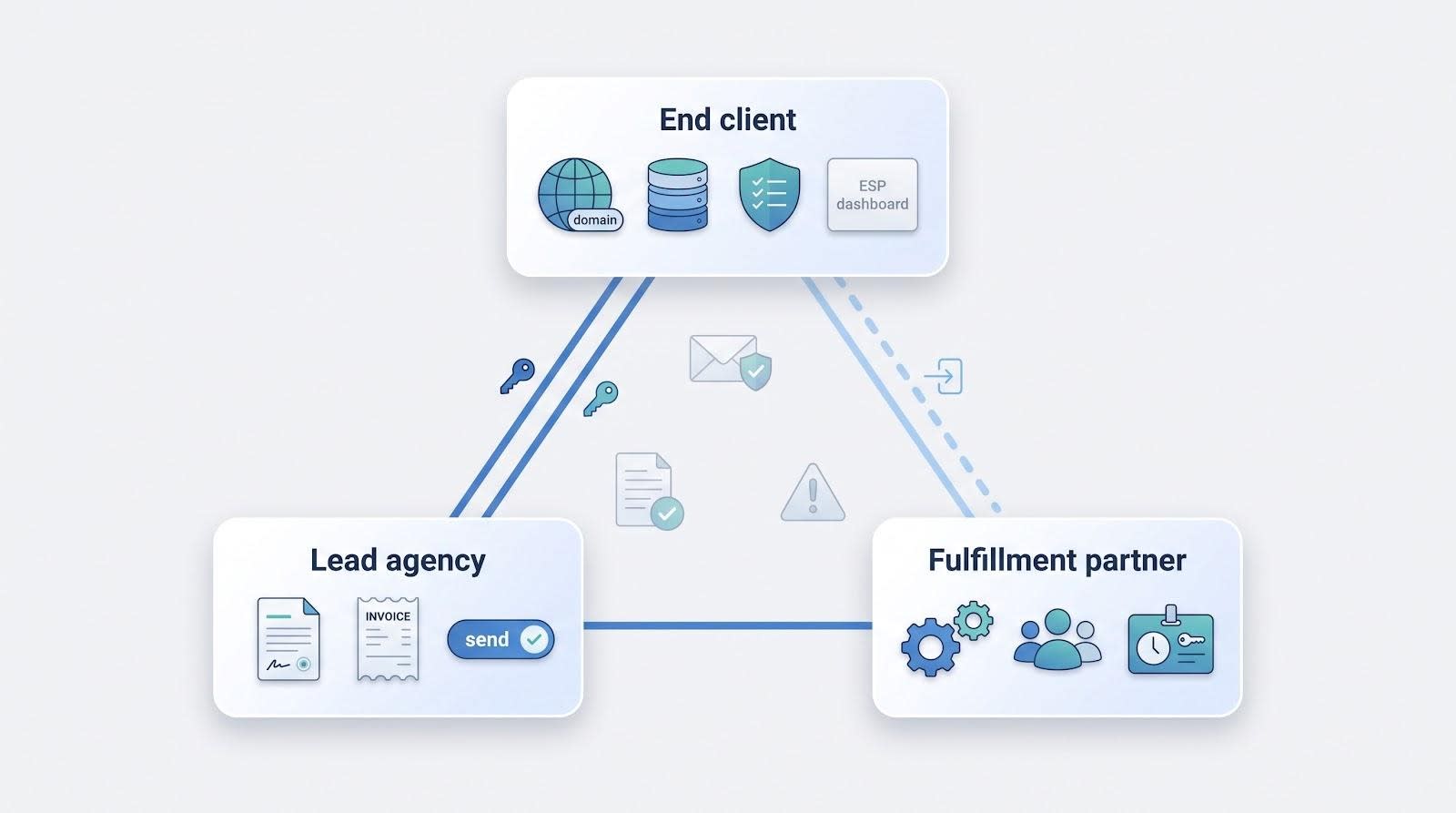
When a lead agency brings in a white-label email partner, three parties share one program. The simplest ownership map looks like this. You, the lead agency, sign the master contract, set retail pricing, bill the client, and give the final green light on every send. The end client keeps what lasts: sending and tracking domains, the primary ESP account, subscriber data, and every consent or suppression log. The fulfillment partner brings its workflows and staff but gets only the role-based, time-boxed access needed to build and launch campaigns. Anything shared (deliverability monitoring, privacy compliance, incident response) goes in the statement of work with a single named owner.
Specialist email agencies are built for lead agencies that keep the client contract under their own name. InboxArmy, for example, says on its white-label page that strategy, creative, automation, and deliverability are covered from day one, that it supports more than 40 ESPs, and that your agency keeps "the relationship, the revenue, and the credit." Its Bear Fox Marketing case study shows the model in practice: InboxArmy ran email programs for 25 of that SEO agency's clients under the Bear Fox name, joined discovery calls from a Bear Fox-branded email address, and built monthly reports in Bear Fox's format for its team to present.
Here are the eight points to settle before the first send.
1. Put the commercial relationship in writing
Decide whose logo sits on the contract and whose invoice reaches the client. If the fulfillment partner signs the master agreement, it sets terms, chases late payments, and holds commercial leverage. Keep the contract under your agency letterhead and issue a wholesale work order to the specialist. Spell out the payment schedule, late-fee triggers, and the right to pause work if invoices stall.
2. Choose the client communication model deliberately
In invisible fulfillment, every touchpoint carries your agency's name and the partner never contacts the client. In the embedded model, the partner's strategist joins calls with an alias on your domain and a title you assign. In the disclosed model, you introduce the expert by name and role while pricing, scope, and strategy stay with your account lead. Whichever you choose, a one-page RACI shows who is Responsible, who must Approve, who is Consulted, and who stays Informed for each routine touchpoint.
3. Keep accounts, domains, and data under client control
Put the ESP license in the client's name from day one, with named seats, MFA, and quarterly access reviews. The client keeps registrar access; the partner edits only the SPF, DKIM, DMARC, and tracking records it needs. Where the EU GDPR applies, the client is usually the controller, the lead agency a processor, and the partner a sub-processor. Article 28 says a processor must not engage another processor without the controller's prior specific or general written authorisation. Data sent to the U.S. can rely on the EU-U.S. Data Privacy Framework only if the partner is certified, with Standard Contractual Clauses as an alternative tool. This is general information, not legal advice.
4. Assign ownership of copy, design, HTML, and automation
List every deliverable in the statement of work, from subject lines to flows. Work created for the client and paid in full transfers; tools the partner built before the contract stay the partner's and are licensed for project use. Under 17 U.S.C. 101, contractor work counts as work made for hire only in nine listed categories and with a signed written agreement, so many contracts add a written assignment as well. Under 17 U.S.C. 204, a transfer of copyright ownership must be in writing and signed.
5. Protect the relationship without unrealistic exclusivity
An NDA guards information; a non-solicitation clause guards clients. Name the protected clients, set a fixed tail such as 12 months after the last invoice, and require the partner to forward any direct client approach. Avoid broad non-competes. Enforceability depends on the governing law: many U.S. states test restrictive covenants for reasonableness, while California Business and Professions Code section 16600 makes void, with limited exceptions, any contract that restrains anyone from a lawful trade or business. Have counsel review the clause.
6. Make wholesale pricing and agency margin predictable
Pick the model that mirrors how you bill the end client: a per-client retainer, per-campaign pricing, a dedicated resource block, or a hybrid. Write down exactly what the fee covers, price rush work and migrations upfront, and decide who pays ESP and other third-party fees. Agree in advance what happens when a payment is late.
7. Put deliverability and compliance into the SOW
Name who publishes and maintains SPF, DKIM, and DMARC, who watches bounces and complaints, and who may pause a send. Google tells bulk senders to keep spam rates in Postmaster Tools below 0.10% and never reach 0.30%, so set your alert below that line. Keep the final "Send" button and warm-up schedule with the agency, and require a short root-cause note after any incident.
8. Test operational fit before scaling
Start with one paid, bounded pilot, such as a deliverability audit or a single welcome-flow rebuild, over about two weeks. Score it on brief comprehension, brand voice, turnaround, QA depth, documentation, and impact, then scale the scope only if the partner passes.
Conclusion
Formal commercial terms, a clear communication model, client-owned data, and written deliverability duties let a lead agency scale white-label email programs without risking client relationships or margins.
Comments
Loading comments…