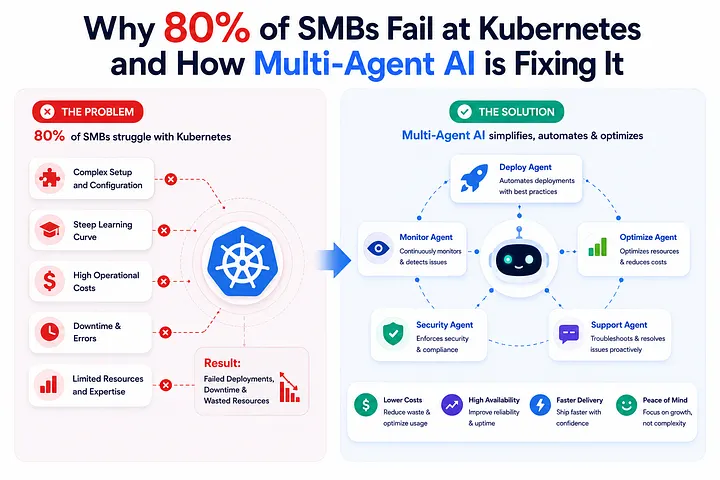
Most small engineering teams don’t fail at Kubernetes because it doesn’t work.
They fail because nobody told them how far “cluster running” is from “cluster running well.”
And that distance? It breaks teams.
I’ve seen it happen more times than I can count. A 4-person startup, brilliant engineers, real product and they spend 3 months fighting infrastructure instead of building features.
Here’s why. 👇
The skill wall is ruthless
Running Kubernetes properly means genuine fluency across kubectl, Helm, RBAC, network policies, ingress controllers, resource management and more.
That’s a career’s worth of depth. For a dedicated platform engineer, it’s a full-time job.
For a generalist developer also writing product features, handling on-call, and reviewing PRs?
It’s an impossible ask.
“The industry-wide Kubernetes skills gap sits at 33% even at enterprises with dedicated DevOps teams. For SMBs without a single SRE on staff, it’s closer to universal.”
The cost compounds before you’re ready
EKS and GKE clusters don’t care if you have users yet.
Control planes, node groups, load balancers, data transfer, log storage — the meter runs from day one.
And here’s what most teams don’t realize: 80–90% of pods over-request CPU and memory by default. You’re paying for headroom you’re not using.
Right-sizing alone can cut costs 30–60%. But you have to know to do it.
Vendor lock-in is a slow, invisible trap
Managed Kubernetes feels like the easy button. EKS, GKE, AKS — fast, familiar, comfortable.
Until you want to move.
By the time most SMBs realize they’ve built on AWS-specific load balancer annotations, proprietary secret management, and Lambda functions wired into core services — switching clouds isn’t a technical decision anymore.
It’s a multi-month engineering project.
Egress fees alone can eat 10%+ of annual cloud spend when migration eventually happens. Every proprietary convenience is a hook you don’t see until you’re already attached.
So what actually works?
The teams that navigate Kubernetes successfully share one thing in common.
They make the right architecture decisions in sprint one. Not sprint 60.
K8s-native from day one means:
- Every service containerized from the first commit
- Helm as the only path to production
- Open-standard autoscaling with KEDA + Envoy — no vendor lock-in
- Cloud-agnostic infrastructure via Crossplane CRDs
- Prometheus + Grafana + OpenTelemetry for observability — not CloudWatch
The problem? Building this correctly has always required exactly the platform expertise most SMBs don’t have.
Until now.
What’s genuinely different in 2026
The most significant shift for SMB infrastructure this year isn’t a new Kubernetes feature.
It’s multi-agent AI.
Not the single-agent tools that write one file at a time, lose context after 3 minutes, and hand you a scaffold you still need to engineer into something real.
I’m talking about a coordinated team of specialized AI agents — the way a real engineering team works.
8080.ai runs a Tech Lead, System Architect, Frontend, Backend, DevOps, QA, and Project Manager agent — all in parallel, all sharing architectural context across a 100M+ token window.
What comes out the other side isn’t a prototype.
It’s a complete, production-grade, Kubernetes-native codebase. Helm charts. CI/CD pipelines. 80%+ test coverage. Real documentation. Push-to-ship.
And critically — zero cloud-provider lock-in. The Helm charts run on EKS today and GKE tomorrow.
“A 4-person team can describe what they want to build — and receive back production-grade, Kubernetes-native software with the architecture decisions already made correctly.”
The boring success story nobody talks about
Companies that get K8s infrastructure right from day one don’t have horror stories.They have the boring story.
Infrastructure that quietly scales from 400 to 40,000 monthly active users. The freedom to move clouds in a week. An architecture that survives the departure of the engineer who designed it because it’s documented, standard, and understandable.
In 2026, that story is accessible to any SMB.
You don’t need to hire a platform engineer. You don’t need to accumulate cloud-specific dependencies. You don’t need the Kubernetes horror story.
You just need to start with the right team.
Comments
Loading comments…