
A RAG system is usually at its cleanest on launch day. The index is small, the test questions are familiar, and the documents have not yet been polluted by months of real uploads. That is why early performance can be misleading. The system looks fast because it has not yet been forced to separate fresh answers from old, repeated, and half-relevant content.
The real slowdown starts after the knowledge base becomes a living mess. Teams add new files without removing old ones. Updated documents sit next to outdated versions. Similar chunks begin competing for the same questions. Retrieval still works, but it has to search through more noise before it finds the right source, and that extra noise affects both speed and quality.
By the third month, the issue is no longer whether RAG works in theory. The issue is whether the system has been maintained like a production asset. If nobody owns cleanup, versioning, evaluation, and document quality, retrieval slowly becomes harder to trust. The system may still answer every question, but users start feeling the difference before dashboards make it obvious.
It is like buying a new desk and then acting shocked when three months of random papers turn it into a crime scene.
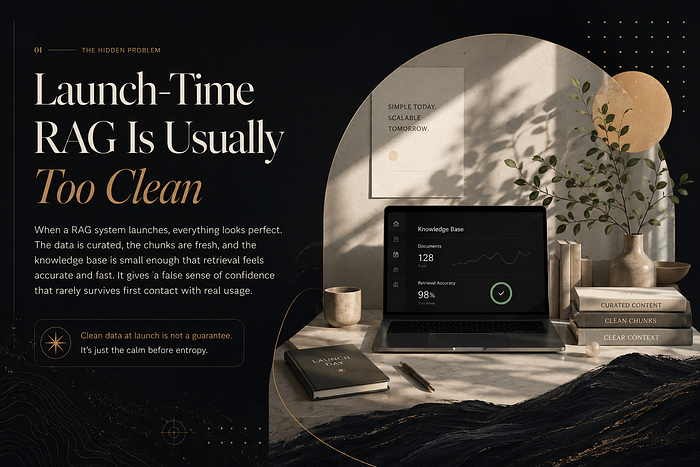
Launch-Time RAG Is Usually Too Clean
Launch-time RAG usually looks better than it deserves. The system is tested with a small set of documents, the questions are known in advance, and the team already understands what the correct answer should look like. Under those conditions, retrieval feels clean because the system is not dealing with the mess that real users will bring later. It is being tested in a room where the floor has just been swept.
That clean setup creates a false sense of stability. The first version may return the right document quickly, but that does not prove the system is ready for a growing knowledge base. It only proves that retrieval works when the content is limited and predictable. Once people start adding outdated files and repeated uploads, the same search process has to work harder to separate useful context from noise.
This is why launch performance should be treated as a baseline, not proof of long-term quality. A RAG system needs to be tested against the kind of content it will actually face after people start using it. If the early tests only use clean documents and friendly questions, the team may confuse a controlled demo with a stable product. The real test begins when the knowledge base stops being tidy.
It is like judging your cleaning habits five minutes after guests leave, before anyone opens the snack drawer.
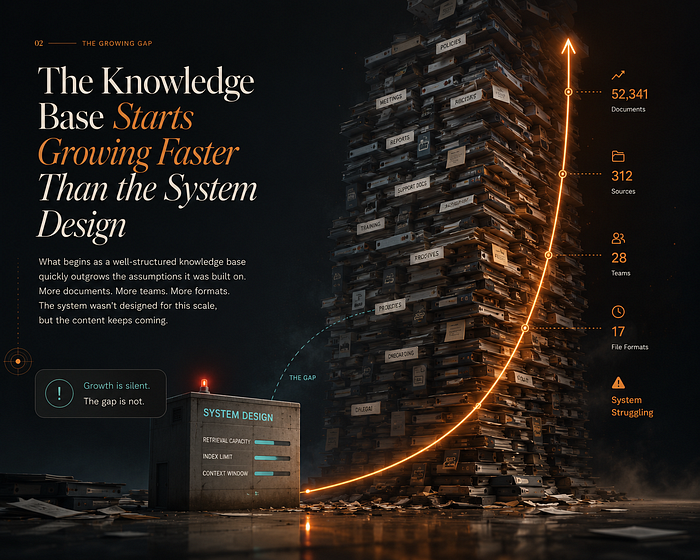
The Knowledge Base Starts Growing Faster Than the System Design
A RAG system starts slipping when the knowledge base grows beyond the rules that were supposed to control it. At launch, the team usually knows what is inside the index and why it belongs there. A few months later, more people are adding content, more folders are connected, and the system is searching through material that was never part of the original plan.
That growth changes the shape of retrieval. The system is no longer choosing from a clean set of sources. It is sorting through crowded neighborhoods of similar content, where the right document has to compete with older copies and partial matches. A question that once pointed clearly to one source can now pull several nearby results, which makes ranking slower and easier to get wrong.
This is where the system design starts showing its limits. More content is not automatically a better knowledge base. Without stronger ingestion rules, cleanup, and clear ownership, the index becomes a place where documents accumulate faster than anyone can explain them. Retrieval does not fail because the system forgot how to search. It fails because the search space became messier than the design could handle.
It is like letting everyone put food in the fridge and then acting surprised when nobody knows what is still safe to eat.
Duplicate and Near-Duplicate Chunks Crowd the Results
Duplicate chunks are one of the fastest ways to make RAG retrieval look worse without changing the actual product. The system may still find relevant content, but it keeps finding the same idea repeated in different places. A policy may appear in the handbook, a help article, and an old PDF. To the retriever, those chunks all look close enough to fight for the same question.
This crowding weakens the result set. Instead of giving the model a mix of useful sources, retrieval may return several versions of the same answer with small differences between them. That wastes space in the final context and pushes out documents that could have added missing details. The answer may still sound confident, but it is being built from a narrow pile of repeated evidence.
Near-duplicates are even harder because they are not always obvious. Two chunks may use different wording but carry the same meaning, or one may be an outdated version of the other. If the system does not remove or down-rank them, the top results become crowded with copies that look useful but do not improve the answer. This is how a larger knowledge base can make retrieval feel smaller.
It is like asking five people for directions and realizing they all copied from the same confused uncle.
Old Documents Keep Competing With Newer Answers
Old documents become a problem when the system treats them as equal to the current source of truth. A RAG system does not automatically know that last year’s policy is weaker than the updated one unless the pipeline gives it that signal. If both versions stay indexed, both can compete for the same question. The outdated file may be wrong, but it can still look relevant because the wording is close.
This creates confusion that looks like a model issue from the outside. A user asks a normal question and gets an answer based on a document that should no longer be used. The model did not invent the mistake. It followed the context retrieval gave it. The real failure happened earlier, when stale content was allowed to stay in the search path without any priority rule.
The fix is to make document age part of retrieval, not an afterthought. Current sources should be clearly preferred, and outdated files should stop competing once they are no longer valid. If the system cannot tell which version is trusted, users will keep getting old answers wrapped in a new interface.
It is like asking for today’s lunch menu and getting a confident answer from a restaurant flyer found behind the sofa.
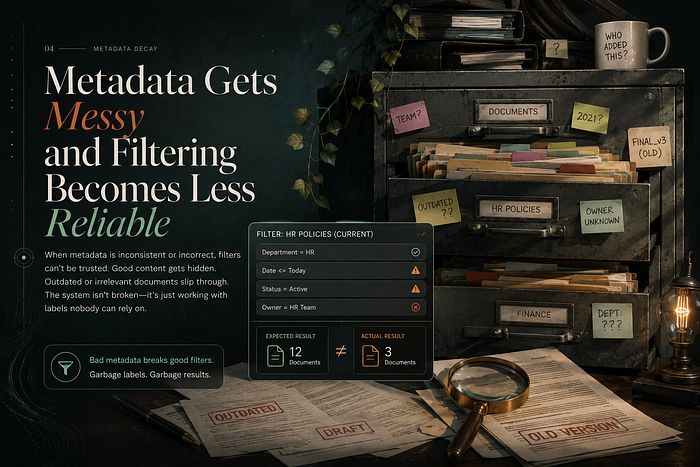
Metadata Gets Messy and Filtering Becomes Less Reliable
Bad metadata can make good retrieval look broken. At launch, document labels are usually clean because only a small group controls what enters the system. The files have clear owners and dates, so filters behave the way the team expects. But once more people start adding content, those labels become less reliable, and the system starts making decisions based on fields that may no longer be trustworthy.
This matters because metadata often decides what the retriever is allowed to see. If a user asks for the current policy, the system may depend on a date or version field to keep old files out of the result set. When that field is missing or wrong, the filter becomes a quiet source of failure. The right document may be skipped, while a weaker one gets through simply because its labels looked cleaner.
Filtering becomes less reliable when metadata is treated as decoration instead of infrastructure. A RAG system needs clear rules for which fields are required, how they are checked, and who fixes them when they drift. Without that, retrieval starts depending on labels nobody fully trusts, and every filtered search becomes a small gamble.
It is like moving houses with boxes labeled “important stuff” and then discovering one has tax papers while another has old chargers.
Debugging Retrieval Becomes Harder as the Index Grows
Retrieval debugging gets ugly when the system can return a bad answer without looking broken. In the early version, the cause is usually easy to find because the index is small and the search path is still simple. Once the knowledge base grows, that clarity disappears. The system may pull a believable source, assign it a reasonable score, and still miss the document the user actually needed.
That is what makes these failures painful. The logs can say the request succeeded while the user knows the answer is weak. The retriever did not crash. The model did not refuse. The pipeline did not throw an error. Everything looks normal until someone checks the source path and realizes the wrong document won by a small margin.
A growing RAG system needs visibility into retrieval behavior, not just the final answer. Teams need to see which source won, which better source lost, and why the ranking changed over time. Without that, debugging becomes a guessing game where every layer claims it did its job.
It is like asking three people who moved your keys and each one confidently saying, “Not me.”
Conclusion
Most RAG systems do not slow down because retrieval suddenly breaks. They slow down because the knowledge base quietly becomes messier than the system was designed to handle. The answers still come back, but they take longer, rely on weaker sources, and become harder to debug when users complain. A RAG system has to be maintained like a production system, not treated like a one-time upload folder with a chatbot attached.
Comments
Loading comments…