Everyone wants better AI. Almost no one learns to ask better questions.
A friend of mine spent twenty minutes arguing that Claude writes better code than ChatGPT. Then he showed me his prompt:
“Build me a CRM.”
Three words. No audience, no tech stack, no constraints. He wasn’t testing the model. He was testing his own assumptions — and blaming the AI when they didn’t hold up. This happens constantly. People compare tools like they’re comparing cars, when the real variable is the driver.
The quality of an AI’s response depends less on which model you use and more on the instructions you give it.
Whether you’re writing code, drafting content, designing a product, or automating a workflow, everything starts with a prompt. And most people still treat prompting as an afterthought — something you type quickly on the way to the “real” work.
AI doesn’t think like you do
Tell a coworker “make this presentation better” and they fill in the blanks automatically your audience, your tone, what “better” has meant in the past. Shared context does the heavy lifting.
AI has none of that. It only knows what’s on the page.
So when a prompt is vague, the model doesn’t fail it guesses. It fills the gap with the most statistically likely assumption, which is often generic, because generic is safe. That flat, forgettable output people complain about isn’t usually a capability problem. It’s an information problem.
The mistake hiding in plain sight
“Build me a CRM.” “Write a blog post.” “Create a dashboard.”
Each of these is technically answerable and that’s the trap. The AI will produce something. But to do it, it has to silently decide:
- Who is this actually for?
- What problem is it solving?
- Professional tone or conversational?
- Built for executives skimming, or analysts digging in?
Every unanswered question becomes a guess. And guessing is rarely how good work gets made by a person or a model.
Give AI a brief, not a command
Inside any well-run company, nobody hands a developer three words and walks away. Designers get briefs. Engineers get specs. Marketers get campaign objectives with a defined audience and goal attached.
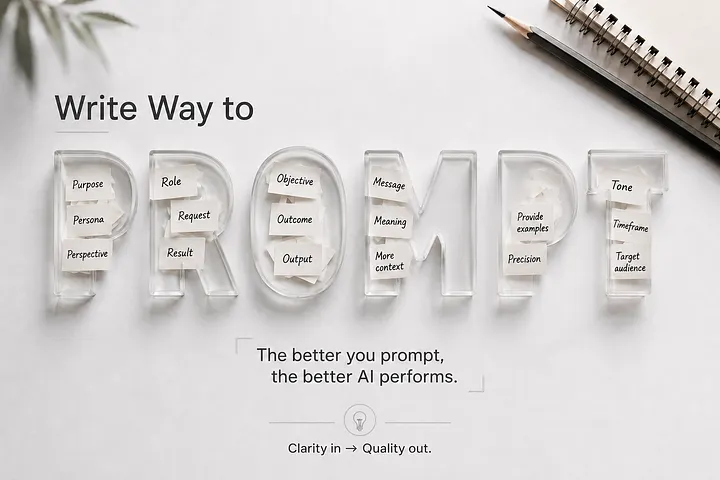
AI deserves the same treatment. A prompt that actually works usually answers:
- Objective — what does done look like?
- Audience — who is this for?
- Context — what do they already know or need to know?
- Constraints — length, tone, format, things to avoid
- Outcome — how will you judge if it’s good?
You don’t need a framework or a template library to remember this. You need to stop and ask yourself what you’d tell a smart junior colleague if you couldn’t sit next to them while they worked.
It’s not about the tool
People debate ChatGPT vs. Claude vs. Gemini vs. Cursor like the tool is the bottleneck. But switch tools with the same three-word habit, and you’ll get the same shallow results wearing a different logo. Every one of these systems responds to the same underlying principle: clear input produces useful output. That principle doesn’t change between platforms which means the skill of prompting well transfers with you, no matter which tool you’re using next year.
The real payoff isn’t the first response
Most people think a good prompt just means a better first draft. The bigger win is everything it prevents downstream:
- Fewer rounds of “no, not like that”
- Less time re-explaining context you assumed was obvious
- Output that’s closer to something you can actually ship
A five-minute investment in framing the request can save forty minutes of correcting it.
This is becoming a core professional skill
A decade ago knowing how to search well made you noticeably more effective at your job. Today, prompting is following the same trajectory.
Whether you’re using ChatGPT for research, Claude for long-form reasoning, Gemini for multimodal tasks, Perplexity for web-backed answers, GitHub Copilot for coding, or 8080.ai to transform business ideas into production-ready software with requirements, architecture, design, project plans, testing, and deployment workflows the quality of the outcome depends on the quality of the prompt.
And this isn’t just for developers.
Founders use AI to validate ideas before investing time and money. Marketers create campaigns and content strategies. Designers map user journeys and generate wireframes. Product managers draft PRDs. Consultants prepare proposals. Students simplify complex concepts. Software teams accelerate development with platforms like 8080.ai that convert structured prompts into complete software execution plans.
The common thread isn’t technical expertise.It’s the ability to define a problem clearly enough that another person or an AI can solve it.
A quick checklist before you hit Enter
Before sending your prompt, ask yourself:
- What am I actually trying to achieve?
- Who is this for?
- What does the AI need to know that I haven’t said out loud?
- What are the constraints? (tone, length, format, audience, deadlines)
- What would a genuinely good answer look like?
Answer those five questions, and your first prompt will often outperform someone else’s third revision.
The takeaway
Prompting isn’t a technical hack it’s structured thinking translated into language. The most advanced AI model can’t rescue a vague request. But a clear, specific prompt can unlock remarkable results from almost any capable AI, whether you’re generating content, writing code, planning a product, or building software with platforms like 8080.ai. claude, lovable.
Before you spend another hour comparing AI tools, spend ten minutes getting clearer on what you’re actually asking for.
That’s where the real productivity upgrade begins.
Comments
Loading comments…