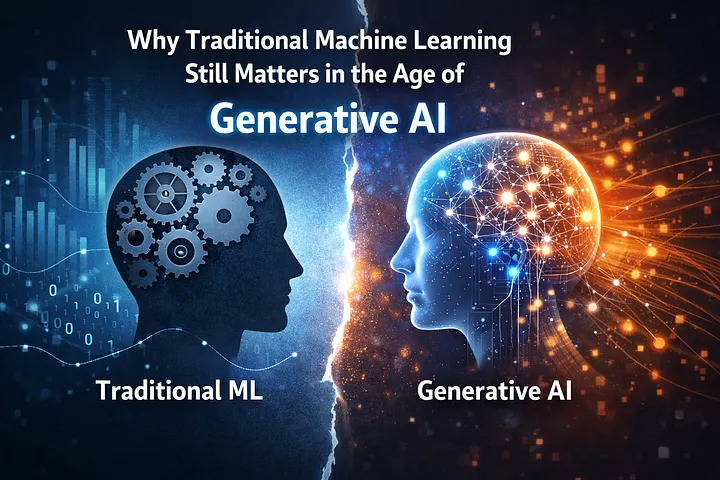
Generative AI is everywhere.
Large Language Models write code, generate images, answer questions, and even conduct interviews. It sometimes feels like traditional machine learning has become obsolete overnight.
But here’s the uncomfortable truth:
Most real-world AI systems still rely heavily on traditional machine learning.
And they will continue to do so.
The Rise of Generative AI (and the Illusion It Created)
There’s no doubt that Generative AI is revolutionary:
- LLMs can reason over text
- Diffusion models can generate images
- Foundation models can adapt to multiple tasks
This led many newcomers to believe:
- Feature engineering is dead
- Classical models are outdated
- You just need an API call to solve any AI problem
Reality is far more nuanced.
Traditional ML Is Still the Backbone of Production Systems
Despite the hype, most production AI systems depend on classical ML models such as:
- Logistic Regression
- Random Forests
- Gradient Boosting (XGBoost, LightGBM)
- Support Vector Machines
Why?
Because real-world systems care about:
- Interpretability
- Cost
- Latency
- Reliability
- Regulatory compliance
Traditional ML excels at all of these.
📊 Structured Data ≠ Generative AI’s Strength
Generative models shine with unstructured data:
- Text
- Images
- Audio
- Video
But what about:
- Financial transactions?
- Medical records?
- Sensor data?
- Tabular business data?
This is where traditional ML dominates.
Tree-based models still outperform deep and generative models on many tabular datasets with less data and far less computation.
Explainability Matters (A Lot)
In industries like:
- Healthcare
- Finance
- Insurance
- Government
You don’t just need predictions you need explanations.
Traditional ML offers:
- Feature importance
- SHAP values
- Clear decision boundaries
Try explaining a transformer with billions of parameters to a regulator.
Cost, Speed, and Deployment Reality
Let’s be honest:
- Generative AI is expensive
- It introduces latency
- It requires constant monitoring
Traditional ML models:
- Train faster
- Run on CPUs
- Are easier to deploy and maintain
- Scale cheaply
For many companies, “good enough and reliable” beats “state-of-the-art but costly.”
Generative AI Complements Not Replaces Traditional ML
The future is hybrid systems, not replacement.
Examples:
- Traditional ML filters candidates → LLM evaluates responses
- ML models detect anomalies → Generative AI explains them
- ML predicts outcomes → LLM communicates insights to users
Generative AI adds a layer of intelligence, but classical ML does the heavy lifting underneath.
Why Learning Traditional ML Is Still Essential
If you skip traditional ML, you miss:
- How learning actually works
- Bias–variance trade-offs
- Overfitting and generalization
- Feature engineering intuition
These concepts transfer directly to:
- Deep learning
- LLM evaluation
- Prompt engineering
- AI system design
Strong fundamentals create strong AI engineers.
The Real Skill: Knowing What to Use (and When)
AI maturity is not about using the newest model.
It’s about:
- Choosing the right tool
- Understanding trade-offs
- Designing systems, not demos
Sometimes the best solution is a simple logistic regression. Sometimes it’s a fine-tuned transformer. Most of the time, it’s both working together.
Conclusion
Generative AI is powerful but it didn’t replace traditional machine learning.
It stands on its shoulders.
The engineers who will thrive are not those who chase trends, but those who master fundamentals and adapt intelligently.
Traditional ML still matters. And it will continue to matter even in the age of Generative AI.
Comments
Loading comments…