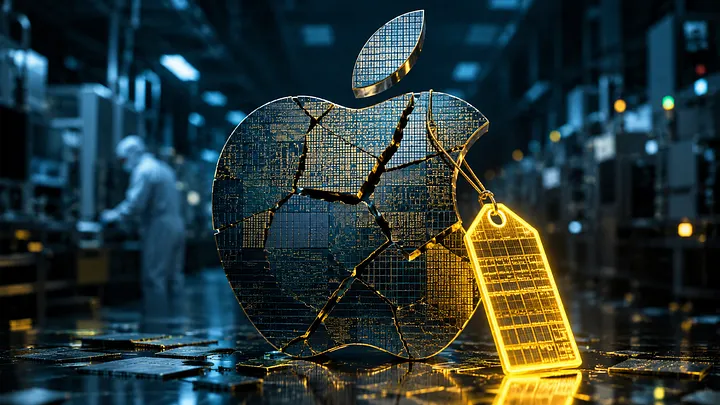
The hidden infrastructure tax quietly baked into every MacBook, iPad, and future iPhone — whether you use AI or not.
“The driving force behind Apple’s sudden 2026 price hike isn’t corporate greed or shipping bottlenecks. It’s the massive, volatile resource consumption of the global AI race — and you’re footing the bill.”
For over a decade, Apple did something most hardware companies couldn’t: it held the line on price.
Supply chain shocks, pandemic-era inflation, shipping crises — Apple absorbed them all without blinking or passing the cost to customers. Entry-level MacBooks and iPads stayed in a predictable band. Consumers trusted it. Analysts called it a structural moat.
Then, on a Tuesday night in June 2026, that moat flooded.
Apple quietly re-indexed pricing across 14 hardware product lines. No press release. No CEO statement. No warning. MacBooks, iPads, Mac Studios, and even the Vision Pro woke up with higher price tags. Some consumer tiers jumped up to 20% overnight.
The standard media narrative blamed the usual suspects: margin protection, post-inflation catch-up, trade tariffs. But those explanations are surface-level. The real cause is structural, systemic, and — crucially — has nothing to do with anything you personally chose to use.
Welcome to the era of the Involuntary On-Device AI Tax.
The Perfect Semiconductor Storm: 3 Vectors That Broke Apple’s Pricing Model
Apple’s hand wasn’t forced by one thing. It was forced by three macro pressures that converged simultaneously on the global semiconductor market in early 2026.
1. “RAMageddon” — When Memory Became the New Oil
Memory used to be a footnote in a laptop spec sheet. In 2026, it became the most contested commodity in consumer tech.
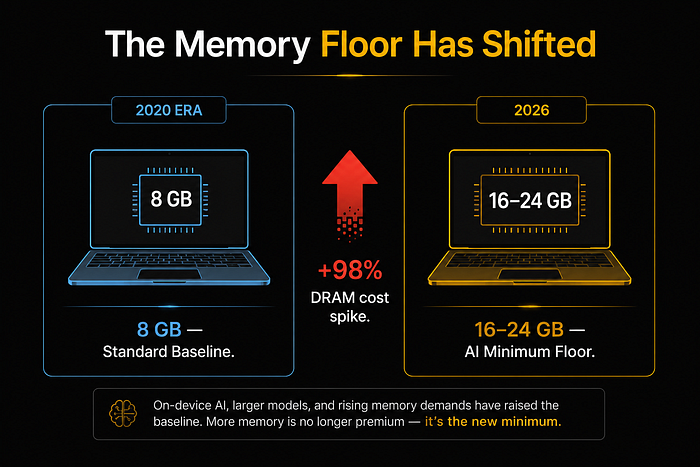
During the first half of 2026, baseline costs for enterprise DRAM and NAND Flash storage surged by close to 98% over prior manufacturing cycle baselines. That is not a rounding error. That is a near-doubling of one of the most critical input costs in hardware manufacturing.
The root cause is architectural, not cyclical. Older devices treated AI as a cloud-hosted feature — something that lived on a server and returned a response. Today’s hardware is architecturally mandated to run AI models locally, on-device, in real time. Apple’s writing assist, image rendering, contextual Spotlight search — these aren’t cloud calls. They’re local inference jobs that require massive, always-resident memory pools.
The practical consequence:
- 8 GB RAM → Once the standard consumer baseline
- 16 GB RAM → Now the minimum floor just to keep the OS functional with local AI active
- 24 GB RAM → Required for any professional or heavy workflow
What used to be a premium upgrade is now the default configuration. And the cost of that default has nearly doubled.
2. Institutional Cannibalisation — Big Tech Is Eating Your Supply Chain
Apple isn’t competing against Dell and Lenovo for components anymore. It’s competing against Google, Microsoft, Meta, and OpenAI.
Those companies are pouring hundreds of billions of dollars into private and sovereign cloud infrastructure. And to build those data centers, they need the exact same memory chips that go into your MacBook. The difference: they sign multi-billion-dollar forward-supply agreements with foundries like Micron, Samsung, and SK Hynix — deals that guarantee long-term revenue and carry vastly superior margins compared to consumer-grade orders.
Foundries are rational economic actors. They prioritize what pays better.
GLOBAL SEMICONDUCTOR ALLOCATION — 2026


Global Silicon Output
│
├──► Enterprise AI Clusters
│       Priority allocation + premium margins
│       (Google, Microsoft, Meta, OpenAI)
│
└──► Consumer Electronics
        Residual fab capacity
        Inflated spot costs
        (Apple, Dell, Lenovo, HP)
The result: consumer hardware companies are locked out of first-tier supply and forced to bid against each other for whatever’s left — at spot prices that have no ceiling.
3. The Invisible R&D Horizon — You’re Funding Apple’s Future
The cost pressure isn’t purely in physical silicon. Apple is simultaneously spending billions on:
- Custom Apple Silicon iteration (Neural Engine depth, next-gen unified memory architecture)
- Private cloud data centers designed specifically to back on-device AI with server-side fallbacks
- Carbon-neutral infrastructure for AI workload sustainability
These capital expenditure cycles are front-loaded. The features won’t generate direct revenue for 2–3 years. Apple’s solution — standard practice for any sophisticated hardware company — is to amortize those R&D costs across retail hardware volume. Every device sold at the new price point partially funds the next generation of chips.
You are, in effect, a pre-paying investor in Apple’s AI infrastructure roadmap.
The Hard Numbers: What Actually Changed Overnight
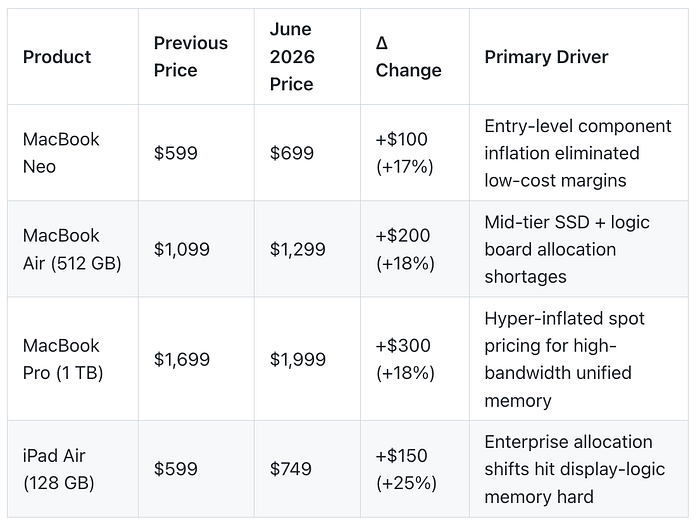
In some international markets, custom-configured MacBook Pros with high-end RAM saw localized retail spikes exceeding an additional $1,200 (approx. ₹1 Lakh) for upgraded configurations. Professional-grade customization is quietly becoming an enterprise luxury tier.
Why You’re Paying the AI Tax Even If You’ve Never Opened ChatGPT
This is the part that legitimately frustrates people — and rightfully so.
The counterargument is obvious: “I don’t use AI features. Why am I paying for hardware that supports them?”
The answer is uncomfortable: you can’t opt out, because the AI is running at the OS level.
Local language models, contextual intelligence layers, and on-device inference engines are no longer add-on features you toggle in Settings. They are integrated directly into the operating system’s core memory management protocols. The OS keeps these models permanently resident in system RAM to guarantee instant response times and protect user privacy from cloud exposure.
The memory footprint exists whether you activate the feature or not. You can’t uninstall the Neural Engine. The silicon is already there, and the cost is already baked in.
On the cloud side, the economics are similarly ruthless:
“Hardware margins are quietly stepping in to front-load and subsidize the massive, ongoing energy and infrastructure costs of the cloud ecosystems.”
Every AI request processed in Apple’s private cloud consumes electricity, cooling capacity, and high-bandwidth networking. Rather than charging a monthly AI subscription — which would visibly alienate users and throttle adoption — Apple offsets these recurring operational liabilities through hardware margins. When you buy the device, you’re pre-purchasing a multi-year cloud compute passport.
It’s a smart strategy. It’s also completely invisible to most buyers.
The iPhone Exception — And Why It’s Temporary
Notably, Apple’s highest-revenue product line — the flagship iPhone family — escaped the June 2026 repricing intact. That restraint is strategic, not structural.

Analysts tracking Apple’s silicon roadmap are clear: the iPhone buffer is temporary. As next-generation iPhone models are engineered to run larger, more sophisticated local LLMs and ultra-dense neural processors on-device, the cost floor underneath them will become unsustainable at current retail prices.
Forward projections suggest future iPhone Pro starting configurations could push toward $1,399 — a threshold that would permanently redefine what a consumer flagship costs. The question isn’t if. It’s when.
The Macro Signal: This Isn’t Just an Apple Story
Apple’s June 2026 repricing is not an isolated corporate decision. It is an early indicator of a sector-wide realignment.
Dell, HP, Lenovo, and Asus are facing the exact same pressures: identical component constraints, the same foundry spot price inflation, the same enterprise allocation squeeze. The supply chain dynamics that hit Apple first will ripple across every hardware vendor that sources from the same global semiconductor pool.
The era of affordable, high-performance consumer hardware is structurally ending — not because companies got greedy, but because the resource war for silicon between enterprise AI and consumer electronics has no neutral ground.
The true cost of digital intelligence is no longer hidden in the cloud. It’s written clearly on your receipt.
What You Can Actually Do About It
Knowing the cause doesn’t lower the price. But it does change how you should think about your next hardware decision:
- Buy sooner rather than later. If a MacBook or iPad upgrade is in your 12-month plan, the supply signals suggest prices aren’t reversing.
- Reconsider the entry-level. The $699 MacBook Neo may be the last affordably-priced point of entry before the next hardware generation arrives with higher AI hardware floors.
- Push back on “free AI.” No feature is free. Evaluate whether the on-device AI bundle justifies the premium for your actual workflow — and vote with your purchases accordingly.
- Watch the iPhone cycle closely. The next major iPhone Pro generation will be the most revealing data point: when it breaks the $1,399 floor, the sector-wide shift becomes permanent.
Final Thought
You didn’t sign up to fund a global AI infrastructure war. But the silicon in your next device has already been drafted into it.
The 2026 Apple price restructuring is not a pricing anomaly. It’s a structural signal — the first clear evidence that the cost of the AI era is migrating from cloud abstractions into physical products that sit on your desk.
Every receipt is now a balance sheet entry in someone else’s compute roadmap.
Comments
Loading comments…