Does your browser currently have fifty tabs open, including a half-watched YouTube tutorial and a dense documentation page you've been meaning to read since last week? Most developers face a recurring paradox: our careers depend on continuous learning, yet our daily workflow, filled with sprint goals, retrospectives, debugging marathons, and context switching, leaves almost no room for long-form study.
Microlearning apps offer a solution here, providing learning information in short bursts and significantly improving long-term retention compared to cramming sessions. For developers, this means that 10 minutes spent during a build compile can be more effective than weekend burnout sessions. Let's review the list below to see which apps best fit your specific workflow gaps!
1. Nibble Microlearning App: Learning Concepts in Short Sessions
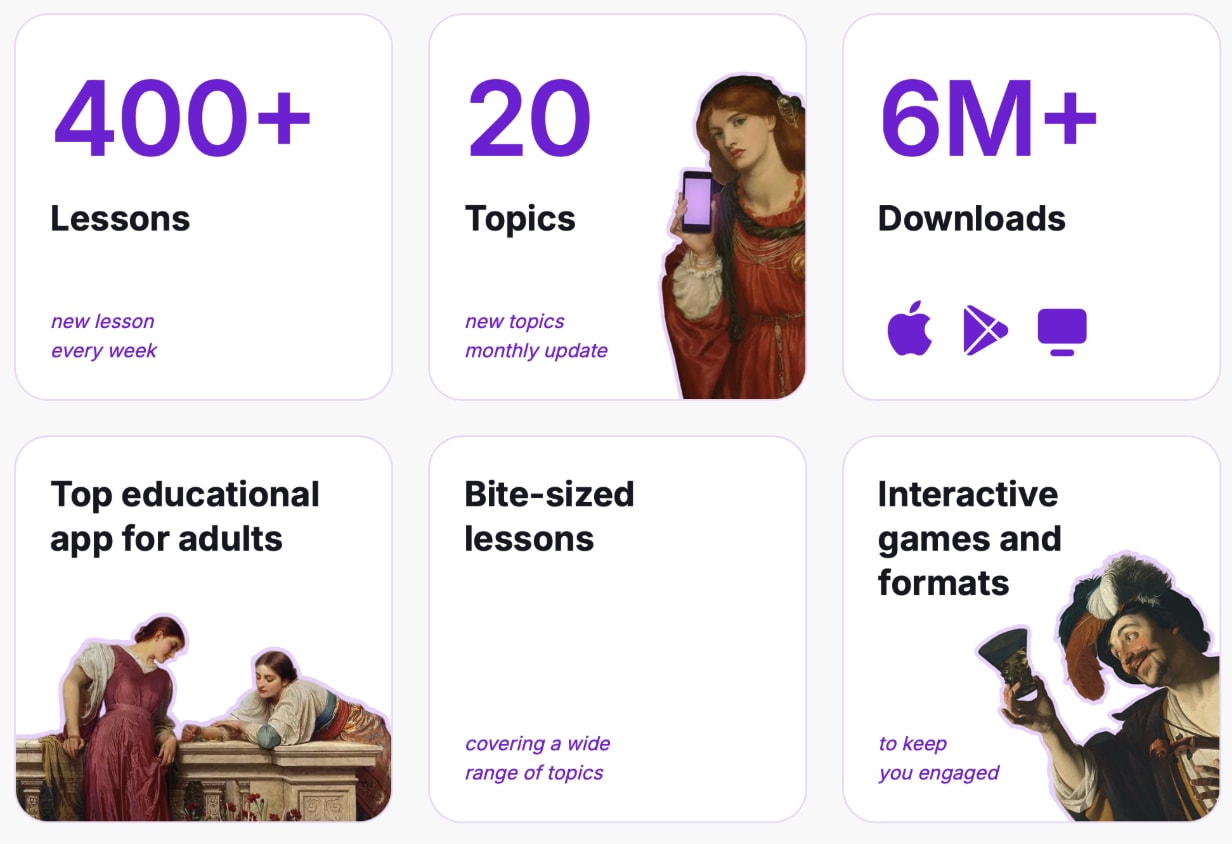
If you have ever felt the shame of mindless scrolling when you're actually just trying to decompress between tasks, the Nibble app is the logical antidote. It is designed specifically for busy professionals who want to remain well-rounded without the pressure of a formal curriculum. Nibble breaks down complex subjects into 10-minute interactive bites.
For a developer, this is the perfect companion for those liminal spaces in the day. The app covers over 20 topics, including Artificial Intelligence, Logic, Biology, and Statistics, which are directly applicable to engineering mindsets:
- Interactive Lessons: Move beyond reading text with quizzes and visual formats that require active engagement.
- Expert-Curated Content: Lessons are crafted by experts to ensure you get the one thing you need to focus on, not unnecessary filler, and have amazing design.
- Gamified Retention: It uses a trial-and-error method, which research from the Rotman Research Institute shows can actually enhance memory effectiveness.
- Broad Spectrum: Quickly pivot from a lesson on Criminology to Mathematical Logic to keep your lateral thinking skills sharp.
2. Headway App: Solving Constant Learning Requirement with Nonfiction Books
Headway is a microlearning app designed to replace doomscrolling with intentional learning, transforming 500-page nonfiction bestsellers into structured, 15-minute summaries you can actually finish and retain. For a developer, such an app can help master soft skills and mental frameworks, such as deep focus, systems thinking, and leadership. Such skills separate a senior engineer from a junior one.
Headway differentiates itself from other summary apps through heavy gamification and retention tools. You will get:
- 15-Minute Bites: Every summary is available in both professional audio and text formats, perfect for commutes or gym sessions.
- Spaced Repetition: The app uses a spaced repetition algorithm to resurface them at optimal intervals, so you actually remember the concepts.
- Personalized Growth Plans: Upon signup, you set goals.
- Interactive Challenges: You can join 15-day or 30-day challenges like Success or Emotional Intelligence to build a consistent habit.
- Daily Insights: Bite-sized quotes and gems delivered via home screen widgets to keep you inspired without even opening the app.
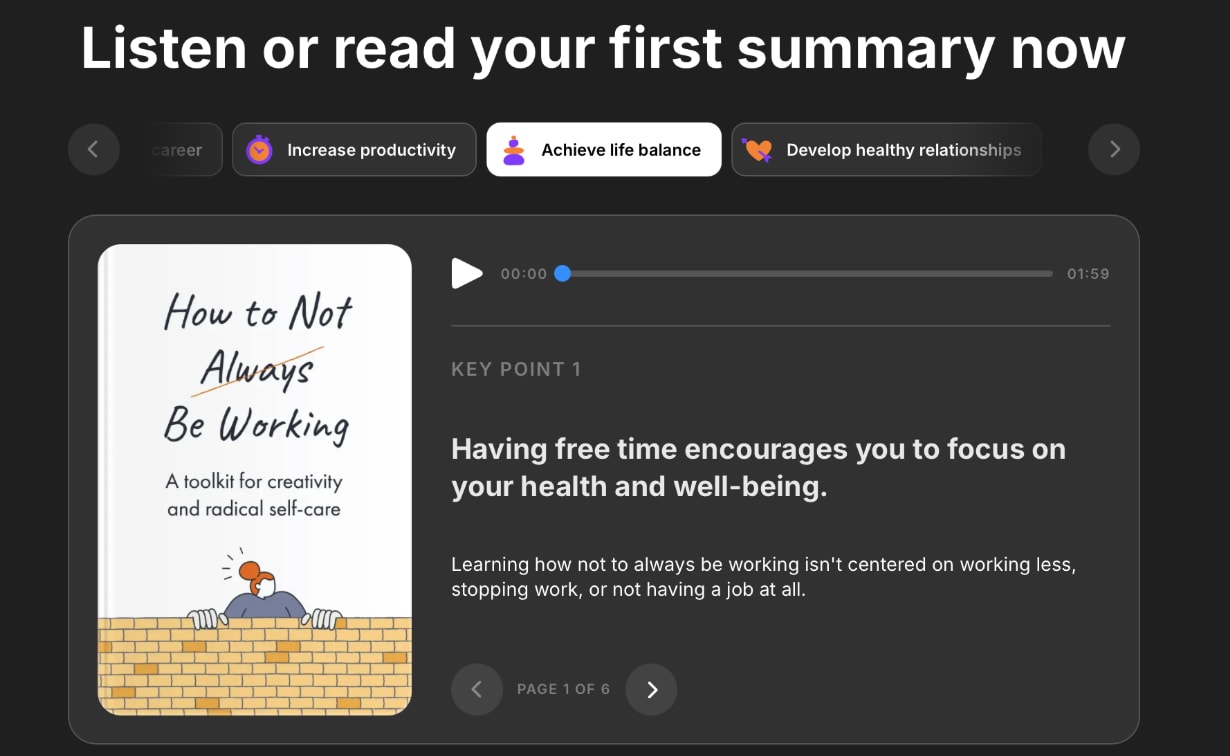
While Headway focuses on nonfiction bestsellers, it hosts the foundational books that every developer needs for career longevity. You can read books about productivity and focus, for example, 'Deep Work' by Cal Newport or 'Atomic Habits' by James Clear. You can find the '80/20 Principle' by Richard Koch that teaches you how to identify the 20% of your code/tasks that produce 80% of the value.
3. Anki: Repeating Concepts Using Flashcards
Anki is a staple in the developer community for one reason: it leverages Spaced Repetition Systems (SRS). If you are tired of looking up the same CSS Grid syntax or Bash command every three weeks, Anki is the tool to move that knowledge from your search history into your long-term memory.
It's based on the cognitive science principle that we are most likely to remember information if we review it right as we are about to forget it:
- Algorithm-driven: the app calculates exactly when to show you a card based on your past performance.
- Custom decks: you can create your own cards for specific frameworks (e.g., React Hooks or Rust ownership).
- Markdown support: many community plugins let you format code snippets beautifully in your cards.
4. Brilliant: Solving Problems Through Interactive Lessons
For developers, problem-solving is a muscle. If you aren't using it for complex logic, it starts to atrophy. Brilliant focuses on the why behind the how. You can interact with visual simulations to understand the fundamentals of computer science, neural networks, and discrete math.
It's particularly useful for engineers who want to move into more senior roles that require a deeper grasp of algorithmic complexity:
- Hands-on learning: you learn by doing, dragging elements, and solving puzzles rather than watching videos.
- STEM focused: deep dives into areas like Logic, Quantum Computing, and Data Science.
- Instant feedback: you get immediate explanations for why a solution worked (or didn't), reinforcing the mental model.
5. Coursera: Taking Short Modules from Courses
While Coursera is known for its massive certifications, it has evolved into a modular platform. Most of its high-level university courses are now broken down into 5- to 10-minute video segments.
This allows you to treat a Stanford-level course on Machine Learning as a collection of micro-lessons. You can tackle one module during your lunch break and slowly chip away at a professional credential over time:
- University-grade content: access knowledge from institutions like Yale, Google, and IBM.
- Modular quizzes: each short video is usually followed by a quick check-in to ensure you understood the concept.
- Flexible auditing: you can audit many courses for free, taking only the bits of knowledge you actually need for your current project.
6. Quizlet: Memorizing Key Concepts Fast
While Anki is for long-term mastery, Quizlet is often the better choice for high-speed, high-visual revision. It is incredibly effective for developers prepping for cloud certifications (like AWS or Azure), where there is a high volume of service names and definitions to memorize. Its Match and Test modes turn technical definitions into a fast-paced game.
- Pre-made decks: thousands of other developers have already made decks for almost every tech cert imaginable.
- Visual learning: easily add diagrams and architectural charts to cards to help with spatial memory.
- Multi-mode study: switch between flashcards, writing exercises, and timed games depending on your energy level.
How Microlearning Fits Developer Workflows
The myth that you need deep work blocks for every type of learning is one of the quickest routes to developer burnout. By integrating microlearning apps into the dead time of your day or those 10-minute gaps between meetings or tasks, you can transform idle frustration into professional growth. These tools provide the foundational knowledge and sharp mental models that make your building more efficient.
You can try picking one app from this list, perhaps starting with a 10-minute session on the Nibble app, and see how it changes your continuous learning. You will find yourself ending the day a little sharper than when you started!
Comments
Loading comments…