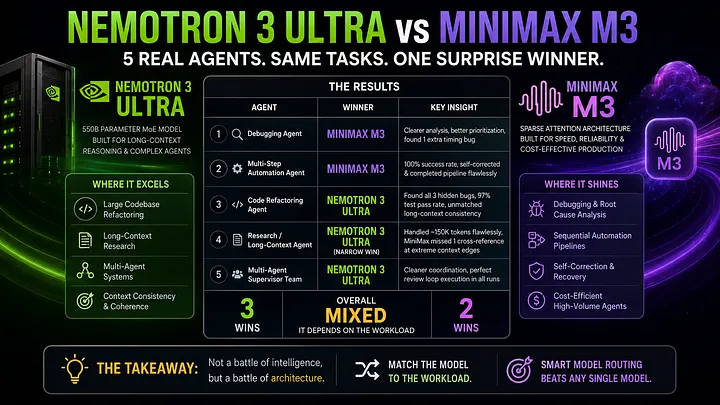
Two of the most talked about models in 2026. Five real agents. The result was not what I expected going in.
Nemotron 3 Ultra and MiniMax M3 have both been making headlines this month, but for completely different reasons.
Nemotron 3 Ultra is NVIDIA’s 550 billion parameter MoE model built for long-context reasoning and autonomous AI agents. MiniMax M3 quietly became my daily driver after outperforming five other frontier models in month-long testing, thanks to its speed, reliability, and surprisingly low cost.
I had tested both separately. I had never put them head to head.
So I built five production-grade AI agents and gave both models the exact same tasks. Same stack. Same prompts. Same conditions.
What happened next completely challenged my expectations, and the winner was not the model most people would have predicted.
The Setup
Every agent used LangGraph for orchestration, FastAPI for API endpoints, and LiteLLM for model routing. Nemotron 3 Ultra ran locally on an A100 80GB node, while MiniMax M3 ran through its API.
Each agent completed three identical test runs. The only metric that mattered was simple: could it finish the task without human intervention, and was the final output ready to use without manual cleanup?
Agent 1: Debugging Agent
The task was simple on paper but brutal in practice: diagnose ten failing tests across a distributed async Python application, trace dependencies between failures, identify which ones shared the same root cause, and produce a prioritized fix plan.
Nemotron 3 Ultra correctly identified that four of the ten failures stemmed from a single underlying issue in all three runs. The analysis was accurate but dense. Everything was there, but turning the reasoning into an action plan required a careful second read.
MiniMax M3 reached the same conclusion and explained the failure chain far more clearly. The output was easier to follow, easier to prioritize, and easier to act on. On one run, it also uncovered a timing-dependent bug buried four service boundaries deep that Nemotron missed.
MiniMax M3 takes this round. Not because it reasoned better, but because it delivered answers that were immediately usable.
Agent 2: Multi-Step Automation Agent
The task was to monitor a folder of incoming data files, validate each against a schema, transform valid files, quarantine invalid ones, and generate a complete processing log.
This was a straightforward sequential workflow where execution reliability mattered far more than deep reasoning.
MiniMax M3 completed the entire pipeline in all three runs without manual intervention. On one run, it detected a validation failure, corrected its approach without prompting, and finished the workflow successfully. Every summary log was complete, accurate, and well organized.
Nemotron 3 Ultra also completed the task, but twice it over-engineered the validation layer, creating a more complex schema-checking process than the workflow required. The results were correct, but the extra logic slowed execution without improving the outcome.
MiniMax M3 wins this round decisively. Of all five agent tests, this produced the clearest gap between the two models.
Agent 3: Code Refactoring Agent
The task was to refactor a 1,500 line Python codebase containing three hidden bugs, keep the test suite above a 95 percent pass rate, and document the reasoning behind every structural change.
This is where Nemotron 3 Ultra lived up to its reputation.
It found all three hidden bugs in every run and maintained a 97 percent test pass rate. Its biggest advantage was long-context consistency. Decisions made in the first file carried cleanly through the last, with no contradictions in naming, architecture, or structure. That level of coherence across an entire codebase is exactly what a 550 billion parameter model built for long-context reasoning is designed to deliver.
MiniMax M3 found two of the three bugs. The one it missed was a subtle async race condition that required tracking execution across multiple files at once, a task where maintaining large amounts of context proved critical.
Nemotron 3 Ultra wins this round convincingly.
Agent 4: Research and Long-Context Agent
The task was to process roughly 150,000 tokens consisting of a technical specification and its related codebase, then answer questions that required connecting information scattered across both documents.
This was a direct test of long-context reasoning.
Nemotron 3 Ultra handled the workload flawlessly in all three runs. Its answers stayed accurate and consistent regardless of whether the required information appeared at the beginning or the end of the input. There was no noticeable drop in quality, even when questions demanded complex cross-document synthesis.
MiniMax M3 also performed better than expected. Its sparse attention architecture kept pace with Nemotron through most of the workload, missing only one cross-reference that depended on linking details from opposite ends of the input. Considering its much lower inference cost and the fact that it required no local hardware, the result was impressive.
Nemotron 3 Ultra wins this round, but only narrowly. MiniMax M3 closed what I expected to be a much larger gap.
Agent 5: Multi-Agent Supervisor Team
The task was to evaluate a supervisor agent coordinating three subagents: a Planner, an Executor, and a Critic. The Critic could reject work, send it back for revision, and repeat the loop until approval or the maximum number of attempts was reached.
This was the most demanding coordination test of the five and the one most likely to expose weaknesses in agent orchestration.
Nemotron 3 Ultra executed the cleanest workflow. The Planner produced clear strategies, the Executor followed them consistently, and both Critic rejections were returned with the correct context before passing on the second attempt. All three runs completed without manual intervention.
MiniMax M3 finished the workflow cleanly in two of the three runs. On the third, the Critic approved an output that still contained a genuine issue, leaving a manual cleanup step that undermined the purpose of the review loop.
Nemotron 3 Ultra wins this round convincingly.
The Honest Scorecard
Agent                        Winner
------------------------------------------
Debugging                    MiniMax M3
Multi-Step Automation        MiniMax M3
Code Refactoring              Nemotron 3 Ultra
Research / Long-Context       Nemotron 3 Ultra (narrow)
Multi-Agent Supervisor        Nemotron 3 Ultra
------------------------------------------
Overall: Mixed. Three wins for Nemotron, two for MiniMax M3.
The Surprise
Going in, I expected Nemotron 3 Ultra to dominate on raw capability because of its scale, while MiniMax M3 would compete mainly on cost efficiency.
That is not what the results showed.
MiniMax M3 won the tasks that depended on reliable execution, clear outputs, and autonomous recovery under real production conditions, particularly debugging and workflow automation. Nemotron 3 Ultra led whenever success depended on maintaining coherent context across large codebases, long documents, or complex multi-agent systems.
The difference was not intelligence. It was architecture.
Nemotron 3 Ultra excelled when the entire problem needed to remain in context at once. MiniMax M3 excelled when sequential execution, practical reasoning, and self-correction mattered more than maximizing context.
There was no universal winner. The real takeaway is that choosing the right model depends less on benchmark scores and more on matching the model’s architecture to the workload.
Which One Should You Use
Use Nemotron 3 Ultra for large codebase refactoring, long-context research, document analysis, and complex multi-agent systems where maintaining consistency across an entire workflow matters more than speed or inference cost.
Use MiniMax M3 for debugging, sequential automation pipelines, and production agents that need to self-correct, recover from failures, and keep moving without supervision. Its lower inference cost also makes it the stronger default for high-volume agent workloads.
If you are building an AI production stack in 2026, the best choice is not one model over the other. It is using each model where its architecture delivers the biggest advantage. Intelligent model routing will outperform relying on a single frontier model every time.
Have you built agents with Nemotron 3 Ultra or MiniMax M3? Share your results in the comments. I read every one, especially if your findings differ from mine.
Follow me for hands-on AI model comparisons based on real production workflows, practical benchmarks, and testing that goes beyond leaderboard scores.
Post you may also like-
I Tested MiniMax M3 Against Claude Opus 4.8 and GPT-5.5. The Brutal Truth.
I Built 5 Production-Grade Agents with Nemotron 3 Ultra. Results After 48 Hours.
Comments
Loading comments…