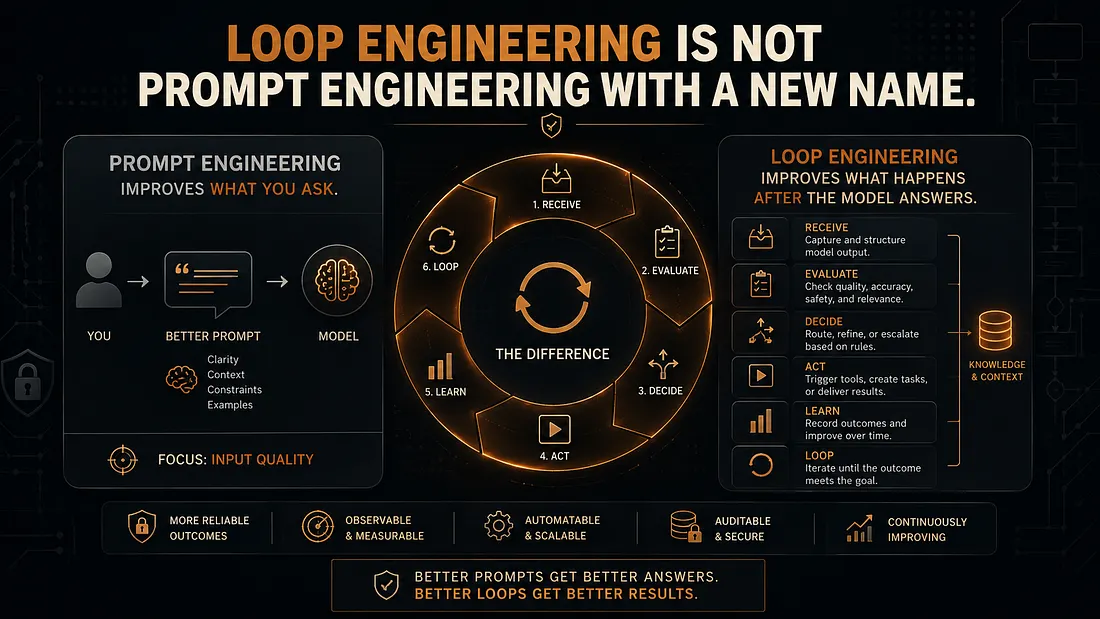
Prompt engineering improves what you ask. Loop engineering improves what happens after the model answers.
More like this: AI in practice — collection: Tools, agents, workflows, and engineering judgment
The first wave of practical AI advice focused on prompts for a sensible reason: better prompts helped. When you gave the model a role, specified an output format, included examples, and stated constraints clearly, the result was usually better than a vague request followed by hope. That discipline was useful. It gave people a first practical layer for working with large language models.
The prompt-centered view starts to fail when the model is expected to do more than produce one reply.
Once an AI system reads files, calls tools, checks results, revises its own work, waits for approval, or retries after failure, the prompt is no longer the whole system. It is one component in a larger process. The important questions change from “What should I ask?” to “What evidence will the system see? What actions may it take? How will it know whether it is making progress? What happens when it is wrong? When should it stop? Who can intervene?”
That is the practical territory of loop engineering.
Prompt engineering shapes the instruction given to a model. Loop engineering shapes the feedback system around it: the repeated cycle in which the model acts, observes consequences, receives evidence, is evaluated, corrects course, and either continues or stops. It matters when AI moves from chat output into workflow behavior.
Many failures blamed on “bad models” are really loop-design failures. The model was asked to do consequential work with too little context, no external evidence, vague success criteria, broad permissions, and no clear stopping condition. Drift, hallucination, overreach, and pointless polishing are predictable outcomes in that setup.
The difference is visible in everyday examples. “Review this article and improve it” is a prompt. “Identify the article’s claim, check whether the outline supports it, flag unsupported technical statements, request sources for unverifiable claims, propose a revision plan, and stop before rewriting unless approved” is a loop. “Fix this bug” is a prompt. “Inspect the relevant files, form a hypothesis, patch the code, run tests, inspect failures, revise, and stop when tests pass and the diff is explainable” is a loop. One asks for output. The other designs a process.
This is why loop engineering deserves its own name. Anthropic’s guidance on building agents emphasizes simple, composable workflows, tool use, and evaluator-optimizer patterns rather than treating agents as magic prompt wrappers. Its later work on agent evals frames reliability in terms of grading logic, human review, and measurable success, not merely eloquent output. OpenAI’s agent materials similarly center orchestration, tools, guardrails, and evaluation for consistent performance. LangChain’s framing of agent engineering leans on reliability, observability, and testing, which points to the same conclusion: the hard part starts after the first model response.
The shift is simple to state and easy to underestimate. Prompt engineering optimizes instructions. Loop engineering designs the process around the model: what context it receives, what actions it may take, what evidence comes back, how outputs are judged, when humans intervene, and when the system stops.
That is the conceptual move this article makes.
Why prompt engineering was the first AI productivity skill
Prompt engineering became the first mass-market AI skill because it matched how most people first encountered language models. You opened a chat window, typed something, got an answer, and noticed that phrasing changed the result. A more specific request produced a better answer. Asking for JSON increased the chance of structured output. Examples gave the model something to imitate. Tone, length, and format constraints made the answer easier to use.
That was real progress.
A decent prompt does several useful things. It clarifies the task, supplies local context, narrows the output shape, sets constraints, and reduces ambiguity. Those mechanics still matter. Professionals write better prompts than casual users because they know vague requests create vague failures. A model asked to “summarize this” without scope may summarize the wrong thing. A model asked to “write production code” without tests, interfaces, or acceptance criteria is being asked to improvise.
Prompt advice spread because it was immediately actionable. It did not require infrastructure, toolchains, or a product team. It only required a better way to describe the work.
There was also a deeper reason. In early usage, the model’s response often looked like the product. For brainstorming, drafting, summarizing, translating, or explaining, the generated text was the main artifact. Improving the prompt genuinely improved the experience. For a large share of office and knowledge work, that mattered.
The trouble starts when people carry the same mental model into repeated, tool-using, or consequential workflows.
A single good prompt can help a model explain a concept, draft an email, or sketch an outline. It cannot, on its own, give the model trustworthy access to a codebase, control permissions, determine correctness, prevent silent failure, create recovery paths, or decide when to ask for human approval. Those are system questions, not wording questions.
This is the first useful demotion of prompt engineering. It remains valuable, but it stops being the center of gravity once the task has memory, iteration, external state, or real consequences.
Prompt engineering is a local optimization. Loop engineering is needed when the work becomes operational.
The limit of the single prompt
The easiest way to understand loop engineering is to look at tasks that fail when treated as one-shot conversations.
Take a writing workflow:
Review this article and improve it.
A strong model may produce a plausible edit. It might tighten the opening, improve transitions, fix grammar, or polish the conclusion. But what is it optimizing for? Accuracy? Structure? Tone? Argument quality? Internal consistency? Citations? Audience fit? If the article contains unsupported technical claims, should the model verify them, remove them, mark them, or quietly rewrite around them? If sources are missing, should it ask for them or infer confidence? If the outline is weak, should it reorganize the piece, or is that outside scope? Should it stop before a large rewrite and ask for approval?
The problem is not that the prompt is short. The task is under-specified as a process.
Now take a software task:
Fix this bug.
If the model can only see the bug report, the request is almost meaningless. It does not know which files matter, what environment the code runs in, what tests exist, what “fixed” means, how risky the patch is, or whether the application still works afterward. A longer prompt eventually hits the same ceiling. The task requires actions and evidence. The model has to inspect code, form a hypothesis, edit a file, run tests, read failures, revise, and stop when a condition is met. That is already a loop, whether or not the product calls it one.
Or take a research assistant:
Summarize this issue.
If the issue lives in a repository with a discussion thread, linked pull requests, test logs, and prior incidents, a one-shot summary with no retrieval path is a gamble. The model may produce something fluent while missing the actual blockers. If it cannot inspect the relevant context, its answer is not grounded. The missing ingredient is a workflow that retrieves the right evidence, tracks what has been checked, surfaces uncertainty, and stops before pretending confidence.
That is the broader limit of the single prompt. It treats the model response as the end of the job. In serious work, the first answer is often only the beginning. It may define a plan, trigger tool use, or expose uncertainty that needs verification. Operationally, the important question is not whether the model can produce a nice-looking paragraph in one shot. It is whether the system can move from a goal toward a trustworthy outcome.
People who use coding agents, research assistants, or support automation in messy environments tend to become skeptical of prompt absolutism. They have seen a convincing answer collapse when it touches a real tool, a real repository, a real user request, or a real constraint. They have seen systems iterate long after they should have stopped. They have seen models optimize for polished output because correctness was never measured. They have seen failure compound over several steps because the loop was never designed.
After that, the useful question changes. The prompt may still matter, but the process has to be sane.
What is a loop?
A loop is the repeated structure that lets a system act, observe, judge, correct, and either continue or stop.
The simplest useful definition looks like this:
goal → context → action → observation → evaluation → correction → stop
That sequence is not academic jargon. It describes what happens in many AI systems, whether or not the product page uses the word agent.
The goal is what the system is trying to accomplish: produce a better article draft, resolve a failing test, answer a customer question accurately, classify a ticket, or route a case correctly. If the goal is vague, the loop will drift.
The context is what the model knows at that step. This can include the prompt, conversation history, retrieved documents, repository files, tool output, state from prior attempts, and system constraints. Bad context produces bad actions, but bloated context can also degrade performance by flooding the model with irrelevant material.
The action is what the model does next. It may generate text, select a tool, propose a patch, retrieve information, ask a clarifying question, or hand off to a human.
The observation is what comes back from the world: a tool result, test failure, search result, API response, human comment, linter warning, missing file, or timeout. This is where the loop stops being just a conversation. Observation is external feedback.
The evaluation step asks whether the action moved the system closer to success. Did the tests pass? Did the answer cite evidence? Did the patch introduce regressions? Did the draft support its central claim? Did retrieval return relevant documents? Evaluation can be code-based, model-based, human-based, or a combination. Anthropic’s guide to agent evals discusses these grader types because reliable agents need ways to measure progress beyond vibes.
The correction step turns evaluation into the next move: revise the answer, retrieve different evidence, narrow the scope, ask for human review, back out a change, or terminate with failure.
The stop condition decides when the loop ends. Stop when tests pass and the diff is explainable. Stop when required evidence is missing. Stop after one revision round unless a human approves more. Stop when confidence is too low. Stop when the output meets explicit criteria. A missing stopping condition is one of the fastest routes to bad agent behavior because the system keeps doing things simply because it can.
Most AI agents are variations on this cycle, with different levels of tooling, autonomy, memory, and oversight. The word loop is useful because it directs attention to process structure instead of model charisma.
A chatbot feels like a conversation. A loop is a workflow.
Prompt engineering, context engineering, tool engineering, and loop engineering
The newer vocabulary can feel slippery because these disciplines overlap. They are layers, not rivals.
Here is the cleanest distinction:
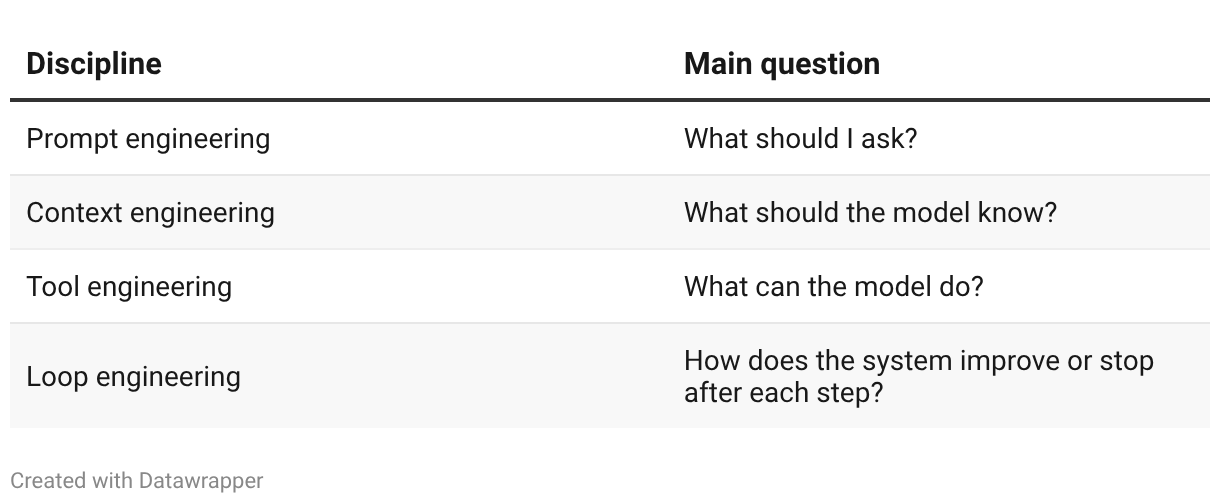
Prompt engineering is about the instruction. It deals with task phrasing, output format, examples, role prompts, constraints, and step framing. Good prompt engineering reduces ambiguity and gives the model a better first move.
Context engineering is about information selection. It asks what the model should receive, when, and in what form. Which documents are retrieved? Which code files are included? Which prior turns matter? What should be summarized instead of passed raw? Which state should persist across steps? Models reason over the slice of reality they are given, so that slice matters.
Tool engineering is about capability and boundary design. What tools exist? What arguments do they accept? How are permissions scoped? What output shape do they return? Can the model search, run tests, read files, write diffs, call APIs, or execute commands? A model without tools is often blind and powerless. A model with sloppy tool access can become dangerous, expensive, or both. OpenAI’s agent materials explicitly highlight tool design and guardrails as central concerns, which reflects the field’s move from pure prompting to controlled action.
Loop engineering sits above and across those layers. It asks how they interact over time. Given the prompt, context, and tools, what happens after each step? What triggers another attempt? What counts as evidence? What counts as success? Who reviews what? When does the system escalate? When does it stop?
A loop can contain many prompts, many context windows, many tool calls, and several checkpoints. Its quality depends less on a single brilliant instruction and more on whether the whole cycle is bounded, observable, and correctable.
A compact comparison helps:
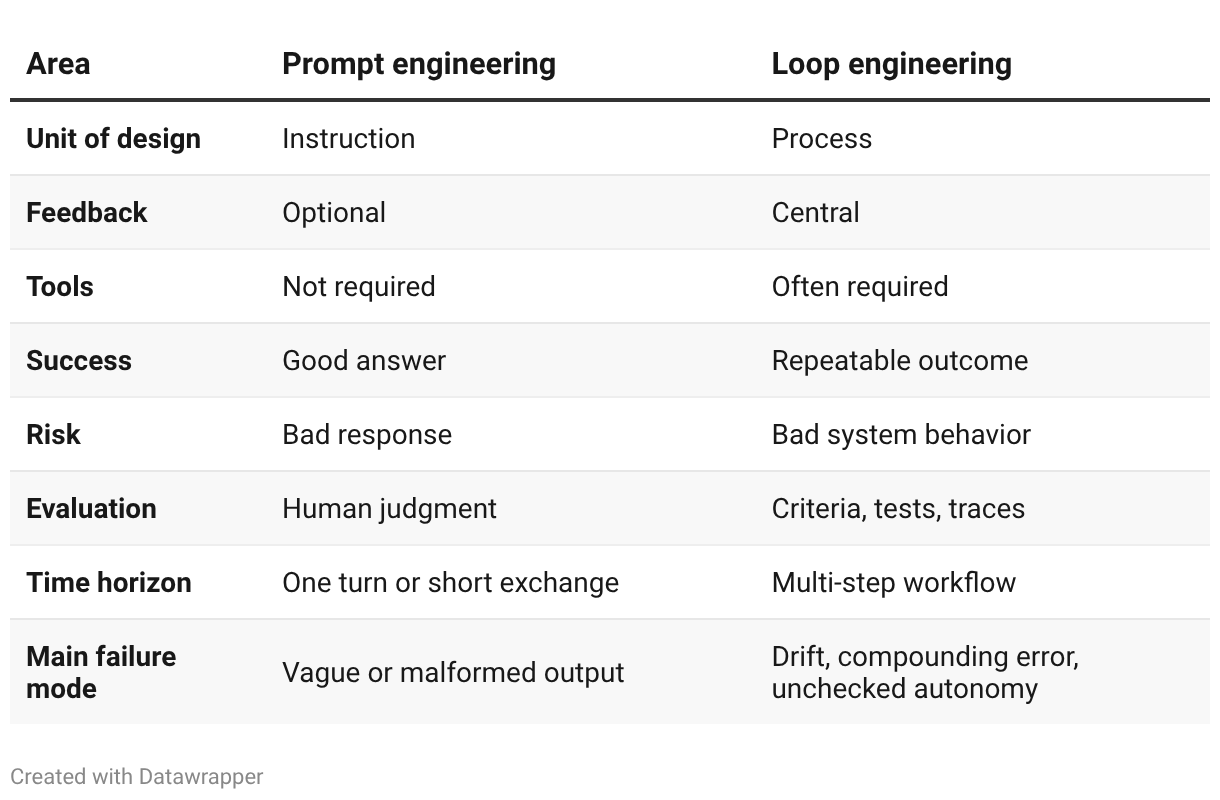
That last row is the operational difference. A bad prompt may give you a mediocre answer. A bad loop can give you an unstable system.
The prompt is not the whole system
A useful mental model is this: the prompt is the instruction inside the loop.
Consumer AI interfaces encouraged people to collapse those layers. A prompt went in, a response came out, and that looked like the whole product. Once the system interacts with files, code, web results, business rules, user records, or approval flows, the prompt behaves more like a function call inside a larger program.
You would not describe a CI pipeline as “just a shell command,” even though shell commands are part of it. You would not describe a deployment system as “just YAML,” even though YAML configures it. An agentic workflow should not be reduced to prompting just because prompts remain one of its components.
This changes how you debug.
If the prompt is treated as the system, every failure looks like a prompt failure. The response is to keep rewriting instructions, adding warnings, and hoping the model behaves. If you think in loops, you ask where the cycle broke. Did it have the right evidence? Did the tool return structured results? Was the evaluation step meaningful? Did the model continue when it should have escalated? Did the stop condition fail? Did hidden state leak into later turns? Did the system optimize for fluency because correctness was never measured?
That debugging stance is closer to engineering than prompt tweaking.
Common AI loop patterns
Loops do not all look the same. You do not need a grand theory of agents to recognize a few common patterns.
The simple agent loop
This is the pattern most people imagine first:
goal → choose action → use tool or produce output → observe result → decide next step → repeat
A coding assistant that reads files, proposes changes, runs tests, and iterates is using a simple agent loop. So is a research assistant that searches, reads sources, synthesizes findings, notices uncertainty, and searches again. Anthropic’s agent guidance emphasizes that effective systems are often built from simple, composable patterns rather than elaborate autonomous architectures.
The advantage is flexibility. The system can adapt its next action based on what it sees. The risk is drift. If the goal is underspecified or the evaluation weak, the agent may keep taking steps that look active without producing trustworthy progress.
The evaluator-optimizer loop
This pattern is one of the clearest examples of loop engineering in practice:
generate candidate → evaluate candidate → feed back critique or score → revise → repeat
One step produces an output. Another evaluates it against criteria. The evaluator may be code, another model, a rubric, or a human. The resulting critique informs the next revision.
Anthropic explicitly discusses evaluator-optimizer workflows in its agent guidance, which is one reason the term has become important in professional AI conversations. The useful distinction is that generation and evaluation are different jobs. Separating them usually produces better systems than hoping a single answer will be correct by default.
In writing, this might mean drafting first, then checking whether the argument is supported, whether terms are defined, whether technical claims require sources, and whether the piece matches the target reader. In code, it might mean generating a patch, then running tests, linters, and static checks before accepting it.
The evaluator still needs evidence. A model scoring its own answer without tests, sources, or human criteria is not robust evaluation. It is another model call with the same basic blind spots.
The verification loop
This loop is narrower and more skeptical:
propose answer → verify against external evidence → accept, revise, or reject
Verification loops matter when correctness matters more than style. They are common in retrieval systems, support workflows, compliance reviews, and code generation. The system does not let the model’s internal confidence count as proof. It checks against something outside the model: retrieved documents, databases, tests, execution results, or formal rules.
This is where external evidence becomes central. A model can be articulate and wrong. Verification loops are built around that fact.
The human-in-the-loop pattern
Human review is often presented as evidence that automation failed. In practice, well-placed human checkpoints are part of good system design.
A human-in-the-loop workflow might look like this:
draft or action proposal → evidence summary → human approval or correction → continue or stop
The human is not there to rescue a broken system at random. The checkpoint is placed where judgment, accountability, permission, or risk handling matters: before a large rewrite, before sending an external message, before merging a patch, before taking a financial action, or when confidence is low.
Bounded autonomy is usually more useful than maximal autonomy. Strong workflows automate reversible, inspectable steps and escalate irreversible or ambiguous ones.
The improvement loop
This is the meta-loop applied to the workflow itself:
run workflow → collect traces and outcomes → inspect failures → update prompts, context, tools, or criteria → run again
This is where observability and evaluation become operational. LangChain’s reliability framing emphasizes observability and testing because you cannot improve what you do not inspect. If you log traces, capture failure cases, and compare outcomes over time, you can refine the system based on actual behavior instead of anecdotes.
The improvement loop is how teams escape prompt roulette. Instead of reacting to every odd output with another manual prompt tweak, they look for recurring failure patterns and adjust the system: better retrieval, tighter permissions, clearer stop conditions, stronger graders, or more targeted human checkpoints.
That is how an AI workflow starts to become engineering rather than folk art.
Why loop engineering matters for reliability
Loop engineering matters because repeated, tool-using systems fail in repeated, tool-using ways. Reliability comes from designing those cycles explicitly.
The first benefit is repeatability. A prompt can produce a good answer once. A loop can produce a good outcome repeatedly because it includes checks, evidence, and stopping rules. The difference is similar to the difference between a good manual performance and a reliable procedure.
The second is observability. When a multi-step AI workflow fails, you need to know where it failed. Was retrieval irrelevant? Did a tool return malformed data? Did the model misread test output? Did the evaluator mis-score the candidate? Did a human checkpoint come too late? Without traces and explicit stages, failure collapses into “the agent went weird.” That is not a diagnosis.
The third is bounded autonomy. Tool use increases power and risk at the same time. Once a model can read internal files, run commands, touch customer data, or send messages, the design question changes from “How capable is the model?” to “Under what conditions may it act, and when must it stop?” OpenAI’s materials on agent building put guardrails and orchestration alongside capability for this reason.
The fourth is testable quality. Evals turn quality from a feeling into a check. Anthropic describes evals as tests for AI systems, where inputs are given and grading logic is applied to measure success. That framing moves the conversation from “Did this answer look smart?” to “Did this workflow meet the criteria we care about?”
The fifth is traceability. In a one-shot chat, the model’s reasoning path is mostly hidden and often irrelevant. In a workflow, the history of actions matters. Which tool calls happened? Which files were inspected? What evidence was found? What caused the system to revise? Why did it stop? Traceability is how teams debug, audit, and improve systems with multiple moving parts.
The sixth is recovery from drift. Real environments are messy. Repository layouts change. APIs time out. Documentation goes stale. Inputs arrive malformed. Customer intents do not fit the taxonomy. A static prompt cannot absorb all of that. A loop with observation and correction can recover, or at least fail cleanly.
This is why agent reliability increasingly points to workflow design rather than model cleverness. The most reliable systems are rarely the ones that look most autonomous. They are the ones with explicit criteria, observable state, constrained actions, and good places to stop.
What makes loops fail
Once you see AI systems as loops, common failures become easier to name.
The first failure mode is a vague goal. If success is underspecified, the system will optimize for something easy to fake, usually polish. A writing agent asked to “improve” may tune tone while leaving unsupported claims untouched. A coding agent asked to “fix” may suppress the visible symptom without addressing the root cause.
The second is missing external evidence. If the loop cannot inspect the world, it can only elaborate on its own guesses. Retrieval, tool output, tests, and source checks matter because iteration without evidence is just repeated speculation.
The third is no stop condition. Systems without clear stopping rules often continue because continuation is the default. They revise, search, or reword long after useful progress ends. In worse cases, they compound errors by taking additional steps on top of a wrong assumption.
The fourth is too much tool access. More capability does not automatically produce better outcomes. Unscoped permissions create more ways to fail. A model that can read everything, write everywhere, and execute broadly is not necessarily more useful. It has a larger blast radius.
The fifth is self-grading without meaningful checks. Self-critique can help, but it is not a substitute for evidence. A model can produce persuasive rationales for bad work. If the only evaluator is another model call with no rubric, source access, or executable check, the system is not robust. It is recursive confidence.
The sixth is hidden state. Multi-step systems accumulate information. If that state is poorly managed, later steps may rely on stale assumptions, missing context, or summaries that silently dropped important details. Hidden state makes debugging hard because the visible prompt no longer explains the behavior.
The seventh is compounding error. One mistaken retrieval step leads to a bad hypothesis, which leads to a wrong patch, which leads to a misleading interpretation of failure output, which leads to more wrong edits. Loops can amplify correction, but they can also amplify drift. Intermediate evaluation is what keeps that from becoming invisible.
The eighth is missing human checkpoints. Some decisions are ambiguous, high-impact, or value-laden in ways the system should not resolve alone. If there is no escalation point, the loop may push forward into territory where a person should make the call.
The ninth is optimizing for appearance rather than correctness. AI systems are good at producing artifacts that look finished: clean prose, plausible code, confident summaries, tidy plans. If the loop rewards polish without grounding, it will learn the wrong lesson.
These are ordinary production-like failure modes, not fringe cases. The fix is not to become anti-AI. The fix is to design better loops.
A concrete example: from one-shot writing prompt to a real loop
Consider the difference between these two instructions.
One-shot version:
Review this article and improve it.
Loop-oriented version:
1. Identify the article’s central claim.
2. Check whether the outline supports that claim.
3. List unsupported technical statements.
4. Ask for sources or mark claims as unverified.
5. Propose a revision plan.
6. Stop before rewriting unless approved.
The second version changes the structure of the task.
First, it introduces explicit goal decomposition. The system is not told to vaguely improve the article. It is told to inspect the claim, support, evidence quality, and revision path.
Second, it introduces evaluation criteria. Unsupported statements become visible failure cases rather than invisible model improvisation.
Third, it introduces a human checkpoint. The model does not proceed to rewrite automatically. It stops and waits for approval.
Fourth, it includes a stopping condition. The system knows where the current phase ends.
Fifth, it shifts the unit of success from “nicer-looking prose” to “a review process that surfaces structural and evidentiary problems.”
That is the core of loop engineering: designing a process where the model can contribute without being trusted blindly.
A concrete example: the coding loop
The same distinction becomes clearer in software work.
A naive prompt says:
Fix this bug.
A loop-oriented workflow looks more like this:
bug report → inspect relevant files → propose hypothesis → patch → run tests → inspect failure → revise → stop when tests pass and diff is explainable
The value is in structure, not verbosity.
The bug report defines the initial goal. Inspecting files gathers context. Proposing a hypothesis makes the model state a reason for the change before editing. Patching is an action. Running tests provides observation. Inspecting failure creates evaluation. Revising applies correction. Stopping when tests pass and the diff is explainable prevents infinite churn and adds a human-readable acceptance criterion.
“Diff is explainable” matters almost as much as “tests pass.” A model can sometimes satisfy a test suite through accidental or overly broad changes. Requiring an explainable patch is a lightweight guard against cargo-cult fixes.
This also shows why agents are more than long prompts. The workflow depends on file access, tool execution, observations from the environment, and a stopping rule. The prompt inside each step matters. The loop across the steps matters more.
A simple loop-design template
If you want a practical worksheet rather than a philosophy, start here:
Goal:
Inputs:
Context:
Allowed actions:
Forbidden actions:
Observation source:
Evaluation criteria:
Human checkpoint:
Stop condition:
Output artifact:
Trace/log:
Each line forces a design decision.
Goal: What specific outcome are we trying to produce?
Inputs: What arrives from the user or upstream system?
Context: What information should be supplied to the model at each stage?
Allowed actions: Which tools or operations may the model use?
Forbidden actions: What is explicitly out of bounds?
Observation source: Where does feedback come from: tests, retrieval, APIs, humans, logs?
Evaluation criteria: How do we judge whether the current result is good enough?
Human checkpoint: Where must a person review, approve, or redirect?
Stop condition: What clearly ends the loop?
Output artifact: What final object are we producing: draft, patch, answer, plan, classification?
Trace/log: What should be recorded so the workflow can be debugged and improved?
This template is intentionally plain. It is closer to an operations checklist than a manifesto. In practice, loop engineering is mostly the work of making hidden assumptions explicit.
Prompt versus loop, visually
The conceptual difference can be reduced to two diagrams.
Prompt:
User → Model → Output
Loop:
Goal → Model action → Tool/result → Evaluation → Correction → Stop or continue
The first pattern is fine for many tasks. The second becomes necessary when outcomes depend on evidence, iteration, and control.
There is no shame in using the first pattern where it fits. A one-off brainstorming session does not need a miniature operating system. One mistake with new vocabulary is assuming every task deserves a loop. It does not. If the task is low stakes, one-shot, and easy to inspect manually, a simple prompt may be enough.
Loop engineering matters when the work is repeated, tool-using, stateful, or consequential.
That scope boundary keeps the term useful. Not every interaction with a model deserves to be described as a loop. Any system that repeatedly acts and reacts probably should be.
Why bounded autonomy beats theatrical autonomy
One damaging habit in AI discourse is treating autonomy as a scoreboard. If one system asks permission and another acts on its own, people often assume the second one is more advanced.
In practice, unbounded autonomy is often just unbounded risk.
A good loop grants the model enough freedom to be useful and enough constraint to remain trustworthy. That usually means scoped tool permissions, explicit escalation rules, and limits on how long or how broadly the system can act without review. It also means humans are placed where judgment matters, not scattered randomly as apology layers.
This is a mature engineering instinct. We already apply it elsewhere. Database migrations have review gates. Deployments have staged rollouts. Payment systems have authorization controls. CI pipelines have status checks. Nobody looks at those controls and says the system is worse because it is not fully autonomous. They understand that controls make automation safe to use.
AI loops deserve the same treatment. A human checkpoint is not an admission of failure. Often it is what makes the rest of the automation viable.
Evals, traces, and harnesses are part of the loop
Once the workflow matters, three supporting concepts become more important: evals, traces, and harnesses.
An eval is a test for the system. Anthropic explicitly defines evals this way in its agent evaluation material. OpenAI also emphasizes evaluation tooling for agent workflows so teams can measure consistency and accuracy. Evals make quality legible. They translate “this feels good” into “this meets or fails these criteria.”
A trace is the recorded history of what happened during the loop. Which action was taken? Which tool was called? What came back? Why did the system continue? Why did it stop? Without traces, you are trying to debug a multi-step system from memory.
A harness is the structure around testing or running the workflow repeatedly. It might provide representative tasks, scoring logic, fixtures, mock tools, expected outputs, or replay capability. The term sounds formal, but the idea is plain: a harness lets you run the same workflow enough times to learn something real about it.
These are not optional extras reserved for enterprise AI. They are how you keep a workflow from becoming an anecdote generator.
Loop engineering as systems design
Loop engineering is a systems view of AI work.
That matters because the chatbot metaphor is too small for serious workflows. Chat is one interface. Underneath, the real work is about state, tools, evidence, permissions, recovery, checkpoints, and termination. That is why the best language for these systems increasingly sounds less like creative prompting and more like software and operations design.
You can see the convergence in primary-source guidance. Anthropic focuses on workflow patterns, composability, and evals. OpenAI’s guides focus on building agents with tools, orchestration, and guardrails. LangChain emphasizes observability and reliable agent engineering. These organizations have different products and incentives, but the center of gravity is similar: the hard part is not getting a model to say something impressive once. The hard part is building a process where repeated model behavior is inspectable, bounded, and good enough to trust.
That is loop engineering in plain language.
It is not opposed to prompt engineering. It contains prompt engineering. You still need clear instructions, good examples, and well-shaped output requests. Once a task has multiple steps, external evidence, or consequences, those prompts become components inside a broader design problem.
That broader problem is where most of the real gains now are.
Final synthesis
Prompt engineering was a useful beginning because it taught people that model behavior is sensitive to instruction quality. That lesson still holds. Better prompts are still better than sloppy ones.
But better prompts are not enough for repeatable workflows.
As soon as a system acts more than once, reads from the world, writes to the world, or has consequences beyond a single answer, the prompt stops being the unit of design. The unit of design becomes the loop: goal, context, action, observation, evaluation, correction, and stop.
That shift changes what you optimize. Instead of chasing perfect wording, you design feedback. Instead of treating a fluent answer as reliable, you add evidence and checks. Instead of treating agents as wrappers around bigger prompts, you treat them as workflows with state, tools, and failure modes. Instead of seeing human review as failure, you treat it as control design. Instead of measuring success by how clever the model sounds, you measure whether the process repeatedly produces an acceptable outcome.
That is why loop engineering is not prompt engineering with a new name.
It is what prompt engineering grows into when the work becomes repeated, tool-using, and consequential.
A sober way to think about AI systems in 2026 is to ask less often, “How do I phrase this better?” and more often, “What happens after the model answers?”
That is usually where the real engineering begins.
Comments
Loading comments…