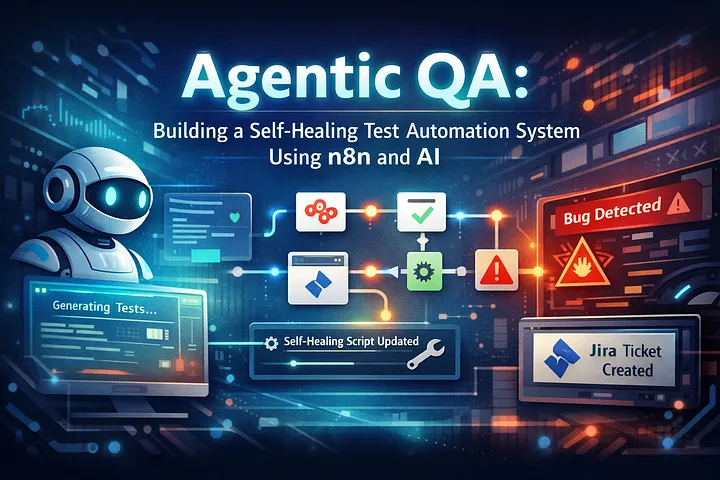
Software teams are shipping faster than ever. CI/CD pipelines push code to production multiple times a day, and with that speed comes a major challenge: testing cannot keep up.
Traditional QA processes depend heavily on manual testing and fragile automation scripts. The moment a UI element changes or an API response structure shifts, automation scripts break. QA engineers then spend hours fixing selectors, updating test cases, and re-running pipelines.
But a new approach is emerging: Agentic QA.
Instead of static automation scripts, we build AI-powered testing agents that can:
- Generate test cases automatically
- Detect broken tests
- Fix selectors or test logic
- Analyze failures
- Report bugs with context
All of this can be orchestrated using n8n, a powerful workflow automation platform.
In this article, we’ll build a Self-Healing Test Automation System using AI agents and n8n that can dramatically reduce QA workload and make testing pipelines far more resilient.
Why Traditional Test Automation Fails
Most QA automation stacks use tools like Selenium, Cypress, or Playwright.
They are powerful, but they still have a critical weakness: tests are brittle.
Typical issues include:
- UI selectors break when developers update the DOM
- API responses change
- Test data becomes outdated
- Environment differences cause inconsistent results
This leads to a frustrating cycle:
- Tests fail
- QA investigates
- QA fixes scripts
- Tests run again
In large projects, 30–40% of QA time is spent maintaining test scripts rather than validating product quality.
Agentic QA flips this model.
What is Agentic QA?
Agentic QA uses AI agents that can reason, analyze failures, and take corrective actions automatically.
Instead of static automation, the system behaves more like a digital QA engineer.
A typical Agentic QA system can:
- Read product requirements
- Generate test scenarios
- Execute automated tests
- Detect anomalies
- Fix broken selectors
- Create bug reports
The orchestrator for these actions can be n8n.
n8n acts like the central nervous system connecting different AI agents, testing frameworks, and communication tools.
System Architecture

Our self-healing QA system includes the following components.
1. CI/CD Trigger
When code is pushed to a repository like GitHub, it triggers a workflow.
2. n8n Workflow Orchestration
The workflow automation platform n8n coordinates:
- test generation
- execution
- failure analysis
3. AI Testing Agent
An AI model analyzes:
- user stories
- previous test results
- application structure
It generates new test cases automatically.
4. Test Execution Layer
Tests are executed using Playwright or Cypress.
5. Failure Analysis Agent
When a test fails, an AI agent investigates logs and screenshots.
It determines whether the failure is due to:
- UI changes
- selector updates
- API response differences
6. Self-Healing Engine
If a selector breaks, the AI finds a new locator and updates the test automatically.
7. Bug Reporting
If the issue is real, a ticket is automatically created in Jira.
Step by Step Workflow
Let’s walk through how this system works in practice.
Step 1 — Code Push
A developer pushes code to the repository.
The pipeline triggers a GitHub webhook.
Step 2 — n8n Workflow Starts
The webhook activates an automation workflow in n8n.
The workflow performs:
- Pull latest test cases
- Generate additional AI tests
Step 3 — AI Generates Test Cases
The AI agent analyzes:
- new features
- existing test coverage
Example generated test scenario:
Test Case: User Login
Steps:
1. Navigate to login page
2. Enter email
3. Enter password
4. Click login
Expected Result:
User is redirected to dashboard
This step dramatically reduces manual QA effort.
Step 4 — Automated Test Execution
The generated tests are executed using Playwright.
Example test code:
import { test, expect } from '@playwright/test';
test('login test', async ({ page }) => {
  await page.goto('https://example.com/login');
  await page.fill('#email', 'test@example.com');
  await page.fill('#password', 'password123');
  await page.click('#login');
  await expect(page).toHaveURL('/dashboard');
});
Screenshots and logs are automatically collected.
Self-Healing Test Automation
Here’s where Agentic QA becomes powerful.
When a test fails, the system does not immediately report failure.
Instead, the AI agent performs analysis.
Example Failure
Original selector:
#login-button
Developer changes it to:
.btn-login
Traditional automation would fail.
But the AI agent scans the DOM and identifies the most likely replacement.
Updated selector:
button[class="btn-login"]
The test script updates automatically.
No human intervention needed.
Automated Bug Analysis
If the failure is not related to selectors, the system performs deeper analysis.
The AI agent evaluates:
- screenshots
- API logs
- network responses
If it identifies a real defect, the system generates a structured bug report.
Example Jira ticket:
Title: Login API returning 500 error Steps to reproduce: AI-generated Environment: Staging Logs: Attached automatically
Ticket is created in Jira.
QA engineers only need to review the issue.
n8n Workflow Design
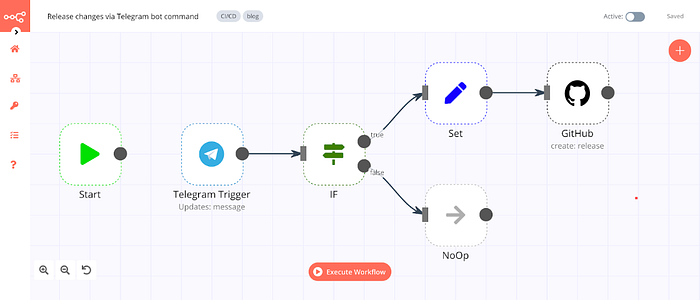
A typical workflow might include these nodes:
- GitHub Webhook Trigger
- AI Test Generator
- Test Execution Script
- Failure Analyzer
- Self-Healing Agent
- Bug Reporting Node
This orchestration ensures the system operates autonomously.
Benefits of Agentic QA
Organizations adopting AI-driven testing pipelines report significant improvements.
1. Reduced QA Maintenance
Self-healing tests eliminate constant selector updates.
2. Faster Release Cycles
Automation coverage increases dramatically.
3. Higher Test Coverage
AI can generate hundreds of test scenarios.
4. Reduced Manual QA Work
QA engineers focus on exploratory testing instead of repetitive checks.
5. Faster Bug Detection
Issues are detected minutes after code deployment.
Challenges to Consider
Agentic QA is powerful but not perfect.
Teams must consider:
AI Accuracy
AI-generated tests may require validation.
Infrastructure Complexity
Building a robust pipeline requires integration across multiple systems.
Security Concerns
Automated agents should not expose sensitive environments.
However, these challenges are manageable with proper implementation.
The Future of QA Automation
Agentic systems are transforming software engineering.
Just as CI/CD revolutionized deployment pipelines, AI agents are reshaping testing workflows.
Within the next few years, we will likely see:
- Autonomous QA engineers
- Fully self-healing test suites
- AI-driven release approvals
Platforms like n8n make this future accessible today.
By combining workflow orchestration with AI agents and modern testing frameworks like Playwright, teams can build intelligent, resilient testing systems.
Agentic QA is not just an experiment.
It is the next evolution of software testing.
If you implement this architecture correctly, your QA pipeline becomes:
- autonomous
- adaptive
- scalable
And that is exactly what modern software teams need.
Comments
Loading comments…