If you talk to founders right now, the pitch is consistent: “We’re building agents.” If you talk to operators, it sounds more like: “We’re trying to stop the agent from breaking things.”
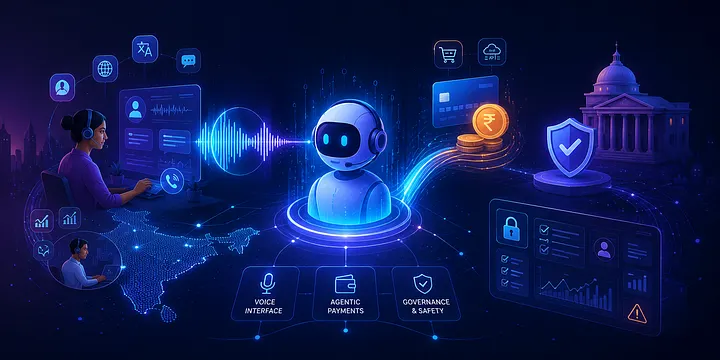
This week’s news made one thing clear: we’re moving from “AI that answers” to “AI that acts” — and action needs three missing pieces. A natural interface (voice), a way to transact (payments), and a governance layer (rules, logs, limits, accountability).
For India, this shift isn’t academic. It touches the largest contact-center market on Earth, a fast‑growing SaaS base, regulated fintech rails, and a policy environment that’s getting serious about synthetic media and cyber risk. If you’re building or buying AI this year, your competitive advantage won’t come from finding the “best model” alone. It will come from shipping agents safely, cheaply, and with distribution.
Voice stops being a feature and becomes the interface
OpenAI’s new real‑time voice models for developers are not just about talking faster or sounding more human. The strategic move is that voice is becoming the default entry point for agentic systems.
Why does that matter? Because the more an agent is expected to do — book, negotiate, troubleshoot, translate, triage — the more friction text-only interactions create. Voice makes the loop tighter: hear → reason → act → confirm. The real value is not “wow, it speaks”, but “it keeps the conversation moving while it executes a task.”
In India, this lands in a very specific place: customer support and sales. We’ve trained an entire talent economy around voice workflows — BPO, collections, telemedicine, insurance, travel, vernacular commerce. The immediate opportunity is not replacing agents with bots. It’s turning every human agent into a supervisor of an AI copilot that can listen in real time, pull the right policy snippet, draft the response, and update the CRM without breaking compliance.
Two practical implications for builders:
- “Latency” becomes a product metric, not just an engineering metric. If your app relies on voice, milliseconds change the feel of trust.
- “Memory” becomes a policy problem. A voice agent that remembers customer history can feel magical — or creepy. The winning products will let users control retention and show their work clearly.
And for professionals, this is the “learn one thing” moment: if you work in any voice-heavy industry, understand how speech-to-text, streaming inference, and guardrails fit together. The next wave of hiring will reward people who can ship reliable voice workflows, not just prompt well.
Agents that can pay: the quiet start of “agentic commerce”
AWS previewed AgentCore Payments for Amazon Bedrock — built with Coinbase and Stripe — so that agents can autonomously pay for APIs, MCP servers, and web content when they hit a paywall.
This sounds niche until you ask a simple question: how do you run an agent that actually uses the web the way humans do?
Most resources worth using — live data, premium tools, reliable services — are paid. Today, agents either scrape and hallucinate, stop and ask a human to authenticate, or stay inside a walled garden.
Payments change the architecture. If an agent can spend small amounts under strict limits, the ecosystem can move to pay‑per‑use tools priced for machines: fractions of a rupee per call, billed in real time, with spending caps enforced at the infrastructure layer.
For India, this is both promising and uncomfortable. Promising because it lowers the barrier to building sophisticated products without negotiating enterprise contracts. Uncomfortable because “agents that pay” immediately intersects with fraud, consent, and auditability.
If you’ve worked in fintech, you know the hard part isn’t the payment — it’s the permissions. Who authorized this spend? Under what policy? What did the agent see? What did it decide? Can we roll it back?
This is where India’s fintech maturity becomes an advantage. We’re already world‑class at building policy into rails. The Indian company that wins here won’t market “AI agent payments.” It will sell “safe automation” to regulated industries.
Governance is becoming the product: from demos to control planes
SEBI released an advisory on emerging AI tools for vulnerability detection. India’s market regulator is explicitly treating advanced AI as a cybersecurity risk surface for regulated entities and vendors.
The key idea is simple and important: AI can make vulnerability discovery faster. That benefits defenders — but it also lowers the cost of attackers finding real flaws. When the same tool can be used for both, governance becomes the only defensible posture.
This aligns with what big enterprise vendors are shipping globally: agent control planes — systems that define what agents can do, what they can access, how they are monitored, and how they are shut down.
For Indian startups selling into BFSI and capital markets, expect sharper diligence questions: what data is sent to a model, how prompt injection is handled, what logs exist for incident response, and what happens when the model is wrong.
In agentic AI, compliance is a moat. Teams that can prove observability and policy enforcement will get distribution.
Enterprise services is the battleground: Anthropic goes “AI-native consulting”
Anthropic announced a new AI-native enterprise services firm with partners like Blackstone, Hellman & Friedman, and Goldman Sachs, backed by a wider consortium. The deeper story isn’t “AI consulting is back.” It’s that deployment is now the product.
Most enterprises don’t fail at pilots because models are weak. They fail because data access is messy, security teams veto ambiguity, workflows don’t map cleanly to tools, and change management is brutal.
So frontier labs are building go‑to‑market machines that look like: packaged agent templates plus embedded engineering teams. If you can deploy in days instead of months, you win the renewal before the competitor finishes procurement.
For Indian founders: if you sell horizontal AI tools, your competition is increasingly a lab-plus-services bundle with distribution and credibility. If you sell into GCCs and enterprises, there’s a huge opening for deeply technical “agent deployment specialists” who can productionize with governance, not just demos.
Google shuts down an agent experiment: consolidation is the strategy
Google shutting down Project Mariner is not a retreat from agents. It’s consolidation: the agent era creates too many overlapping experiments, and winners fold capabilities into a few surfaces with distribution — search, browser, OS, and productivity.
In India, distribution matters more than ever. Agents will win when they live where work already happens: WhatsApp, email, spreadsheets, ticketing systems, and mobile.
So when you watch the big players this year, focus less on which model is “smarter” in a benchmark and more on where the agent lives, what permissions it gets, what it can safely automate, what it costs per completed task, and how quickly it can be deployed and governed.
Closing thought
Agents are turning into economic actors. The moment an agent can speak naturally, use tools, and spend money under policy, it stops being a chatbot. It becomes a worker — and that forces every stakeholder to agree on primitives: identity, permissions, observability, and liability.
India will feel this fast. We have the scale, the services muscle memory, and regulators alert to new risk surfaces. The upside is massive: trusted automation exported globally. The downside is also real: new fraud patterns and new cyber risks.
The next 12 months will reward builders who stop selling “AI magic” and start selling “trusted automation.”
Comments
Loading comments…