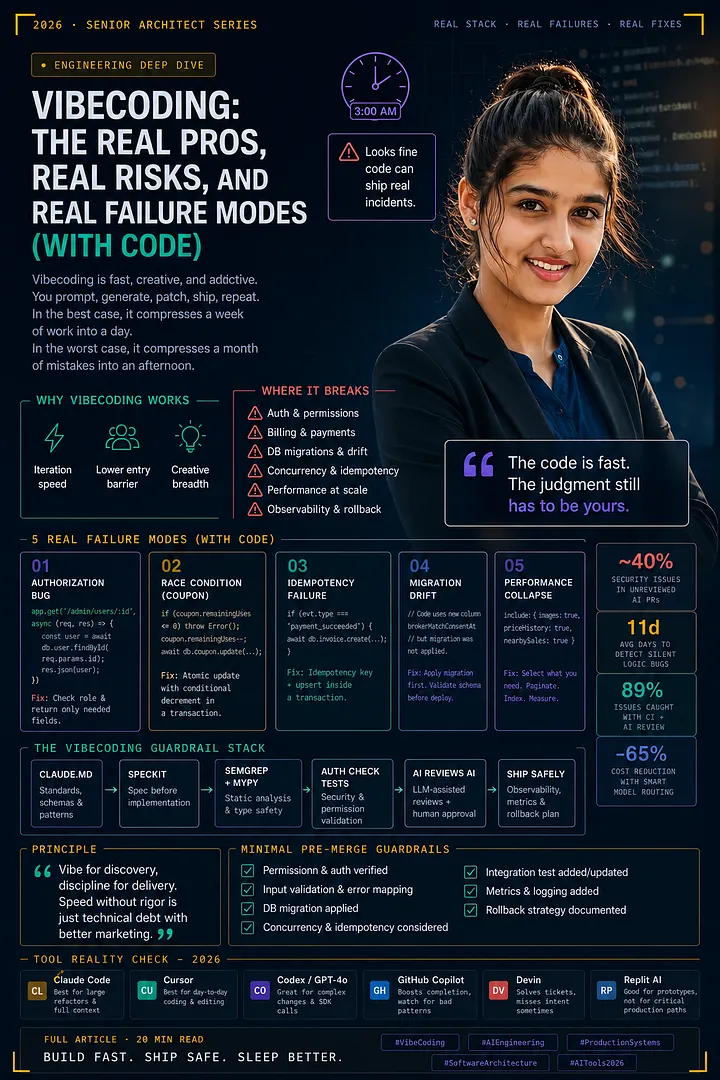
Vibecoding is fast, creative, and addictive.
You prompt, generate, patch, ship, repeat. In the best case, it compresses a week of work into a day. In the worst case, it compresses a month of mistakes into an afternoon.
This post gives a complete view: why vibecoding works, where it breaks, and concrete code examples of how “looks fine” code causes real production incidents.
What Vibecoding Gets Right
Vibecoding is powerful for three reasons:
- Iteration speed: You can test ideas in hours, not days.
- Lower entry barrier: More team members can contribute code.
- Creative breadth: You can explore multiple implementations rapidly.
For prototypes, internal tooling, and pre-PMF products, this can be a major strategic advantage. The problem isn’t the speed. The problem is what gets skipped in service of it.
Where Vibecoding Goes Wrong
The common pattern is simple: code ships before assumptions are validated.
You don’t fail because AI wrote code. You fail because fast output bypassed engineering controls.
The highest-risk areas are:
- Auth and permissions
- Billing and payment logic
- DB migrations and schema drift
- Concurrency and idempotency
- Performance at scale
- Observability and rollback readiness
Let’s walk through each failure mode with real code.
Example 1: Authorization Bug That Leaks Data
The “looks fine” code
// GET /api/admin/users/:id
app.get('/api/admin/users/:id', async (req, res) => {
  const user = await db.user.findById(req.params.id);
  return res.json(user);
});
The real problem
This endpoint never checks whether the requester is an admin. In staging, everyone testing had admin accounts, so the bug never surfaced. In production, any authenticated user can query another user’s full record by ID — including PII, internal flags, and whatever else lives on that object.
The corrected version
app.get('/api/admin/users/:id', requireAuth, async (req, res) => {
  if (req.user.role !== 'admin') {
    return res.status(403).json({ error: 'forbidden' });
  }
const user = await db.user.findById(req.params.id);
  if (!user) return res.status(404).json({ error: 'not-found' });
  return res.json({
    id: user.id,
    email: user.email,
    createdAt: user.createdAt
    // Return only the fields you actually need.
  });
});
Operational impact if missed
- PII exposure
- Legal and compliance risk
- Mandatory incident disclosure in many jurisdictions
Example 2: Race Condition in Coupon Redemption
The “looks fine” code
async function redeemCoupon(userId: string, couponCode: string) {
  const coupon = await db.coupon.findUnique({ where: { code: couponCode } });
  if (!coupon || coupon.remainingUses <= 0) {
      throw new Error('invalid-coupon');
    }
    await db.coupon.update({
      where: { code: couponCode },
      data: { remainingUses: coupon.remainingUses - 1 }
    });
    await db.discountUse.create({ data: { userId, couponCode } });
  }
The real problem
Two concurrent requests can both read remainingUses = 1 and both decrement. The check and the update are not atomic. Result: over-redemption and direct revenue leakage.
The corrected version (transaction + conditional update)
async function redeemCoupon(userId: string, couponCode: string) {
  return db.$transaction(async (tx) => {
    const updated = await tx.coupon.updateMany({
      where: { code: couponCode, remainingUses: { gt: 0 } },
      data: { remainingUses: { decrement: 1 } }
    });
if (updated.count !== 1) {
      throw new Error('invalid-coupon');
    }
    await tx.discountUse.create({
      data: { userId, couponCode }
    });
  });
}
The updateMany with remainingUses: { gt: 0 } as a condition makes the check and the decrement a single atomic operation. If nothing was updated, the coupon was already exhausted or never existed.
Operational impact if missed
- Direct financial loss
- Reconciliation headaches
- Customer support churn
Example 3: Idempotency Failure in Webhook Handling
The “looks fine” code
app.post('/webhooks/payment', async (req, res) => {
  const evt = req.body; // assume signature verified upstream

if (evt.type === 'payment_succeeded') {
    await db.order.update({
      where: { id: evt.orderId },
      data: { status: 'paid' }
    });
    await db.invoice.create({
      data: { orderId: evt.orderId, amount: evt.amount }
    });
  }
  res.sendStatus(200);
});
The real problem
Payment providers retry webhooks on network failures, timeouts, and non-2xx responses. The same event will arrive more than once. The second delivery creates a duplicate invoice, triggers duplicate side effects (emails, fulfillment), and corrupts your financial records.
The corrected version (idempotency key)
app.post('/webhooks/payment', async (req, res) => {
  const evt = req.body;
  const eventId = evt.id;
await db.$transaction(async (tx) => {
    const already = await tx.webhookEvent.findUnique({ where: { id: eventId } });
    if (already) return;
    await tx.webhookEvent.create({ data: { id: eventId, type: evt.type } });
    if (evt.type === 'payment_succeeded') {
      await tx.order.update({
        where: { id: evt.orderId },
        data: { status: 'paid' }
      });
      await tx.invoice.upsert({
        where: { orderId: evt.orderId },
        create: { orderId: evt.orderId, amount: evt.amount },
        update: {}
      });
    }
  });
  res.sendStatus(200);
});
Storing the event ID and checking for it first — inside a transaction — guarantees exactly-once processing regardless of how many times the webhook fires.
Operational impact if missed
- Double emails and notifications
- Duplicate financial records
- Manual cleanup across finance systems
Example 4: Migration Drift That Causes 500s in Production
The scenario
AI generates a model and an endpoint that references a new DB column — say, brokerMatchConsentAt. The code looks correct, passes local testing, and gets merged. But the production database migration was never applied before deploy.
The symptom
- Works perfectly in local dev
- Works perfectly in staging (if staging ran migrations)
- Throws runtime ORM errors on every request in production:
column does not exist - Users see 500s the moment traffic hits the new endpoint
The preventive checklist
- [ ] Migration file is present in the repo alongside the code change
- [ ] Migration was applied in staging and smoke-tested
- [ ] Migration is applied in production before (or atomically with) the app release
- [ ] Startup health check validates the expected schema version or required columns
Schema drift is one of the most common and most preventable vibecoding failure modes. The AI generates the code — but no one ran prisma migrate deploy.
Example 5: Performance Collapse from Over-Fetching
The “looks fine” query
const listings = await db.listing.findMany({
  where: { city: req.query.city },
  include: {
    images: true,
    priceHistory: true,
    broker: true,
    nearbySales: true
  }
});
The real problem
On a dataset of 50 rows this looks fast. At 50,000 rows with nested relations, the payload balloons, join cost explodes, and response time collapses. This is almost never caught in development or early staging.
The corrected approach
const listings = await db.listing.findMany({
  where: { city: req.query.city },
  select: {
    id: true,
    title: true,
    price: true,
    thumbnailUrl: true,
    broker: { select: { id: true, name: true } }
  },
  take: 20,
  skip: Number(req.query.offset ?? 0),
  orderBy: { createdAt: 'desc' }
});
Select only what the UI actually renders. Paginate. Order by an indexed column. These are not optimizations — they are table stakes for any list endpoint.
Operational impact if missed
- p95 latency spikes under load
- Higher infra costs at scale
- Degraded UX and SEO for slow pages
The Real Engineering Problems Behind Vibecoding Failures
These are not “AI problems.” They are systems problems that fast output makes harder to catch.
No explicit invariants. The team never defines non-negotiables — things like “webhooks must be idempotent” or “no endpoint ships without an auth check.” Without written-down invariants, they don’t get enforced.
No failure-path testing. The happy path gets tested. Retries, race conditions, concurrent writes, and invalid states do not. AI-generated tests are almost always happy-path tests.
No deployment discipline. Code and schema changes are treated as independent. They are not.
No ownership boundaries. Prompt-by-prompt development introduces pattern drift. The same problem gets solved three different ways in three different files, and nobody owns the seams between them.
No runtime feedback loop. Bugs are discovered by users instead of by telemetry. The team finds out from support tickets, not dashboards.
A Practical Vibecoding Workflow That Actually Scales
Think in two lanes.
Lane 1: Explore fast
- Generate aggressively
- Prototype quickly
- Optimize for learning and signal
Lane 2: Commit safely
Before anything merges, require:
- Auth checks reviewed
- Migration validated end-to-end
- Idempotency confirmed on async and webhook flows
- Integration test for the critical path
- Dashboards and alerts for the new endpoint
- Rollback plan documented
The mental model: vibe for discovery, discipline for delivery.
Minimal Pre-Merge Guardrail Template
Copy this into your PR description template. It takes 90 seconds to fill out and catches the majority of the failure modes in this post.
- [ ] Permissions and auth verified
- [ ] Input validation and error mapping handled
- [ ] DB migration applied in target environment
- [ ] Concurrency and idempotency considered
- [ ] Integration test added or updated
- [ ] Metrics and logging added for new code path
- [ ] Rollback strategy documented
Seven checkboxes. Not a process tax — a minimum viable safety net.
Final Take
Vibecoding is a force multiplier when paired with engineering rigor. Without rigor, it’s just technical debt with better marketing.
The teams that win won’t be the ones that reject AI-assisted speed. They’ll be the ones that turn speed into reliable outcomes — by being deliberate about the handful of places where fast and sloppy is genuinely expensive.
The code is fast. The judgment still has to be yours.
Comments
Loading comments…