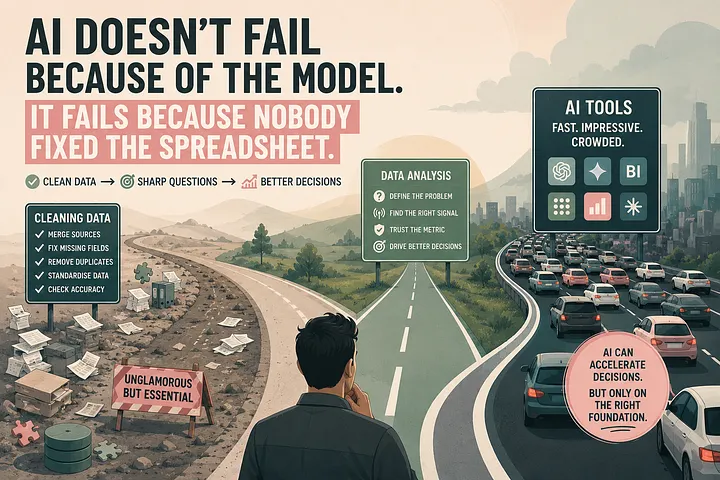
“Everyone wants to talk about AI. Almost nobody wants to talk about the work that makes AI useful.”
Week after week, a fresh AI gadget grabs attention. A new one spreads fast each time around.
A quicker turnaround on reports is what one delivers.
A single click builds slides fast. Moments later, it’s ready.
A person types messages on a screen. Meanwhile, someone else puts together reports with charts and numbers. A third voice says one question might do what used to take most of the day.
It makes sense that people feel this way.
Still, what person would turn down quicker results on the job?
Here it is, hard to face but real:
Inside the AI tool, real value shows up least often.
Before any prompt gets typed, it already begins.
The Race Everyone Sees
Today’s AI landscape is crowded.
Out front, firms rush toward fresh systems. One step ahead, businesses chase latest versions. Moving fast, organizations grab new tools. Ahead of peers, corporations seek modern setups.
Employees compete to master the latest productivity tools.
Out there on LinkedIn, you’ll spot loads of AI dashboards — neat reports here, slick workflows there. Screenshots pop up like snapshots from a digital photo album. Each one shows off automation dressed sharp. Polished outputs spread fast across feeds. Some look too clean to be real. Others feel like templates pretending to be magic.
Faster now grabs the spotlight.
Yet direction shapes what speed can do.
Wrong information leads to flawed outcomes, yet artificial intelligence speeds up the process. When facts are shaky, technology doesn’t fix errors — it amplifies them. Mistakes travel quicker when machines get involved. Faulty inputs mean misguided results, even with smart tools. The speed increases, but accuracy drops just the same.
This sort of efficiency? It carries risk. What seems smooth might hide harm. Speed here often means skipping care. Not everything fast works well. Trouble grows quietly in what feels seamless.
The Work Nobody Applauds
Hidden beneath each striking AI showcase lies a far more silent effort.
Out of nowhere, a question slipped into the room
- Who really cares about this issue anyway?
- What kind of information feels solid? Sometimes it wobbles when you look close.
- Reality shows up how — through what measurement?
- This analysis — what choice might it really shape?
Most times, you won’t hear those questions during a demo. Still, they matter just as much.
Still, without them, what you get is costlier confusion instead of clear insight.
AI can process information.
One moment it leans toward belief, the next doubts creep in. Trust wavers when proof feels thin. Something about the details just does not sit right. Hesitation takes hold instead of certainty. Confidence slips without clear signs to follow.
The Most Important Work Often Gets Overlooked
Let’s be honest.
Folks rarely cheer when it’s time to tidy up data.
Deleting repeated entries never shows up in shared images.
Most folks ignore fixing customer names when they’re messy. Standardized dates? That kind of work never gets a party.
Still, it’s these jobs that slip under the radar, shaping what comes out of AI: real understanding or made-up answers.
Actual data tasks go something like this:
- Combining information from disconnected systems.
- Filling missing values.
- Removing duplicate records.
- Standardizing categories and definitions.
- Validating whether the numbers actually reflect business reality.
It feels repetitive.
Sometimes frustrating.
Almost always invisible.
Yet its worth can’t be ignored.
AI Cannot Fix Poor Evidence
Many people think AI magically cleans up disorganized data. But it does not work like that at all.
It doesn’t.
AI can summarize incomplete data.
Patterns emerge even when data jumps around.
With ease, it points out mistakes in numbers.
Notice the pattern?
Better handling of poor data doesn’t mean it suddenly turns accurate. Instead, performance improves even when inputs stay flawed.
Garbage in.
Faster garbage out.
Just add far better-looking graphs.
Business Context Builds True Edge
Most top analysts when AI is big won’t win by tool count alone.
Most folks get how it runs.
Notice will come when numbers seem strong yet track what matters least.
Out there, a lone detail catches their eye while others walk past. A quiet signal stands out where most see noise. Only they pause when everything says move on.
One moment they’re nodding at flawless logic, next second they see it won’t sell. A perfect equation on paper can still fail in practice. Just because numbers add up does not mean customers will show up. Logic bends when real people enter the room. What works in theory often trips over reality.
That’s judgment.
Still, people hold on to their own sense of right and wrong.
AI accelerates execution.
People provide direction.
Leaders Questions That Matter
Wrong questions often open too many leader gatherings.
“Which AI platform are we using?”
A different chat might go something like this:
- Who decides where our facts come from?
- Every month, what reports need hands-on fixes?
- What counts as a business shifts all the time.
- Some groups keep fixing spreadsheet errors by hand. Others fix messy data because tools fail them. A few waste full workdays just adjusting columns. Many reshuffle numbers when reports go wrong. Some recheck figures after systems mix up entries.
- What choices matter most when facts are missing?
These questions don’t sound as exciting.
Yet results turn out much stronger.
A shaky foundation stays shaky, even if you dress it up with fancy tools. What goes in messy comes out messy, regardless of the tech polish.
The Companies That Will Win
Big models might not mean big results. Value comes from how you use tools, not just size. Some teams build smarter systems without the largest versions. Power shows up in practice, not papers. Success hides where effort meets insight. Ownership of massive tech doesn’t guarantee impact. What matters is application, not scale.
They’ll have:
- Cleaner data.
- Better governance.
- Consistent definitions.
- Strong analytical thinking.
- Folks who get tech, sure — yet they also grasp how companies actually run. A rare mix, really.
When strong systems support it, AI gains serious strength. Foundations matter more than most think.
A shaky base turns even speed into just wild guesses.
The Real AI Strategy
Right now, focusing on shiny updates misses the point entirely. What matters comes later.
Before the model starts, work on making each earlier step more solid. What matters most shows up long before any processing begins. Focus shifts to the pieces feeding into it, building them stronger. The real difference comes from what’s already in place ahead of time. Strength grows where attention goes first, not during execution.
Cleaner data.
Sharper questions.
Better business thinking.
That is where true advantage takes hold.
Only then does it work like something real. When the parts finally fit.
Becomes real leverage when others can’t keep up.
That is the sort of change which sticks around for good.
Final Thought
Inside your company, the largest leap in artificial intelligence might arrive without purchasing new software.
Perhaps it stems from seeing data quality as a key priority, not just routine upkeep.
Here’s what we’re asking ourselves now
Picture this: what if the task labeled “just admin” is really where smart choices begin? Could that unnoticed step shape outcomes more than anyone admits? Might those quiet efforts hold power overlooked till now?
Comments
Loading comments…