
Most organizations are still asking:
“How do we use AI?”
The more important question is structural:
“Has intelligence become native to our enterprise architecture?”
There is a profound difference between using AI and becoming intelligence-native. One improves tasks. The other redesigns how decisions are made, governed, and monetized.
That difference will define competitive advantage in the decade ahead.
The Structural Shift Most Boards Are Underestimating
We are entering what I call the Third-Order AI economy.
In this phase, advantage will not belong to companies that deploy the most AI tools. It will belong to enterprises that embed intelligence directly into:
- capital allocation
- risk evaluation
- pricing systems
- supply coordination
- compliance controls
- product evolution
The shift is subtle — but structural.
AI is no longer a tooling conversation. It is an operating model conversation.
And operating model shifts always reshape industry structure.
The Familiar Pattern of Technological Revolutions
Every major disruption follows a three-stage arc:
1. Efficiency First Use the technology to do existing work faster and cheaper.
2. Re-Architecture Second Redesign workflows and systems around the technology.
3. New Categories Third Create entirely new business models that were previously impossible.
The internet followed this pattern:
- Digitization: websites, email, e-commerce
- Platformization: search, marketplaces, cloud
- Category creation: Uber, Airbnb, on-demand logistics
Those final winners did not merely “use the internet.” They monetized real-time coordination.
AI is following the same curve — but this time the scarce asset is not connectivity.
It is judgment.
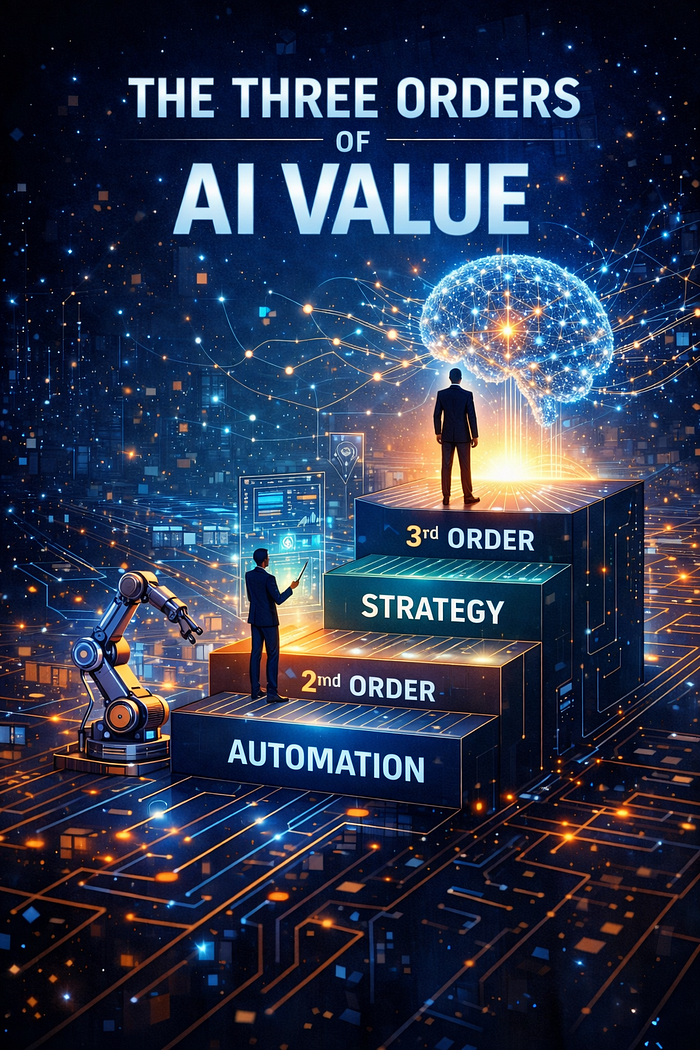
The Three Orders of AI Value
First-Order AI: Productivity and Automation
This is the wave most enterprises are currently riding:
- copilots
- chatbots
- document summarization
- faster reporting
- compliance automation
This layer is valuable — but it is not durable advantage. Everyone can access similar tools.
First-order AI quickly becomes table stakes.

Second-Order AI: Embedded Decision Intelligence
Second-order AI is where enterprise seriousness begins.
Here, AI is embedded into decision points with accountability.
Examples:
- AI-assisted underwriting
- real-time fraud intervention
- autonomous ticket routing
- dynamic pricing guardrails
- exception handling in finance operations
The shift here is subtle but powerful:
From: Human execution + AI advice
To: Human authority + AI action (within bounded controls)
Once AI begins acting, “working” no longer means uptime and latency alone. It means correctness of action, policy compliance, recoverability, and safe degradation.
This is where governance becomes operational — not theoretical.

Third-Order AI: When Intelligence Becomes the Business
Third-order AI is the inflection point.
It is when organizations stop asking:
“How do we apply AI to our operations?”
…and start asking:
“What business becomes possible when intelligence is abundant, cheap, and continuously improving?”
Third-order firms do not simply deploy models. They monetize decision advantage at scale.
The product is not software. The product is intelligence.
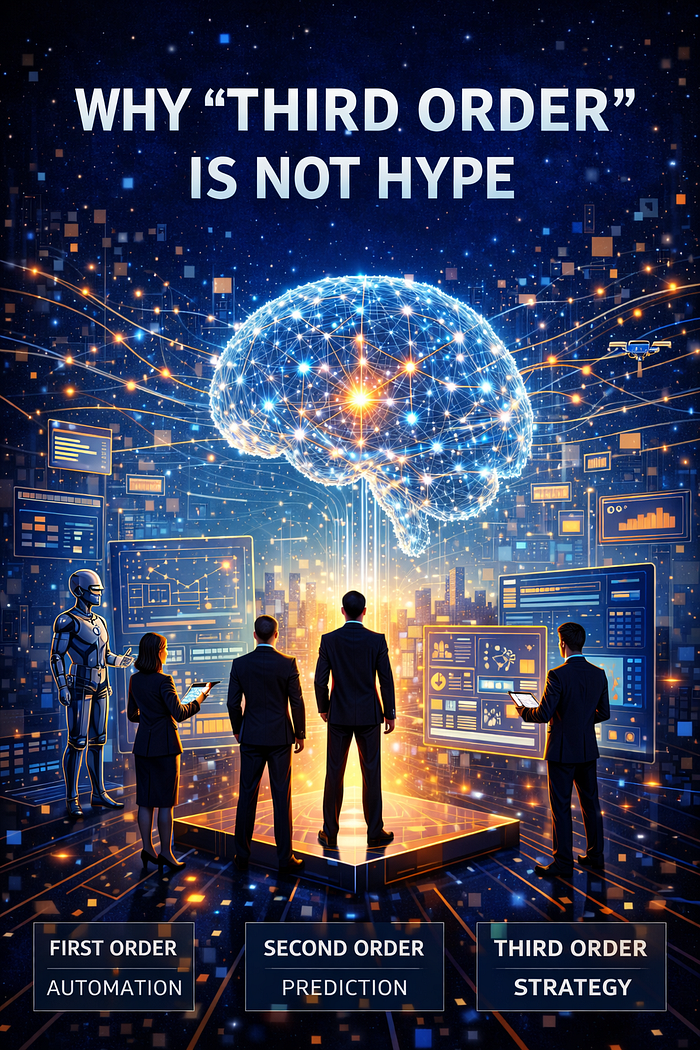
Why “Third-Order” Is Not Hype
Boards are right to be skeptical of new terminology. But the economic mechanism is clear.
- First order reduces cost inside processes.
- Second order changes how decisions are made.
- Third order changes what the enterprise is.
The internet did not optimize taxis. It created real-time coordination businesses.
AI will do the same — this time with judgment.
One line worth remembering:
The internet monetized connectivity. AI will monetize judgment.
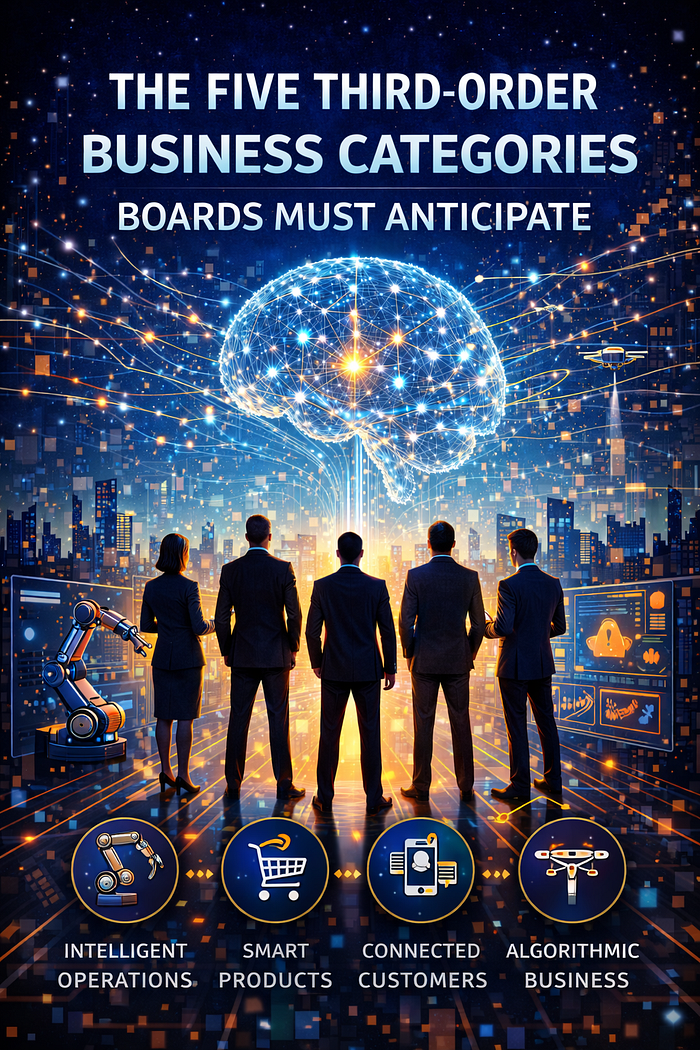
The Emerging Third-Order Business Categories
Across industries, five patterns are beginning to form.
1. Decision Markets
Judgment becomes a tradable product.
Instead of selling loans, firms may sell continuously updated risk decisions. Instead of selling cybersecurity software, firms may sell verified risk posture scoring.
Risk becomes a subscription.
2. Outcome-as-a-Service
Enterprises stop buying tools. They buy guaranteed performance improvements:
- fraud loss reduction
- retention lift
- compliance readiness
- supply chain resilience
This requires deep second-order discipline — because outcomes demand accountability.
3. Autonomous Coordination Platforms
Just as Uber monetized coordination, AI-native firms will monetize:
- supply orchestration
- energy optimization
- field service coordination
- cyber response across ecosystems
The product is dynamic orchestration, not software interfaces.
4. Intelligence Infrastructure Providers
As autonomy scales, enterprises will demand:
- agent identity systems
- policy enforcement layers
- audit trails
- runtime monitoring
- safe degradation frameworks
Trust infrastructure becomes a category of its own.
5. Agent Economies
Organizations will manage two workforces:
- humans
- autonomous agents
The unit of scale shifts from headcount to supervised autonomy.
A new metric emerges: Human-to-agent ratio — and how safely it scales.

What Makes an Enterprise Intelligence-Native?
Many firms will adopt AI. Few will become intelligence-native.
Four traits distinguish them.
1. Intelligence Is Governed as a Strategic Asset
Leadership allocates and compounds intelligence deliberately — not as scattered pilots, but as institutional capability.
2. The Enterprise Has a Decision Operating System
High-value decisions are mapped, measured, and continuously improved.
Without this, AI becomes fragmented automation. With it, AI becomes compounding advantage.
3. Autonomy Is Bounded and Reversible
Autonomy without reversibility creates fragility. Autonomy without auditability creates reputational risk.
Intelligence-native firms design control layers before scaling autonomy.
4. Learning Velocity Becomes the Advantage
In the intelligence decade, the winning firms are not those with the largest datasets.
They are those that improve decision quality faster than the market changes.
Learning speed becomes competitive advantage.
The Board’s Real Responsibility
Boards do not need to become technical.
They need to become structural.
Three priorities matter:
- Govern where autonomy is allowed.
- Allocate capital to compounding intelligence capability.
- Spot category creation early — before value migration completes.
Capital and talent move before value is fully visible.
The calm board watches signals, not hype.
A Practical Transition Path
If you want to move without panic:
- Identify your highest-leverage decision engines.
- Separate authority from execution.
- Build minimum viable control layers.
- Reuse successful decision loops internally.
- Explore which of those capabilities could become monetizable products.
That final step is the doorway to third-order advantage.
The Bigger Structural Question
The question is not:
“Will AI reshape our industry?”
The question is:
“Will we participate in shaping the new category — or will we become a customer of someone who does?”
Intelligence-native enterprises will not simply be more efficient.
They will redefine how value is created.
And in the Third-Order AI economy, that is the only durable advantage that matters.
Intelligence-Native Enterprise Doctrine
If a board member wants the full operating doctrine behind third-order AI, here is the guided path:
- Start here (core doctrine): The Enterprise AI Operating Model https://www.raktimsingh.com/enterprise-ai-operating-model/
- Why advantage shifts from models to reuse: The Intelligence Reuse Index https://www.raktimsingh.com/intelligence-reuse-index-enterprise-ai-fabric/
- Why production AI breaks without discipline: The Enterprise AI Runbook Crisis https://www.raktimsingh.com/enterprise-ai-runbook-crisis-model-churn-production-ai/
- Who should own enterprise AI (accountability and decision rights): https://www.raktimsingh.com/who-owns-enterprise-ai-roles-accountability-decision-rights/
- Board-level value framing (why this matters now): What Is the AI Dividend? https://www.raktimsingh.com/ai-dividend-boards-structural-gains/
- Growth lens (how AI shifts planning from averages to precision): https://www.raktimsingh.com/precision-growth-end-of-averages-enterprise-ai/
- Macro shift (India + global services reinvention): https://www.raktimsingh.com/from-labor-arbitrage-to-intelligence-arbitrage-why-indian-its-ai-reinvention-will-define-the-next-decade/
Institutional Perspectives on Enterprise AI
Many of the structural ideas discussed here — intelligence-native operating models, control planes, decision integrity, and accountable autonomy — have also been explored in my institutional perspectives published via Infosys’ Emerging Technology Solutions platform.
For readers seeking deeper operational detail, I have written extensively on:
- What Makes an Enterprise Intelligence-Native? The Blueprint for Third-Order AI Advantage https://blogs.infosys.com/emerging-technology-solutions/artificial-intelligence/what-is-enterprise-ai-the-operating-model-for-compounding-institutional-intelligence.html
- Why “AI in the Enterprise” Is Not Enterprise AI: The Operating Model Difference Most Organizations Miss https://blogs.infosys.com/emerging-technology-solutions/artificial-intelligence/why-ai-in-the-enterprise-is-not-enterprise-ai-the-operating-model-difference-that-most-organizations-miss.html
- The Enterprise AI Control Plane: Governing Autonomy at Scale https://blogs.infosys.com/emerging-technology-solutions/artificial-intelligence/the-enterprise-ai-control-plane-governing-autonomy-at-scale.html
- Enterprise AI Ownership Framework: Who Is Accountable, Who Decides, and Who Stops AI in Production https://blogs.infosys.com/emerging-technology-solutions/artificial-intelligence/enterprise-ai-ownership-framework-who-is-accountable-who-decides-and-who-stops-ai-in-production.html
- Decision Integrity: Why Model Accuracy Is Not Enough in Enterprise AI https://blogs.infosys.com/emerging-technology-solutions/artificial-intelligence/decision-integrity-why-model-accuracy-is-not-enough-in-enterprise-ai.html
- Agent Incident Response Playbook: Operating Autonomous AI Systems Safely at Enterprise Scale https://blogs.infosys.com/emerging-technology-solutions/artificial-intelligence/agent-incident-response-playbook-operating-autonomous-ai-systems-safely-at-enterprise-scale.html
- The Economics of Enterprise AI: Designing Cost, Control, and Value as One System https://blogs.infosys.com/emerging-technology-solutions/artificial-intelligence/the-economics-of-enterprise-ai-designing-cost-control-and-value-as-one-system.html
Together, these perspectives outline a unified view: Enterprise AI is not a collection of tools. It is a governed operating system for institutional intelligence — where economics, accountability, control, and decision integrity function as a coherent architecture.
Comments
Loading comments…