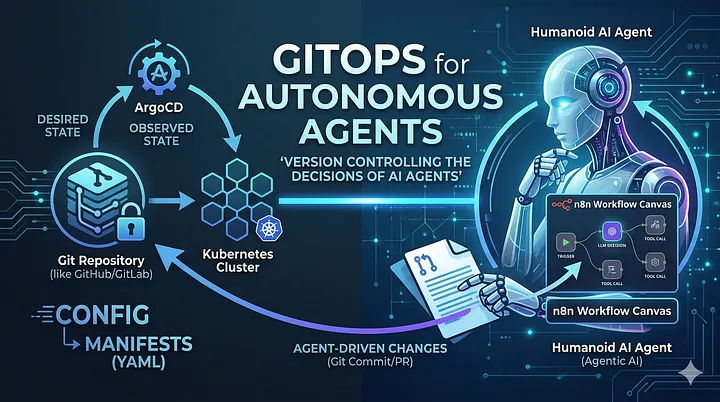
The Day My Infrastructure Fixed Itself (And I Didn’t Touch a Thing)
It was 2:13 AM.
The kind of time when alerts usually mean one thing: Your night is over.
A critical service had started crashing. Memory spikes. Restart loops. Latency going through the roof.
Normally, this is where the chaos begins:
- Slack blowing up
- Dashboards everywhere
- Half-awake debugging decisions
But this time?
Nothing happened.
No panic. No firefighting. No emergency fixes.
Because by the time I opened my laptop…
The system had already fixed itself.
What Actually Happened Behind the Scenes
Here’s the part that sounds unreal — but isn’t.
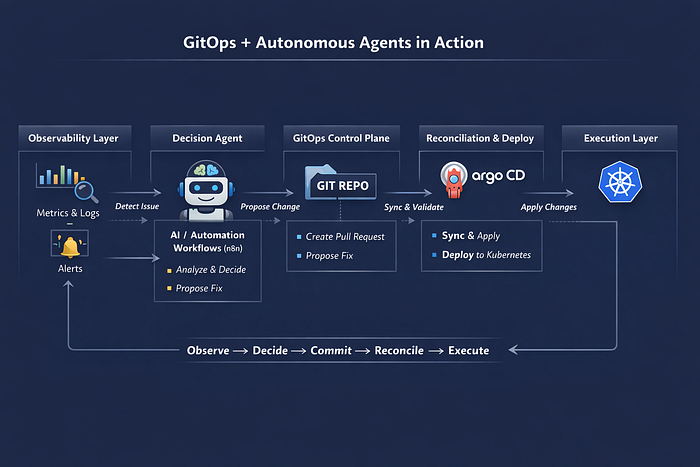
An autonomous agent detected the anomaly. It analyzed logs, correlated metrics, and figured out the root cause:
Memory limits were too low for the workload spike.
Instead of just alerting me, it:
- Generated a fix
- Opened a pull request
- Updated the config
- Triggered deployment
All through Git.
No direct access. No cowboy patching. No chaos.
Just a clean, auditable change — exactly how you’d want it.
The Shift Nobody Is Talking About
We’ve spent years optimizing:
- CI/CD pipelines
- Infrastructure as Code
- Observability stacks
But here’s the uncomfortable truth:
We automated execution… not decision-making.
That’s changing fast.
Autonomous agents are becoming:
- Your on-call engineers
- Your incident responders
- Your optimization layer
And if you don’t control them properly?
They become your biggest liability.
Why GitOps Changes Everything
This is where most teams get it wrong.
They give agents power, but not structure.
That’s a disaster waiting to happen.
Enter GitOps.
Tools like Kubernetes and Argo CD already treat Git as the single source of truth.
Now imagine plugging autonomous agents into that model.
Instead of:
“Agent makes changes directly”
You get:
“Agent proposes changes via Git”
That one shift changes everything.
The New Flow (And Why It Works)
Let’s simplify it:
Old World:
- Alert → Human → Fix → Deploy
New World:
- Detect → Decide → Commit → Reconcile
Agents don’t act blindly. They commit intent.
Git becomes:
- The approval layer
- The audit log
- The rollback mechanism
It’s not just automation anymore.
It’s controlled autonomy.
Real Talk: Why This Feels So Different
Because for the first time:
Your infrastructure is not just reacting — it’s thinking.
And yeah, that’s both exciting… and a little terrifying.
Let’s be honest:
- What if the agent makes a bad call?
- What if it loops changes?
- What if it breaks production faster than you can react?
These are valid concerns.
That’s why GitOps isn’t optional here.
It’s your safety net.
The Guardrails That Make This Work
If you’re serious about this model, you need boundaries.
1. Policy as Code
Use tools like Open Policy Agent Every agent decision gets validated before execution.
2. Human-in-the-Loop (When It Matters)
Not every PR should auto-merge. Critical systems still need oversight.
3. Scoped Autonomy
Agents shouldn’t have full control. Give them just enough power to be useful.
4. Full Observability
Track:
- What the agent saw
- Why it acted
- What changed
No black boxes.
Where Most People Miss the Opportunity
Everyone’s chasing AI features.
But the real leverage is here:
Operational intelligence.
Tools like n8n can act as the execution layer for these agents:
- Trigger workflows from alerts
- Call AI models
- Generate Git commits
- Orchestrate approvals
You’re not just automating tasks anymore.
You’re building systems that manage themselves.
The Brutal Truth
This isn’t plug-and-play.
You will struggle with:
- Trusting the system
- Debugging agent decisions
- Avoiding over-automation
And the hardest lesson?
Just because you can automate something… doesn’t mean you should.
What’s Coming Next
We’re heading toward a world where:
- Incidents resolve before alerts fire
- Systems optimize cost automatically
- Infrastructure rewrites itself based on usage
And engineers?
They stop being operators…
…and start becoming system designers.
Final Thought
That night at 2:13 AM wasn’t just a lucky break.
It was a glimpse into the future.
A future where:
- Systems don’t wait for instructions
- Problems don’t escalate into incidents
- And Git isn’t just version control…
It’s the governance layer for intelligent infrastructure
If you’re already working with Kubernetes, GitOps, or automation tools…
You’re closer than you think.
The only question is:
Are you ready to let your systems think for themselves?
Comments
Loading comments…