
What machine collaborators get right and what they structurally can’t replace…
Open the average developer feed, and someone is announcing the death of pair coding.
The argument is tidy: AI completes your code, suggests your refactors, and never asks for a coffee break.
Why pay two engineers to sit at one keyboard when one of them now has a co-pilot in their IDE?
It’s a clean narrative.
It also misunderstands what pair coding is for.
Pair coding was never primarily about typing speed or syntax recall.
Those were always its least interesting features.
The real value lives in the conversation happening over the keyboard, the friction, the second opinion, the argument that surfaces an unstated assumption before it ships to production.
AI dramatically changes the texture of solo coding.
It does not replicate the social and cognitive dynamics that make pairing valuable in the first place.
What AI genuinely does well
Credit where it’s earned.
Modern AI coding assistants are extraordinary at compressing the parts of programming that used to be tedious.
They handle boilerplate, recall obscure API signatures, scaffold tests, and translate intent into syntactically valid code in seconds.
For the lonely 2 a.m. debugging session, an AI is a tireless rubber duck that occasionally answers back with something useful.
If the question is “Can AI make a single developer more productive?” the answer is obviously yes.
That is not the same question as “Can AI replace a thinking partner?”
Where the analogy breaks
A good pair partner does several things that AI cannot do structurally.
They push back.
AI assistants are trained to be helpful, which, in practice, often means being agreeable.
Ask one to defend a questionable architectural choice, and they will usually find a way to validate it.
A human pair, especially one who has been burned by a similar choice before, will look at your screen and say, “We tried this two years ago, and it took six weeks to untangle.”
That kind of lived organizational memory is not in the model’s weights, and never will be.
They notice the silences.
When you pause for too long, a human pair asks why.
When you over-explain a function, they pick up that you’re uncertain about it.
AI responds to what you type.
A good human partner responds to what you didn’t type: the hesitation, the third draft of a comment that keeps getting deleted, the variable name that quietly betrays a fuzzy mental model.
They build a shared context that compounds.
After three months of pairing, two engineers share a deep understanding of the codebase, the team’s trade-offs, the customer’s actual workflow, and the political reasons certain decisions exist.
That context grows with every session.
AI starts each conversation roughly where the last one ended, with no genuine accumulation of trust, taste, or judgment about your specific situation.
They mentor in both directions.
The junior engineer learning from the senior is the obvious case.
The reverse case, the senior being challenged by someone who hasn’t given up on a “naive” question, is the one most teams underrate.
Pair coding is one of the few formats where that exchange happens organically.
AI delivers information.
The accountability question
There is a quieter point worth making.
Code written by two engineers is genuinely co-owned.
Both names go on the commit, both careers are touched by its outcomes, and both reputations sharpen each other’s judgment.
Code written by one engineer with AI assistance is, ultimately, that engineer’s code.
That asymmetry matters when something goes wrong at 3 a.m., and someone has to actually understand the system well enough to fix it.
This is not an argument against AI tools.
It is an argument for being honest about who is responsible for the work and for not confusing speed of generation with depth of understanding.
The friction problem
Software gets better when smart people disagree productively.
Most senior engineers can point to a moment when a colleague’s stubborn objection saved a project from a costly mistake.
AI does not provide stubborn objections.
It provides confident-sounding completions, regardless of whether the underlying idea is sound.
Used carelessly, it removes the friction that good engineering quietly depends on.
A pair partner who occasionally says “I think this is wrong, and here’s why” is doing something far more valuable than a tool that says “here’s the next 40 lines.”
The actual future
The realistic future is not pair coding versus AI.
It is pair coding with AI inside it.
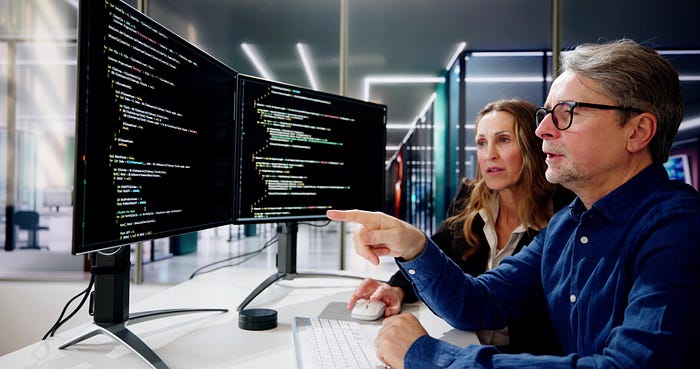
Two engineers, one keyboard, and a shared assistant that handles the mechanical work while the humans focus on the parts that require judgment, design, tradeoffs, naming, edge cases, customer reality, and the occasional “wait, why are we even building this?”
That arrangement plays to the strengths of both.
The AI compresses the boring middle.
The humans hold the ends intent at one end, accountability at the other.
Pair coding, in other words, isn’t being replaced.
It’s being upgraded.
The teams that will look smartest in five years are not the ones who fired half their engineers and trusted the model.
They are the ones who kept their pairs, gave them better tools, and remembered that software is, and always has been, a deeply human activity.
Comments
Loading comments…