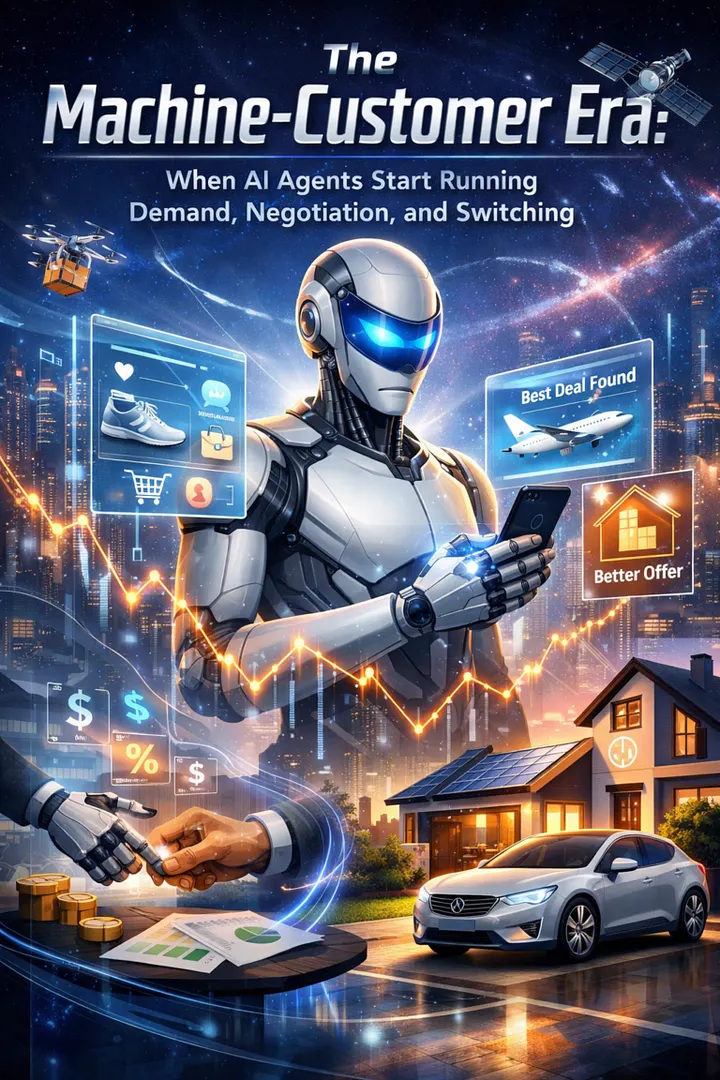
When AI Agents Begin Representing Demand — and Markets Start Rewriting Themselves
For the last decade, leaders were trained to think of customers as humans.
Humans browse. Humans compare. Humans decide. Humans buy.
The next decade will require a different mental model.
Customers will increasingly show up as software.
Not metaphorically. Not as “digital-first users.”
Literally.
AI agents will research options, evaluate trade-offs, negotiate terms, execute purchases, monitor outcomes, and trigger switching decisions — on behalf of individuals and enterprises.
This is not a feature trend.
It is a market structure shift.
And market structure shifts do not reward incremental adoption. They reward institutional redesign.
Press enter or click to view image in full size

A New Kind of Customer Has Entered the Market
A machine customer is not a robot randomly placing orders.
It is an AI agent acting as a decision delegate.
It carries:
- preferences
- budget constraints
- policy rules
- compliance boundaries
- performance thresholds
- switching triggers
It can:
- interpret intent (“Find a better plan with fewer hidden fees.”)
- compare structured offerings
- compute total cost of ownership
- negotiate within predefined guardrails
- execute transactions
- monitor post-purchase performance
- recommend renewal, downgrade, or switching
The key variable is not capability.
It is decision authority.
As AI systems are granted more delegated authority, they begin to influence — and eventually reshape — how markets clear.
Press enter or click to view image in full size
Why This Is Bigger Than “AI Adoption”
Most executives still frame AI as:
- productivity acceleration
- workflow automation
- internal decision support
That is second-order change — transformation inside the enterprise.
The Machine-Customer Era is third-order change.
It changes how demand behaves.
When AI agents represent buyers, demand becomes:
- faster — friction collapses
- more comparable — structured evaluation replaces persuasion
- more negotiable — pricing logic becomes computable
- less loyal — switching costs shrink
- more audited — claims must be provable
Markets begin behaving like always-on negotiation systems.
And the competitive question shifts.
You are no longer just marketing to humans.
You are competing for machine decisions.
The A.G.E.N.T. Buying Stack
To make this practical, consider five layers of how AI agents will buy.
A — Acquisition
How do agents discover options?
In the human era, companies optimized for:
- search rankings
- ads
- influencer reach
- app store visibility
In the machine era, discovery increasingly depends on:
- structured product catalogs
- authoritative data
- machine-readable specifications
- verifiable claims
- third-party validation
Distribution power shifts from brand awareness to machine discoverability + trust footprint.
G — Grounding
What data does the agent trust?
Agents privilege:
- transparent pricing rules
- explicit policies
- warranty clarity
- dispute procedures
- consistent documentation
Trust becomes computational.
Reputation becomes infrastructure.
This is not public relations.
It is conversion architecture.
E — Evaluation
How do agents compare value?
Agents compute:
- total cost of ownership
- performance guarantees
- integration compatibility
- delivery constraints
- policy compliance
- risk signals
Beautiful landing pages will not be enough.
Agents compute value.
And they compute it continuously.
Competitive advantage moves toward clear, structured, comparable value.
N — Negotiation
How are terms set?
Negotiation scales when:
- pricing is modular
- bundles are structured
- constraints are explicit
- approval thresholds are policy-based
In the Machine-Customer Era, negotiation becomes programmable.
Organizations that design negotiation-native pricing — with guardrails — will retain margin control.
Those that rely on ambiguity will experience friction.
T — Transaction + Trace
How do we prove what happened?
When agents transact, disputes are resolved by:
- logs
- authorization proofs
- policy checks
- evidence trails
- reversible workflows
“Who authorized it?” becomes a strategic question.
Proof becomes a customer expectation.
Not just a compliance artifact.
Press enter or click to view image in full size

Three Examples That Make the Shift Obvious
1. Subscription Switching Becomes Default Behavior
An AI agent monitors:
- usage patterns
- renewal dates
- fee changes
- competitor offers
It triggers renegotiation automatically.
In the human era, inertia protects suppliers.
In the machine era, inertia collapses.
2. Enterprise Procurement Becomes Continuous
A procurement agent monitors:
- SLA compliance
- security posture changes
- renewal clauses
- performance metrics
It flags renegotiation opportunities or multi-vendor splits.
Enterprise demand becomes dynamic.
Contracts become living systems.
3. Negotiation Becomes a Product Feature
Forward-looking firms expose:
- structured pricing corridors
- modifiable bundles
- clear policy boundaries
- automated approvals within thresholds
Agents negotiate inside guardrails.
Humans intervene only for exceptions.
Negotiation becomes infrastructure.
Press enter or click to view image in full size
What Breaks First in Most Companies
The Machine-Customer Era does not fail because AI is weak.
It fails because enterprises are not designed for machine demand.
Common breakpoints:
- Non-structured catalogs Inconsistent specifications collapse agent conversion.
- Ambiguous pricing Agents cannot negotiate with opacity.
- Thin trust surfaces Claims without evidence are discounted.
- Weak authorization systems Delegated decisions without traceability create disputes.
- No agent observability If you cannot measure agent traffic, you cannot compete for it.
The deeper risk is strategic disintermediation.
If third-party agents sit between you and customers, you may lose demand visibility — much like earlier platform shifts reallocated relationship ownership.
Press enter or click to view image in full size
Demand Infrastructure Is the New Moat
In earlier eras, moats were built through:
- distribution scale
- brand dominance
- switching friction
- information asymmetry
In the Machine-Customer Era, the moat becomes:
- agent discoverability
- trust infrastructure
- negotiation-native pricing
- transaction traceability
- continuous optimization loops
The question for leadership is no longer:
“Are we deploying AI?”
It becomes:
“Are we designed to sell to machine customers — without losing trust, margin, or control?”
The Strategic Doctrine Behind This Shift
This essay sits inside a broader strategic view:
- Third-Order AI Economy — when intelligence becomes market infrastructure
- Intelligence-Native Enterprise — the firm redesign required to compete
- C.O.R.E. (Comprehend → Optimize → Realize → Evolve) — the compounding loop that makes enterprises adaptive
In the Machine-Customer Era:
- demand becomes programmable
- negotiation becomes continuous
- switching becomes automated
- trust becomes economic infrastructure
This is not about chatbots.
It is about market recomposition.
What Leaders Should Do Now
- Build Agent-Ready Product Truth Create a single, structured source of truth for specs, pricing logic, policies, and proof artifacts.
- Design Negotiation Interfaces With Guardrails Define pricing corridors, modifiable bundles, and non-negotiables clearly.
- Treat Trust as Conversion Infrastructure Make evidence machine-readable and auditable.
- Engineer Ethical Switching Defense Compete on measurable value — not friction traps.
- Add Agent Observability to Your Dashboard Track agent-driven demand, negotiation outcomes, and switching triggers.
If you cannot measure machine demand, you cannot compete for it.
Conclusion: Market Recomposition, Not Tool Adoption
AI adoption will not define winners.
Market recomposition will.
The Machine-Customer Era is one of the clearest signals that we have entered a structural shift:
Demand is becoming programmable.
Negotiation is becoming continuous.
Switching is becoming automatic.
Trust is becoming infrastructure.
The strategic question is no longer:
“Are we using AI?”
It is:
“Are we architected for machine customers?”
Those who answer early will not merely defend market share.
They will define the next category of advantage.
Enterprise AI Operating Model
Enterprise AI scale requires four interlocking planes:
Read about Enterprise AI Operating Model The Enterprise AI Operating Model: How organizations design, govern, and scale intelligence safely — Raktim Singh
1. Read about Enterprise Control Tower The Enterprise AI Control Tower: Why Services-as-Software Is the Only Way to Run Autonomous AI at Scale — Raktim Singh
2. Read about Decision Clarity The Shortest Path to Scalable Enterprise AI Autonomy Is Decision Clarity — Raktim Singh
3. Read about The Enterprise AI Runbook Crisis The Enterprise AI Runbook Crisis: Why Model Churn Is Breaking Production AI — and What CIOs Must Fix in the Next 12 Months — Raktim Singh
4. Read about Enterprise AI Economics Enterprise AI Economics & Cost Governance: Why Every AI Estate Needs an Economic Control Plane — Raktim Singh
Read about Who Owns Enterprise AI Who Owns Enterprise AI? Roles, Accountability, and Decision Rights in 2026 — Raktim Singh
Read about The Intelligence Reuse Index The Intelligence Reuse Index: Why Enterprise AI Advantage Has Shifted from Models to Reuse — Raktim Singh
The Intelligence-Native Enterprise Doctrine
This article is part of a larger strategic body of work that defines how AI is transforming the structure of markets, institutions, and competitive advantage. To explore the full doctrine, read the following foundational essays:
1. The AI Decade Will Reward Synchronization, Not Adoption Why enterprise AI strategy must shift from tools to operating models. https://www.raktimsingh.com/the-ai-decade-will-reward-synchronization-not-adoption-why-enterprise-ai-strategy-must-shift-from-tools-to-operating-models/
2. The Third-Order AI Economy The category map boards must use to see the next Uber moment. https://www.raktimsingh.com/third-order-ai-economy/
3. The Intelligence Company A new theory of the firm in the AI era — where decision quality becomes the scalable asset. https://www.raktimsingh.com/intelligence-company-new-theory-firm-ai/
4. The Judgment Economy How AI is redefining industry structure — not just productivity. https://www.raktimsingh.com/judgment-economy-ai-industry-structure/
5. Digital Transformation 3.0 The rise of the intelligence-native enterprise. https://www.raktimsingh.com/digital-transformation-3-0-the-rise-of-the-intelligence-native-enterprise/
6. Industry Structure in the AI Era Why judgment economies will redefine competitive advantage. https://www.raktimsingh.com/industry-structure-in-the-ai-era-why-judgment-economies-will-redefine-competitive-advantage/
Institutional Perspectives on Enterprise AI
Many of the structural ideas discussed here — intelligence-native operating models, control planes, decision integrity, and accountable autonomy — have also been explored in my institutional perspectives published via Infosys’ Emerging Technology Solutions platform.
For readers seeking deeper operational detail, I have written extensively on:
- What Makes an Enterprise Intelligence-Native? The Blueprint for Third-Order AI Advantage https://blogs.infosys.com/emerging-technology-solutions/artificial-intelligence/what-is-enterprise-ai-the-operating-model-for-compounding-institutional-intelligence.html
- Why “AI in the Enterprise” Is Not Enterprise AI: The Operating Model Difference Most Organizations Miss https://blogs.infosys.com/emerging-technology-solutions/artificial-intelligence/why-ai-in-the-enterprise-is-not-enterprise-ai-the-operating-model-difference-that-most-organizations-miss.html
- The Enterprise AI Control Plane: Governing Autonomy at Scale https://blogs.infosys.com/emerging-technology-solutions/artificial-intelligence/the-enterprise-ai-control-plane-governing-autonomy-at-scale.html
- Enterprise AI Ownership Framework: Who Is Accountable, Who Decides, and Who Stops AI in Production https://blogs.infosys.com/emerging-technology-solutions/artificial-intelligence/enterprise-ai-ownership-framework-who-is-accountable-who-decides-and-who-stops-ai-in-production.html
- Decision Integrity: Why Model Accuracy Is Not Enough in Enterprise AI https://blogs.infosys.com/emerging-technology-solutions/artificial-intelligence/decision-integrity-why-model-accuracy-is-not-enough-in-enterprise-ai.html
- Agent Incident Response Playbook: Operating Autonomous AI Systems Safely at Enterprise Scale https://blogs.infosys.com/emerging-technology-solutions/artificial-intelligence/agent-incident-response-playbook-operating-autonomous-ai-systems-safely-at-enterprise-scale.html
- The Economics of Enterprise AI: Designing Cost, Control, and Value as One System https://blogs.infosys.com/emerging-technology-solutions/artificial-intelligence/the-economics-of-enterprise-ai-designing-cost-control-and-value-as-one-system.html
Together, these perspectives outline a unified view: Enterprise AI is not a collection of tools. It is a governed operating system for institutional intelligence — where economics, accountability, control, and decision integrity function as a coherent architecture.
Comments
Loading comments…